


The latest climate warning places Chennai’s urban future at the intersection of two pressures: global emissions must fall sharply, while cities must prepare for more dangerous heat and flooding already affecting public health, livelihoods and infrastructure. The challenge is not limited to lowering carbon emissions. It is also about whether neighbourhoods, public institutions and basic services can protect residents as climate risks intensify.
The United Nations Environment Programme’s Emissions Gap Report 2026, titled The Point of Return and released on October 21, warns that the window to limit the worst impacts of climate change is narrowing. According to the report as described by Deccan Chronicle, global emissions would need to decline by 18 per cent from 2025 levels by 2030, 45 per cent by 2035 and 69 per cent by 2040. Existing national climate pledges, however, remain insufficient to meet that trajectory. Under current policies, the world is projected to face approximately 2.8°C of warming this century.
For Chennai, the importance of these figures lies in how a global emissions gap becomes a local planning problem. Higher warming does not remain an abstract change in atmospheric temperature. It increases the pressure on drainage systems during intense rainfall, raises heat exposure in built-up areas and makes the quality of public spaces, homes and basic services more consequential. The report’s implications therefore extend beyond energy policy to the way Tamil Nadu plans and manages its cities.
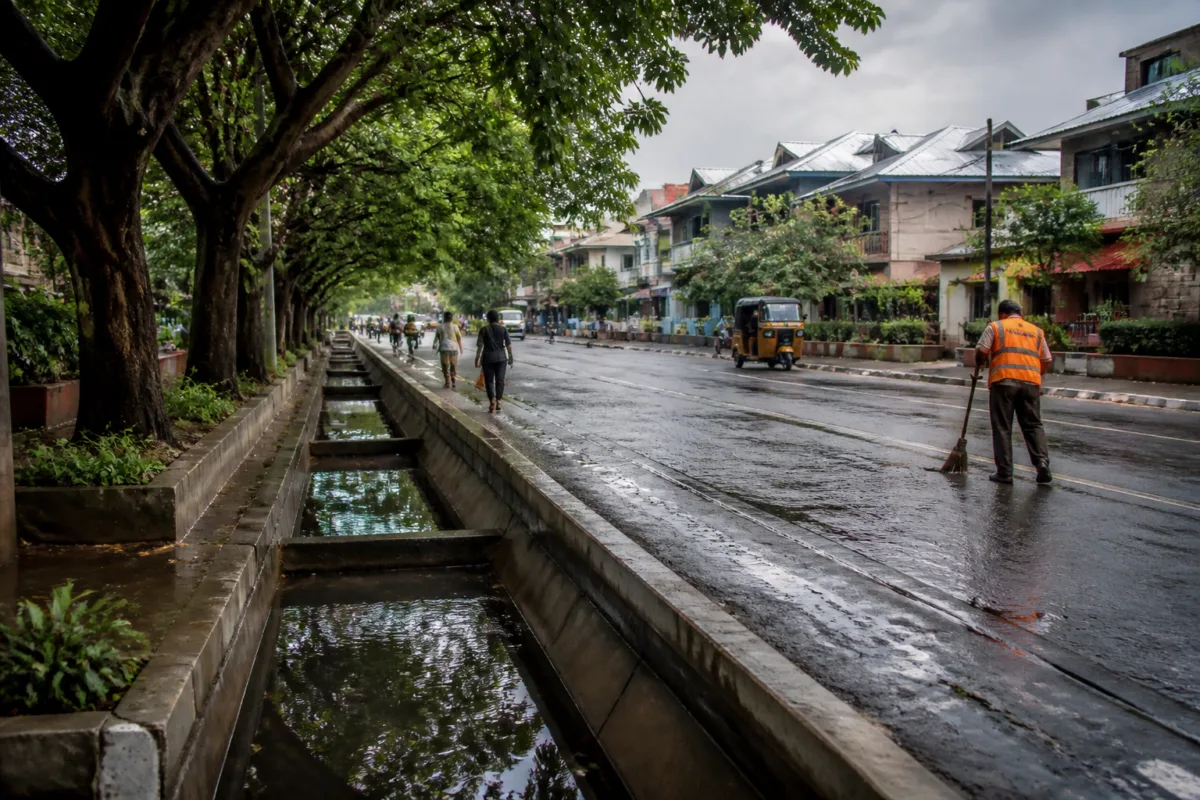
Dr Abraham Lingan, a Chennai-based environmental and social expert cited in the report, said the city must urgently become more heat-resilient and flood-safe. The measures identified include expanding tree cover, adopting suitable cool roofs, protecting lakes and wetlands, improving stormwater drainage and creating shaded public spaces. These are not separate environmental interventions. Together, they represent a city-management response to risks that affect streets, homes, workplaces and public facilities.
The climate challenge also exposes the difference between emissions reduction and adaptation. Emissions reduction addresses the causes of warming through cleaner energy, more efficient buildings, lower fossil-fuel dependence and reduced methane emissions. Adaptation addresses the consequences already being experienced or anticipated, including dangerous heat, flooding and uneven exposure among different groups of residents. The report and the expert commentary cited by Deccan Chronicle point to the need for both approaches at the same time.
The global numbers show why mitigation remains central. The UNEP report, as presented in the supplied account, calls for faster renewable energy expansion, improved energy efficiency, reduced fossil-fuel dependence and substantial methane cuts. It also says carbon-removal technologies may support climate action but cannot substitute for direct reductions in emissions. This distinction matters for cities because urban growth can lock in energy demand through transport systems, buildings, construction and industrial activity.
India’s position is particularly complex. The country must continue meeting expanding energy, industrial and infrastructure needs while attempting to control emissions. The report projects that India’s annual emissions in 2035 could be 1,254 million tonnes of carbon dioxide equivalent higher than in 2030, even if its new climate pledge is fully implemented. At the same time, India’s projected per-capita emissions of 3.6 tonnes in 2035 remain below the corresponding projections cited for China, at 9.3 tonnes, and Russia, at 11.5 tonnes.
These figures establish two facts without resolving the policy tension. India’s development needs cannot be separated from its climate strategy, but development that depends heavily on high-emission systems could increase future climate exposure. The policy question is therefore not simply how to reduce emissions in isolation. It is how to expand housing, mobility, energy access and infrastructure without reproducing systems that intensify heat, pollution and climate vulnerability.
For Chennai, that question is visible in the built environment. Tree cover can provide shade and reduce exposure in public spaces. Cool roofs can limit heat accumulation in buildings. Lakes and wetlands can play a role in the city’s water landscape, while stormwater drainage determines how quickly rainfall is moved through urban areas. The supplied report does not quantify the capacity or performance of each intervention in Chennai, but it identifies them as key components of a heat- and flood-resilience agenda.
Tamil Nadu has already begun mapping the urban dimension of heat risk. An assessment prepared by the Tamil Nadu Green Climate Company and ICLEI South Asia maps heat risks in Chennai, Coimbatore, Tiruchirappalli and Tirunelveli. The guidelines propose city-specific cooling plans and a dedicated Urban Cooling Authority. This indicates a shift from treating heat as a temporary weather emergency to recognising it as a planning and governance issue requiring institutional coordination.
The proposal for city-specific cooling plans is significant because heat does not affect all urban spaces or residents equally. The report identifies outdoor workers, older people, children, persons with disabilities and residents of poorly ventilated homes as groups requiring particular attention. For these communities, resilience cannot be measured only through citywide temperature data or the presence of large infrastructure projects. It also depends on whether people can access drinking water, shade, early warnings, cooling centres and safer working conditions when temperatures rise.
This places responsibilities across several parts of urban administration. Drainage agencies must address stormwater movement and local flooding. Planning authorities must protect water bodies and incorporate shaded, accessible public spaces. Building and housing systems must consider roof heat and ventilation. Public-health institutions must prepare warnings and response measures. Transport and labour systems must account for the exposure of commuters and outdoor workers. The proposed Urban Cooling Authority, if established, would have to operate across these administrative boundaries rather than function as a standalone climate programme.
The same institutional challenge applies to emissions reduction. The measures cited in the report include renewable energy, electric mobility, public transport, energy-efficient buildings and cleaner industrial production. Each belongs to a different policy and investment system, even though the emissions consequences are connected. Transport choices influence energy use and air quality. Building design affects cooling demand. Industrial production affects both emissions and employment. Renewable energy requires infrastructure, finance and grid coordination.
The supplied material does not establish the funding structure, statutory powers or implementation timeline for the proposed Urban Cooling Authority. It also does not provide project-level details on Chennai’s tree-cover expansion, cool-roof adoption, wetland protection or drainage upgrades. Those gaps are important because climate plans often become effective only when responsibilities, budgets, standards and monitoring systems are clearly assigned.
The report does, however, provide a framework for measuring climate success more broadly. The expert commentary cited by Deccan Chronicle says success should be assessed not only through carbon reductions but also through safer, healthier and more secure lives. That approach connects climate policy with the UN Sustainable Development Goals on health, clean water, clean energy, reduced inequalities, sustainable cities and climate action.
For a city such as Chennai, this wider measure changes the way infrastructure priorities are understood. A drainage improvement is not only a flood-control project. A shaded public space is not only an urban-design feature. A cool roof is not only a building intervention. Each can reduce exposure for residents, but only if it reaches the neighbourhoods and groups facing the highest risks. Similarly, cleaner transport and energy systems can support emissions reduction while also affecting household costs, public health and access to jobs.
The larger urban question is whether climate action will remain a collection of individual projects or become part of routine city governance. The evidence supplied in the report points to a combined agenda: emissions must decline rapidly, while urban systems must become safer under the warming already being experienced. Chennai’s response will depend on how these goals are translated into land-use decisions, building practices, mobility systems, drainage management, public-health protocols and protection for vulnerable residents.
What is clear is that waiting for a major heatwave or flood to expose weaknesses would leave the city responding after the fact. What remains to be established is how Tamil Nadu and Chennai will finance, coordinate and measure the interventions identified in the climate-risk assessment. The next milestones to watch are the development of city-specific cooling plans, the proposed institutional arrangements for urban cooling, and the implementation of measures covering tree cover, cool roofs, wetlands, drainage, early warnings and accessible cooling facilities.

