


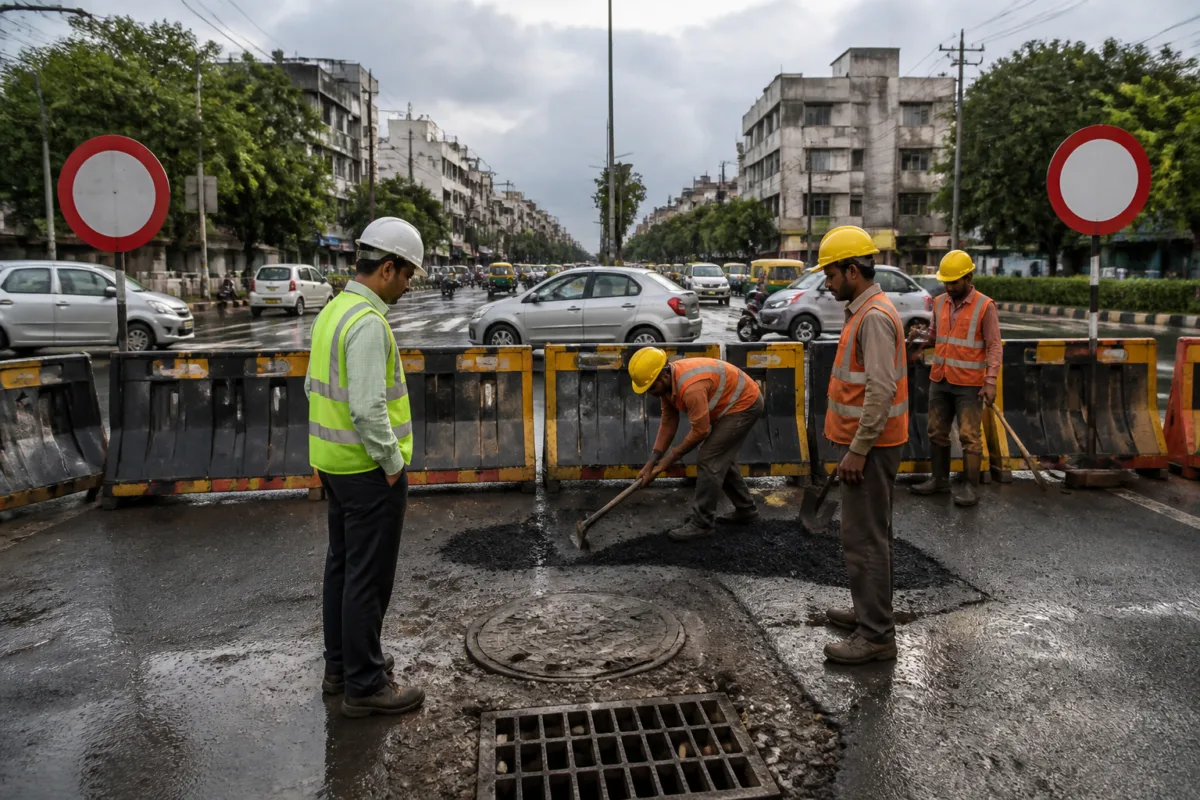
Gujarat’s Urban Development and Urban Housing Department has issued new guidelines for urban roads, streets, junctions and signage, requiring municipal corporations to conduct road surveys before and after the monsoon and complete repairs on severely damaged and dangerous roads within 48 hours.
The guidelines cover roads ranging from 8 metres to 60-100 metres in width and set out requirements for design, construction quality, pedestrian movement, junction safety and road-level management. Municipal commissioners have instructed engineering departments to follow the standards while planning and executing road works.
Under the new directions, municipal corporations must survey roads before and after the monsoon. Officials are also required to examine underground water, drainage and stormwater networks before preparing estimates for road works. Frequently damaged old drainage or stormwater lines and manholes must be rehabilitated or strengthened before a road is constructed or resurfaced.
The guidelines place specific requirements on hot-mix asphalt work. Contractors and project management consultants must submit a quality assurance plan before work begins, which must be approved by the competent authority. A quality-control officer must be present at the hot-mix plant and paving site. Records must be maintained for the quantity of hot-mix material, the time it leaves the plant, its arrival time at the site and its temperature.
Material that does not meet the required standards must not be sent to the site or reused, according to the directions. The surface must be cleaned before hot-mix is laid, the prescribed temperature must be maintained and the material must be spread at the approved thickness. Officials have also been told to pay attention to road levels and slopes and to send materials for laboratory testing.
The guidelines require care to prevent damage to manholes, valve chambers and catch pits during road construction. If the road crust is damaged, repairs are to be completed within 15 days, while smaller patchwork must be addressed within 30 days. For roads classified as seriously damaged and dangerous to citizens, the repair deadline is 48 hours. Photographs of completed repairs must be uploaded to the municipal corporation’s application within 72 hours. Barricading will be mandatory during repair work.
The directions also mention cold-emulsion injection and infrared recycling for road repairs. For resurfacing, regrading or milling, officials and design consultants must jointly inspect the site. The inspection is intended to account for water lines, drainage, stormwater infrastructure and other underground utilities before work begins.
Junction design and signage form another part of the standards. The guidelines identify intersections as areas requiring particular attention because of traffic concentration and citizen safety concerns. Signboards indicating a speed limit of 30 kilometres per hour in road areas and up to 50 kilometres per hour on main roads are to be installed. Signs must be placed at suitable heights, remain visible to road users and use different colours where required for clarity.
The measures make road construction a broader coordination exercise involving pavement quality, drainage, utility mapping, traffic movement and pedestrian safety. Municipal engineering departments will now be expected to apply these requirements while undertaking new road works and repairs.

