


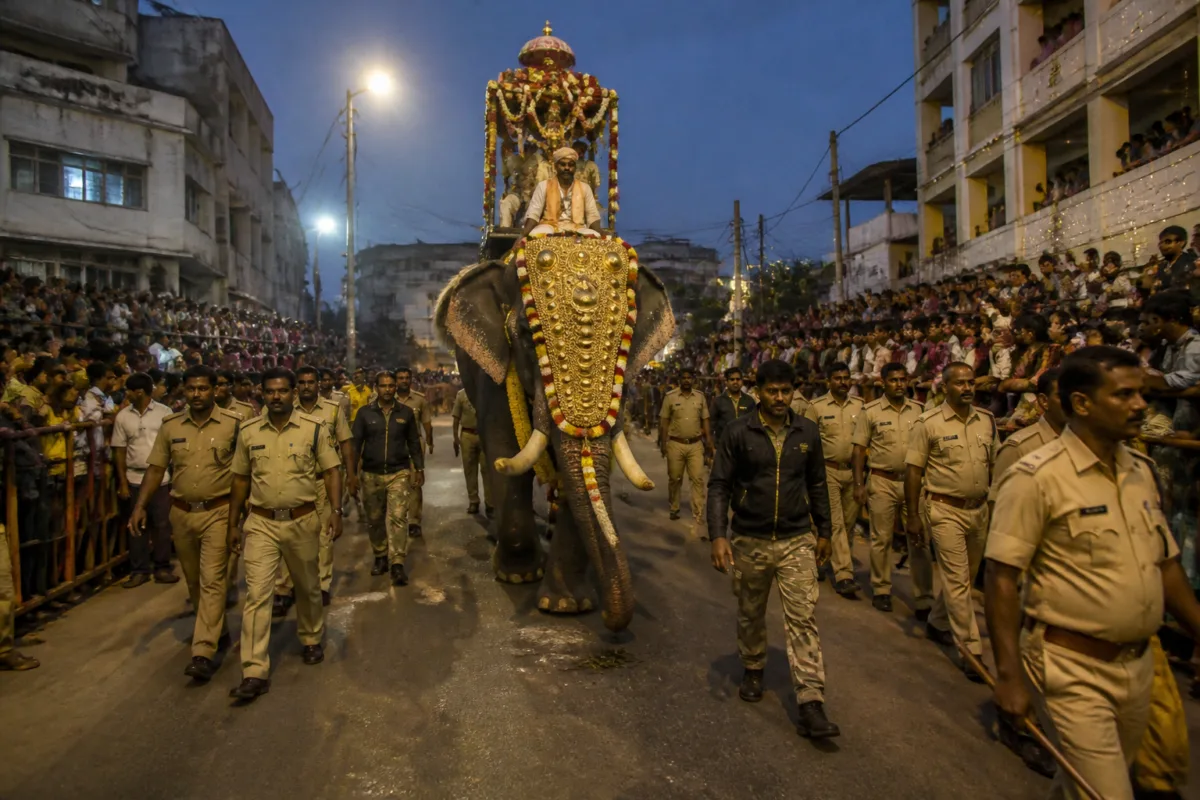
The report submitted after the Shivamogga Dasara elephant incident places the focus on a familiar but often underexamined urban problem: a traditional public procession can become unsafe when the movement requirements of a large animal collide with dense crowds, loud noise and restricted space. According to the findings presented by Circle Chief Conservator of Forests KT Hanumanthappa, elephant Somanna panicked on October 21 after moving through a procession environment that offered little room for manoeuvre.
The report, submitted to senior officials in Bengaluru, was based on video clips, CCTV footage and statements from staff members, Hanumanthappa told reporters. Its central finding was that the incident was triggered by conditions at the site rather than by a failure in the process used to select the elephant for carrying the howdah. The account has been supported by Shivamogga district minister Madhu Bangarappa, who said the selection and training followed Forest Department rules.
That distinction matters because it shifts the question from whether Somanna was fit for the role to whether the procession environment was compatible with the needs of the animal and the safety requirements of the public. The report, as described, says Somanna moved smoothly for about 800 metres near Ramanna Shetty Shreshti Park after the howdah was mounted. The problem emerged when he encountered a combination of dense onlookers, loud sounds, a narrow passage and the sudden movement of other elephants.
In practical terms, the incident illustrates how urban event safety is shaped not only by the principal participants but also by the physical design of the route. A procession may be organised according to established ritual and administrative practice, yet still become difficult to control when a large animal has to turn, stop or respond to an unexpected movement in a confined space. The report specifically notes that elephants require broad physical clearance when turning or relieving themselves. A tight environment surrounded by onlookers can therefore create distress or confusion even when the animal has completed training.
This is the institutional gap exposed by the incident. Fitness assessments and preparation can establish whether an elephant is capable of carrying the howdah, but they do not by themselves establish whether the route, crowd density and sound environment are safe at every point. Somanna’s smooth movement over the initial 800 metres suggests that the risk was not uniform along the procession. It changed when the physical and sensory conditions changed.
The selection process had involved elephants Sagar and Somanna, with authorities assessing both during preparation. The report says Sagar did not respond as dynamically or comfortably as required during training. Inputs from Sagar’s mahout, Imtiyaz, were considered, and authorities concluded that Somanna was the better choice. Minister Bangarappa said the decision was made by a committee after rigorous fitness assessments and was not a last-minute choice. He also said three elephants underwent continuous training.
These details establish that the administration had a formal selection process. They do not, however, answer whether the process included a route-specific risk assessment. The supplied report does not state whether the elephants were evaluated under crowd conditions comparable to those on the Dasara route, whether sound levels were assessed, or whether specific sections were identified as requiring wider clearances. It also does not indicate whether the movement of accompanying elephants was rehearsed in the same spatial conditions.
That absence is important without becoming proof of a procedural failure. The CCF’s report attributed the panic to situational triggers and did not admit to internal mismanagement, according to the report. The available account therefore supports a narrower conclusion: the animal-selection process was defended by officials, while the immediate conditions around the procession were identified as the cause of the incident. It does not establish whether the event-planning system had a separate, documented protocol for managing those conditions.
Public processions are temporary changes to the urban use of streets. They convert roads and public spaces from ordinary movement corridors into controlled routes containing crowds, officials, animals, religious objects and security personnel. That conversion creates a governance challenge because responsibility is distributed across multiple agencies. In this case, the minister said senior officials, including the deputy conservator of forests, deputy commissioner, superintendent of police, chief executive officer, additional deputy commissioner, MLA and corporation commissioner, acted as a team.
The presence of several authorities indicates the cross-departmental nature of the event. Forest officials are responsible for the animals and their preparation. Police and district administration manage crowd control and public order. The municipal corporation controls parts of the physical environment and public space. Elected representatives and event organisers carry political and ceremonial responsibilities. When an incident occurs, a coordinated response is possible only if these roles are converted into a clear operational plan before the procession begins.
The report does not specify which agency controlled crowd distance around Somanna, who had authority to halt the procession, or whether a designated clear zone was maintained along the route. Those are not minor administrative details. They determine whether the system can react when an animal encounters a trigger. A procession involving elephants cannot be managed solely as a ceremonial movement; it also requires real-time control of space, sound and the sequence of participants.
The incident also demonstrates why the absence of casualties cannot be the only measure of safety. Bangarappa described the event as an alarming warning rather than a major disaster and emphasised that there were no human casualties or animal fatalities. That outcome is significant. It also means the incident offers an opportunity to examine the system before a more serious event occurs. A near miss can reveal weaknesses that remain invisible in routine operations.
The available figures are limited but useful. Somanna completed approximately 800 metres before experiencing difficulties. The selection process considered two named elephants, Sagar and Somanna, while the minister said three elephants underwent continuous training. The contrast between the distance covered without difficulty and the later panic reinforces the importance of location-specific planning. A route cannot be treated as a single uniform environment when crowding, width, noise and the behaviour of accompanying animals vary from one section to another.
The report’s reliance on video clips, CCTV footage and staff statements is also relevant to event governance. These records can reconstruct the sequence of movements and identify where crowd density, noise or restricted space became critical. They can help distinguish between an animal’s response to a particular condition and a broader failure in preparation. But the supplied material does not include the footage, the full report, the route plan or the statements, so the precise chain of events remains limited to the account provided by the CCF and the newspaper report.
The damaged idol of Chamundeshwari and the damaged howdah add another dimension to the incident. They show that the disruption affected both the ceremonial elements of the procession and the public-space system around it. The fact that there were no casualties does not erase the operational consequences: the procession was interrupted, property was damaged and authorities had to review how the event was conducted.
The institutional response has so far concentrated on defending the choice of Somanna and confirming that the selection was made according to Forest Department rules. That addresses one question but leaves another open: whether the rules adequately account for the conditions of a crowded urban procession. An animal can meet fitness requirements and still face an unsafe environment. Conversely, a route may appear manageable under ordinary conditions but become hazardous when crowds press inward, noise rises or another elephant moves unexpectedly.
The larger urban question is how cities should manage culturally important events that temporarily bring unusual risks into public spaces. The answer cannot be inferred from this report alone, and the supplied material does not describe any revised protocol or official next steps. It does, however, show that safety depends on the interaction between animal preparation, route design, crowd behaviour, sound management and inter-agency command.
Shivamogga’s Dasara incident therefore should not be reduced to a question of whether Somanna was the correct elephant for the howdah. The evidence presented by the CCF supports the immediate role of crowding, noise, narrow space and sudden elephant movement in triggering panic. It also confirms that officials had conducted selection and training exercises. What remains unclear is whether those exercises were integrated with a route-specific safety plan and clearly assigned operational controls. Those are the details that deserve scrutiny as authorities assess future processions.

