


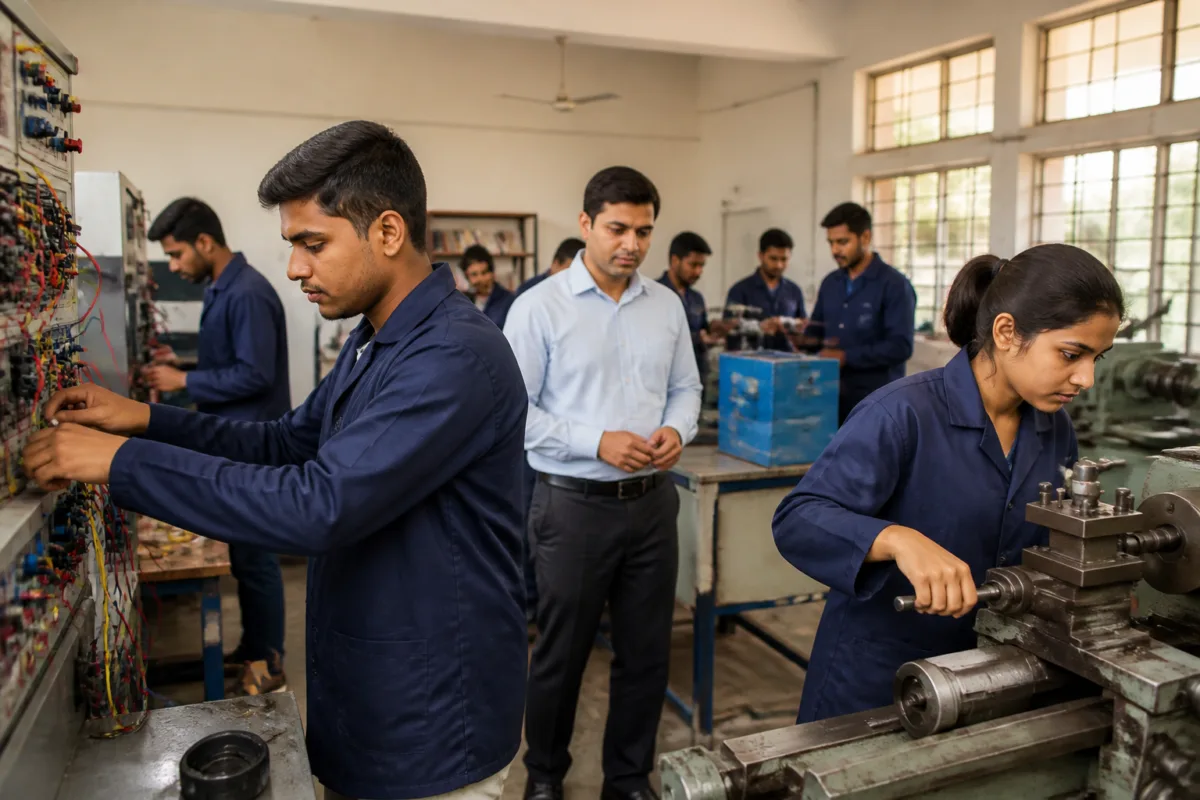
Haryana’s approval of a ₹320.44-crore PM-SETU cluster in Kurukshetra is more than an investment in seven industrial training institutes. It is an experiment in reorganising the state’s public skill infrastructure around a hub-and-spoke model, shared financing and formal industry participation. The outcome will depend not only on new laboratories and machinery, but also on whether the new institutional structure can connect training with better employment and salary outcomes for young people.
The project was approved by the state’s standing finance committee at a meeting chaired by Chief Minister Nayab Singh Saini. It will upgrade Government ITI, Kurukshetra, as the hub and link it to six spoke institutes: Women’s ITI, Kurukshetra; ITI Kaithal; ITI Pehowa; ITI Pabnawa; Women’s ITI, Ambala City; and Women’s ITI, Kaithal. The cluster will receive funding from the Centre, the state government and an industry partner.
The arrangement places the Kurukshetra project within a much larger reconfiguration of Haryana’s training network. The state plans to establish 12 clusters covering around 60 government ITIs, with an estimated total outlay of ₹2,892 crore. Haryana’s expected contribution to the wider programme is approximately ₹954 crore. Seven clusters have been identified so far, indicating that Kurukshetra is an early component of a state-wide rollout rather than an isolated institutional upgrade.
PM-SETU, or Pradhan Mantri Skilling and Employability Transformation through Upgraded ITIs, is a centrally sponsored scheme with a national outlay of ₹60,000 crore. The reported funding structure comprises ₹30,000 crore from the Centre, ₹20,000 crore from states and ₹10,000 crore from industry. The scheme envisages upgrading 1,000 government ITIs and five National Skill Training Institutes into centres of excellence.
That design matters because it assigns responsibility across three levels. The Centre supplies a substantial share of the capital framework, states provide funding and administrative ownership, and industry is expected to participate financially and institutionally. For Haryana, the Kurukshetra cluster makes that division visible: the Centre will contribute ₹160.22 crore, the state ₹105.75 crore and the industry partner ₹54.47 crore.
The project’s spending pattern also shows how the scheme defines modernisation. Of the total ₹320.44 crore, ₹163.06 crore is earmarked for capital expenditure, primarily for infrastructure and laboratory upgrades. The remaining ₹157.38 crore is classified as operational expenditure and will be shared by the state government and industry partner in a 65:35 ratio. This means the cluster is not being treated only as a construction or equipment procurement exercise. Its operating costs form a substantial part of the overall commitment.
The distinction between capital and operational spending is important for public training institutions. Buildings, machinery and laboratories can be created through a time-bound project, but their usefulness depends on maintenance, teaching capacity, digital learning systems and continued institutional management. The reported financial structure places part of that continuing responsibility on the state and industry partner, rather than limiting the partnership to an initial capital contribution.
The implementation contract has been awarded to Jindal Naveen Avsar Ltd. The cluster will be managed through a Section 8 company, with the anchor industry partner holding a 51% stake and the Centre and state each holding 24.5%. This governance arrangement gives the industry partner the largest share in the operating entity while retaining formal representation for both levels of government.
The model therefore attempts to address a recurring institutional question in publicly funded skilling: who is responsible for ensuring that upgraded facilities remain relevant after the original project is completed? In the Kurukshetra structure, that responsibility is distributed through ownership and financing rather than left entirely with individual ITIs. The supplied information does not establish how performance will be measured, however, or what employment outcomes the cluster will be required to report.
The state has also created a new budget head for PM-SETU and sanctioned ₹105.75 crore as its share for the Kurukshetra cluster over 2026-27 to 2030-31. An advance payment of ₹10.50 crore has been authorised for the current financial year. These decisions provide the administrative mechanism for releasing Haryana’s contribution across a multi-year implementation period.
The timeline for other clusters suggests a phased programme. Strategic investment plans for Palwal, Sonipat and Chhara are at the request-for-proposal stage. Tenders for Panipat and Rewari are scheduled for December, while the Kalayat cluster plan is to be taken up after January 2027. The state has not therefore reached the same implementation stage across all planned clusters. Kurukshetra has moved ahead with approval, an identified industry partner and an awarded implementation contract, while other locations remain at planning or tender stages.
The hub-and-spoke arrangement is intended to connect each hub ITI with approximately four spoke institutes. Kurukshetra’s proposed cluster has six spokes, including women’s ITIs in Haryana. This spread gives the project a regional character: the upgraded infrastructure at the hub is expected to form part of a network serving institutes in multiple locations rather than operate as a single-campus centre.
That network approach could change how investment is distributed across the state’s training system. Instead of upgrading every institute to the same level, the programme concentrates selected infrastructure and organisational capacity in hubs while linking surrounding institutes to them. The available information does not specify which courses, trades or student numbers will be covered, so the extent of academic integration between the hub and spoke institutes remains unclear.
The inclusion of Women’s ITIs in Kurukshetra, Ambala City and Kaithal is a significant feature of the proposed cluster, but the report does not detail how the project will address their specific infrastructure, access or placement requirements. Their presence in the network establishes institutional coverage; it does not by itself indicate how participation or employment outcomes will change.
For the state, the central policy challenge is to convert physical modernisation into employability. The project’s stated objective is to improve employability and secure better salary packages for skilled youth. That objective places the burden of proof beyond the construction of laboratories or installation of machinery. It will ultimately depend on whether the upgraded ITIs offer training that industry partners recognise and whether students can access the employment opportunities associated with it.
The financial design offers a clear framework for investment, but it also creates a need for transparent accountability. The Centre, Haryana and the anchor industry partner have defined contributions and ownership shares. The supplied report does not identify placement targets, salary benchmarks, completion milestones, student intake figures or mechanisms for publicly reviewing results. Without those details, the project can be assessed at this stage as a substantial institutional and infrastructure commitment, but not yet as evidence of improved labour-market outcomes.
Kurukshetra is consequently a test of whether Haryana can manage skill development as an integrated urban and regional infrastructure system. The institutes are distributed across cities and towns, their facilities are being connected through a common cluster, and their operations are being placed under a new public-private governance structure. The programme’s significance lies in that combination of physical assets, state budgeting and industry participation.
The approval confirms the scale of Haryana’s intended ITI transformation and establishes the funding and management architecture for its first major cluster. What remains to be established is how the seven institutes will be integrated in practice, how the operational partnership will function and whether the promised gains in employability and salary packages will be measured against published outcomes. The progress of the Kurukshetra contract and the movement of the state’s other clusters through procurement will show how far the model moves from approval to functioning training infrastructure.

