


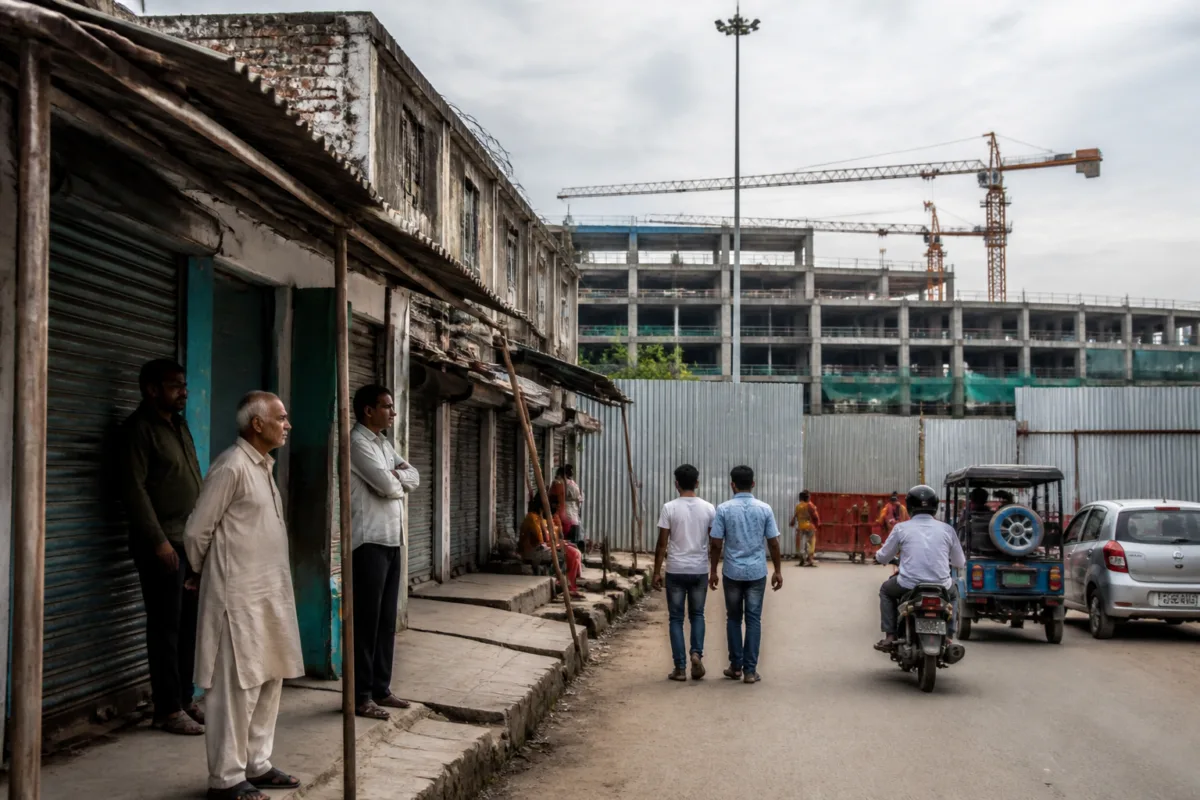
The Allahabad High Court’s intervention in the eviction of Ayodhya shopkeepers for a 300-bed super-speciality hospital has brought a familiar urban conflict into sharp focus: public infrastructure can serve a legitimate public purpose while still imposing serious costs on the people displaced to make it possible. In this case, the Lucknow bench said evicting the shopkeepers without rehabilitation or compensation was “highly condemnable” and observed that the action affected their right to livelihood.
The dispute is not only about a group of shops or the construction of one hospital. It concerns the administrative sequence that precedes many public projects: land is transferred, existing occupants are asked to leave, and construction is treated as the central objective. The court’s observations indicate that the legal status of the occupants, the terms of their leases and the consequences for their livelihoods must be addressed before possession is taken. That makes the case relevant to the wider governance of urban land and public infrastructure in Ayodhya.
The petition was filed by Mohammad Naeem and five others. According to the report, the Sitapur Eye Hospital Society, Faizabad, allotted the shops to the petitioners on 30-year leases in 2000. After completing the required formalities, the shopkeepers received possession on February 28, 2000. The leases were to be renewed every 30 years under the applicable rules.
That detail is central to the dispute. The occupants were not described as informal encroachers or temporary users of public land. The court noted that the shops had been allotted on lease and that the occupants had acquired the status of lessees. It therefore found that directing them to vacate without first terminating the leases was unjustified. The issue before the administration was consequently not simply whether the land was required for a hospital, but how that requirement could be acted upon while dealing lawfully with existing leaseholders.
The conflict began with an eviction notice issued by the Ayodhya district magistrate on June 26, 2025. The notice directed the shopkeepers to vacate within 15 days and stated that the land and shops had been transferred to the medical and family welfare department. The petitioners then approached the high court, which directed the authorities to maintain status quo until a decision was taken on their representation.
The subsequent administrative decision sharpened the dispute. In an order dated July 31, 2026, the district magistrate said the land was required for construction of the hospital and that the shopkeepers had no right to continue occupying the premises. The high court’s latest observations challenge that position by focusing on the leases and on the consequences of eviction for people dependent on the shops for their livelihood.
The court did not question the public-interest character of the hospital project. The division bench of Justice Shekhar B Saraf and Justice Amitabh Kumar Rai expressly observed that construction of the hospital was in the public interest. Its intervention instead addressed the conditions under which that public purpose could be pursued. Shopkeepers who rely on their businesses for income, the bench said, could not be evicted without alternative arrangements being made for them.
This distinction matters for urban administration. Public infrastructure projects are often assessed through their intended service—here, a super-speciality hospital with 300 beds. But the project footprint also contains existing economic relationships. Shops provide income to their occupants and services to surrounding users. When those premises are removed, the project changes not only the physical use of land but also the local livelihood network attached to it.
The court therefore underlined two possible forms of redress: rehabilitation of the affected shopkeepers or compensation for the losses suffered. The report does not establish that either measure had been offered before the eviction notice was issued. It records instead that the court directed the state’s medical and health department to file a counter-affidavit detailing the steps proposed for rehabilitation.
The requirement that the affidavit be filed by an officer not below the rank of secretary is also significant. It places the response at a senior administrative level rather than leaving the matter solely to local officials. The dispute began with a district-level eviction notice and a later order by the district magistrate, but the court has sought a response from the state department responsible for the project. That movement across administrative levels reflects the institutional chain behind public construction: local land and eviction decisions can have consequences that require state-level accountability.
The case also shows how a land transfer can create a gap between ownership or departmental control and the rights of people occupying the site. The June 2025 notice stated that the land and shops had been transferred to the medical and family welfare department. The petitioners’ case, however, was based on leases granted in 2000 and on possession delivered after the required formalities. The court’s observations suggest that a departmental transfer does not by itself settle the legal and livelihood questions attached to existing occupants.
The timeline further illustrates why rehabilitation cannot be treated as an issue that begins after demolition. The shopkeepers were given 15 days to vacate under the 2025 notice. They then secured an interim status quo direction while their representation was considered. The later order of July 31, 2026 stated that they had no right to remain because the land was required for the hospital. Against this background, the high court has asked the government to explain what rehabilitation steps it proposes. The sequence places the planning of relocation and compensation alongside, rather than after, the decision to use the land.
The source material does not provide the number of shops, the individual financial losses claimed by the petitioners, the hospital’s construction schedule or the precise terms governing renewal of each lease. It also does not establish whether construction has begun or whether any alternative commercial space has been identified. Those details will be important in assessing how the project proceeds and whether the state’s proposed response addresses the practical disruption faced by the shopkeepers.
What is established is narrower but consequential. The court has recognised the hospital as a public-interest project while also holding that the affected shopkeepers’ livelihoods require protection. It has linked the dispute to Articles 19 and 21 of the Constitution, as reported, and has treated rehabilitation or compensation as an essential part of the state’s response. The case therefore moves beyond a simple contest between development and resistance. It concerns the legal and administrative terms on which development is carried out.
For cities, that is the larger question. Hospitals, roads, transit facilities and other public assets require land, but the land is rarely empty in the institutional sense. It may be leased, occupied, used for trade or embedded in a local economy. A project authority that accounts only for the final structure can underestimate the transition required to reach it. The Ayodhya dispute shows how an apparently straightforward transfer of land can become contested when the prior rights and livelihoods attached to that land are not resolved in the same process.
The next stage will depend on the state’s counter-affidavit. The medical and health department has been directed to explain the rehabilitation steps it proposes, and the matter is listed for November 16. That filing should clarify whether the government has identified alternative arrangements, a compensation framework or another mechanism for addressing the shopkeepers’ losses. Until then, the court record establishes the public purpose of the hospital but leaves the practical terms of displacement unresolved.

