


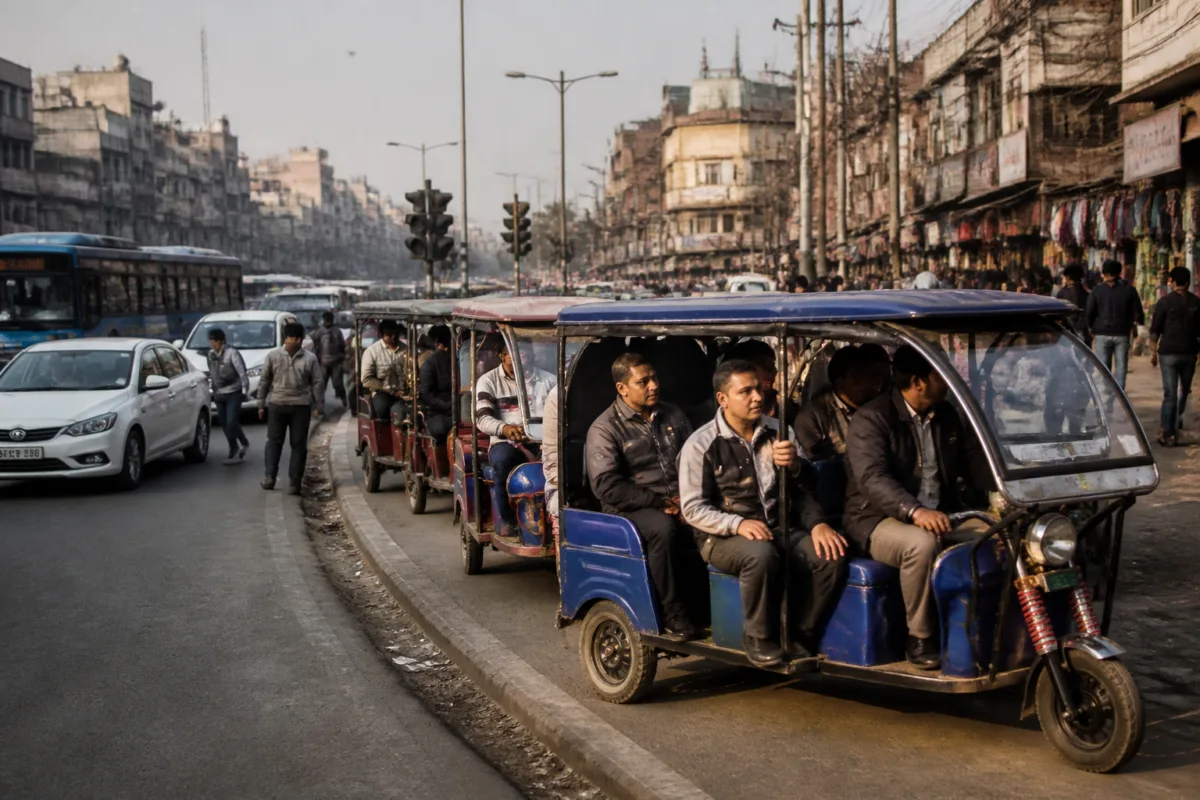
Delhi’s proposed e-rickshaw policy is built around a sharp numerical intervention: reducing the city’s estimated fleet of 4.5 lakh to 5 lakh vehicles to 2.5 lakh. But the debate triggered by the draft scheme is not simply about how many e-rickshaws the capital can accommodate. It is about whether congestion and road encroachment are fundamentally a fleet-size problem, or a failure of regulation, routing and enforcement.
The state government says the proposed framework is intended to improve road safety, curb congestion and regulate a rapidly expanding fleet. It has proposed making a digital E-Rickshaw Compliance Certificate, or ECC, mandatory and has invited public suggestions for 30 days before formally launching the scheme. The draft would introduce a compliance window, ownership limits and requirements for drivers and vehicles.
Yet the details reported so far show a policy trying to perform several functions at once. It seeks to control the number of vehicles, establish a digital compliance system, improve safety standards and organise an important last-mile transport mode. Each of these objectives involves a different administrative challenge. A numerical cap may reduce the number of vehicles on paper, but it does not automatically ensure that the remaining vehicles are distributed where passengers need them, kept away from congested locations or operated under enforceable rules.
That distinction is central to Delhi’s e-rickshaw question. According to unions and electric vehicle experts cited in the report, e-rickshaws are unevenly distributed. Some roads have large concentrations, while areas with high demand have limited availability. If that assessment is correct, congestion is being shaped not only by the size of the fleet but also by where vehicles wait, where they collect passengers and how they interact with road space.
Dinesh Goyal, an electric vehicle expert, argued that better management and balanced deployment could address congestion and encroachment without relying only on a cap. His criticism also points to an asymmetry in the proposed response. The draft focuses specifically on e-rickshaws, while the number of private cars and other commercial vehicles continues to rise. Goyal questioned whether e-rickshaws should bear the principal burden of a congestion problem involving multiple categories of road users.
This does not make the e-rickshaw fleet irrelevant to road management. The vehicles operate in dense urban environments and compete for kerb space, lanes and passenger access. Their concentration can create local bottlenecks even when the citywide fleet is not the only source of congestion. But the available evidence suggests that the administrative question is less about choosing between regulation and no regulation than about determining what kind of regulation can connect vehicle numbers to actual travel demand.
The proposed ECC is meant to become a mandatory compliance and operational authorisation for Delhi-registered e-rickshaws. Existing vehicles would have 90 days from the date of notification to obtain the certificate, which would remain valid for two years unless suspended or cancelled earlier. The ECC would be separate from a permit under Section 66 of the Motor Vehicles Act.
That separation creates an important institutional issue. Sanjay Bathla, chairman of the Electric Vehicle Association and a member of the Transport Operators and Labour Welfare Association, said an ECC alone would not ensure effective regulation. He argued that e-rickshaws should be brought under a permit system administered by the Transport Department, as other commercial vehicles are. His question was practical: if e-rickshaws are not covered by a permit system, under which rule can traffic authorities impound them for violations?
The question goes to the difference between registration, compliance and operational control. A digital certificate can record whether a vehicle meets specified requirements, but it does not by itself decide where that vehicle may operate, how many vehicles can use a particular road or what enforcement action follows a violation. Those functions depend on clear legal authority, administrative capacity and consistent enforcement by the relevant departments.
The draft scheme also proposes ownership limits. Individuals would be allowed to own a maximum of five e-rickshaws, while entities could own up to 100. Vehicles operating without registration after the notification could be impounded and crushed or auctioned according to prescribed guidelines. Drivers would need a valid e-rickshaw driving licence and a Public Service Vehicle badge. Vehicles would have to comply with battery safety requirements, carry no more than four passengers and 40 kg of luggage, and display mandatory safety and identification features.
These provisions show that the government is not proposing a cap as its only measure. It is attempting to create a formal compliance architecture around a vehicle category that has expanded through relatively accessible ownership and driving opportunities. The reported purchase cost of an e-rickshaw is around Rs 1.5 lakh, according to Goyal. That comparatively low entry cost has made driving available to people who may not be able to invest in more expensive auto-rickshaws or other commercial vehicles.
The proposed reduction therefore has a livelihood dimension that cannot be separated from the transport dimension. Anuj Sharma, former chairman of the e-rickshaw committee at the Ministry of Road Transport and Highways, said the existing fleet is more than double the proposed limit and asked whether the government had a plan for people who could become unemployed. E-rickshaw associations are planning to meet the Delhi government and request alternative employment opportunities for drivers affected by the cap.
The policy’s social consequences will depend partly on how the government determines which vehicles remain within the 2.5 lakh limit. The reported material does not establish the selection mechanism. That gap matters because a cap transforms compliance from a safety exercise into a question of access: some existing owners and drivers may receive continued operational status, while others may not. Sharma also warned that the process could create opportunities for corruption, although the report does not provide evidence of specific instances.
The draft’s treatment of subsidies is another unresolved issue. Bathla said it was unclear whether subsidies for e-rickshaw buyers would continue. Since e-rickshaws fall within special-vehicle and electric-vehicle categories, the continuity of financial support could influence future purchases and the economics of compliance. The supplied report does not specify the subsidy framework or explain whether existing owners would receive support to meet new battery, safety or identification requirements.
The proposed scheme consequently places Delhi’s last-mile transport system at a policy crossroads. A cap could provide the government with a clear numerical target, but the city’s mobility needs are not distributed evenly across its roads. If vehicles are removed without correcting the uneven availability identified by unions and EV experts, areas already short of last-mile options could face reduced access while congested locations continue to attract vehicles and passengers.
The institutional design will determine whether the policy becomes a functioning mobility framework or primarily an enforcement exercise. The draft includes a 90-day compliance window and a two-year ECC validity period, but the reported provisions do not yet clarify how demand-based deployment would be planned, how permits would interact with the ECC, or how drivers losing access to the sector would be supported. Those are not secondary details. They determine whether the policy can connect safety, road space and livelihoods in one enforceable system.
Delhi’s e-rickshaw debate therefore reveals a broader urban governance problem: cities often try to manage visible congestion by restricting a particular vehicle category, even when the underlying problem includes land-use patterns, inadequate kerb management, weak enforcement and uneven transport supply. The evidence available in the reported draft and stakeholder responses does not prove that the cap will fail, but it does show that the cap alone cannot answer all the questions the policy has raised.
The government has opened a 30-day public consultation before formally launching the scheme. Suggestions can be submitted by email to schemeconultation2026@gmail.com or by post to the DTO (operations), Delhi Transport Department. The consultation will be the next formal stage at which the government can clarify the cap’s implementation, the role of permits, subsidy continuity, enforcement powers and safeguards for drivers whose livelihoods may be affected.

