


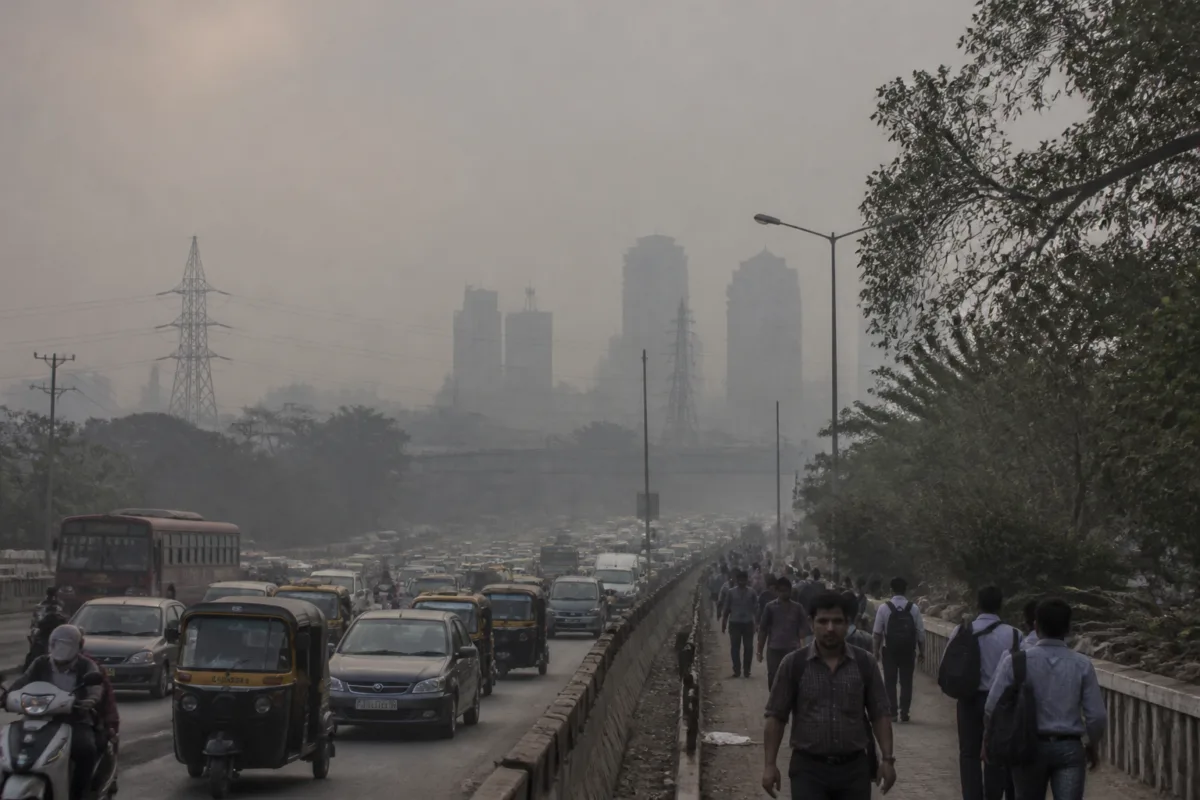
Mumbai has moved to third place in IQAir’s global ranking of the most polluted cities, with an air quality index of 166, as particulate pollution worsened across several parts of the city.
The latest ranking, which assessed 122 global cities, placed Kuala Lumpur first with an AQI of 192 and Kolkata second with an AQI of 170. Mumbai had ranked fifth in the same list a week earlier. PM2.5 was identified as the primary pollutant in all three cities.
The Central Pollution Control Board’s readings showed a different picture on Monday, recording Mumbai’s AQI at 114 in the unhealthy category. The CPCB dashboard showed unhealthy readings at 13 of the 20 operational monitoring stations in the city.
Among the higher readings recorded by the government monitors were 158 at Navy Nagar in Colaba, 156 at Bandra Kurla Complex, 145 in Andheri East, 143 at Siddharth Nagar in Worli and 138 in Malad. These station-level readings indicate that pollution levels are not uniform across Mumbai and vary by location.
Civic officials said the difference between the IQAir and CPCB readings is linked to the way the two systems collect and combine data. Additional municipal commissioner Avinash Dhakane said private monitoring organisations use hourly averages, which can capture sudden pollution spikes earlier. He also said that the sensors used by such organisations may cover a shorter geographic area.
Government agencies such as the CPCB, in contrast, record ambient air quality at specific geographical locations. Dhakane said private agencies combine data from government stations and other sources, including low-cost sensors, and calculate a city reading using the median of hourly station AQI values. Because the data mix is different, the two readings should not be directly compared, he said.
The worsening air quality has been attributed by atmospheric scientist Gufran Beig to weather conditions associated with an El Niño pattern. Beig, chair-professor at the National Institute of Advanced Studies and the Indian Institute of Science, said Mumbai was experiencing slower wind speeds along with hot and humid conditions.
According to Beig, the reduced air circulation is allowing pollutants to settle in the lower atmosphere, contributing to the rise in pollution levels. The explanation links Mumbai’s air-quality deterioration to both the presence of pollutants and the atmospheric conditions that determine how quickly they disperse.
For residents, the readings point to a citywide air-quality problem with significant variation between neighbourhoods and monitoring systems. The latest data also show why a single ranking cannot be read in isolation: the international city comparison and the government station readings measure air quality through different methods. Mumbai’s air-quality conditions will continue to be reflected through the respective monitoring systems and their subsequent updates.

