


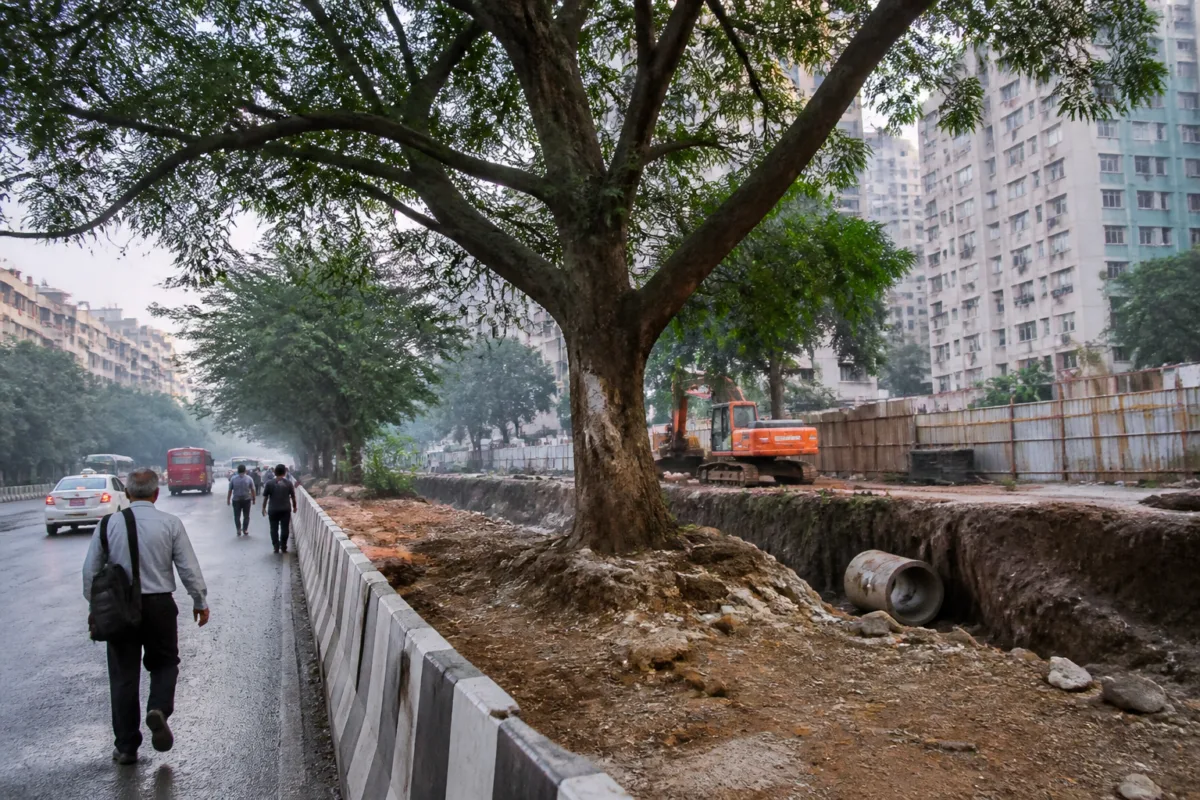
Pune’s tree-cutting figures reveal a problem larger than the loss of individual trees: the city has no clearly demonstrated system for showing whether compensatory planting actually replaces the ecological value removed by construction and infrastructure projects. A report by Lokmat – Pune says 10,389 trees were cut within Pune Municipal Corporation limits over the past four years, while the municipal record lists 5,781,578 trees across the city.
The figures sit uneasily alongside Pune’s rapid physical expansion. Metro works, flyovers, road widening, private construction and government projects have all required land and right-of-way changes. The report says private developers accounted for 8,674 of the trees cut during the four-year period. Against this, developers were ordered to undertake compensatory transplantation of 6,321 trees. However, the municipal administration reportedly does not have a basic consolidated record showing how many trees were actually planted and how many survived.
That gap changes the meaning of a compensatory tree-planting order. On paper, an order to plant or transplant trees creates an administrative response to tree loss. In practice, its environmental value depends on location, species, survival, maintenance and monitoring over time. If these outcomes are not recorded, the city can count permissions and orders without being able to establish whether its green cover has been protected.
The report also highlights the limited evidence available on transplantation. It states that transplanted trees should be geo-tagged and regularly inspected, but alleges that the administration has not adequately followed through on these requirements. The central issue is therefore not only how many trees Pune has lost, but whether the civic system can track the entire chain from permission to removal, replacement, survival and long-term protection.
Pune’s overall tree count also conceals sharp differences between neighbourhoods. The municipal record cited by the report lists 1,115,987 trees in the Dhankawadi-Sahakarnagar regional office area, the highest among the city’s 15 regional offices. The report links this higher count to hills, green belts and available open spaces. Aundh-Baner, Hadapsar-Mundhwa, Nagar Road-Wadgaon Sheri, Kothrud-Bavdhan and Shivajinagar-Ghole Road are also described as areas with substantial tree populations.
By contrast, the densely built central parts of Pune have far fewer recorded trees. Bhavani Peth has the lowest number among the 15 regional office areas, with 12,582 trees, while Kasba-Vishrambagwada has 42,126. These numbers should not be read simply as a ranking of better and worse neighbourhoods. They reflect the accumulated effects of land availability, development intensity, road design, public open space and the age of the urban fabric. They also indicate why city-wide tree totals can hide local shortages of shade and vegetation.
For residents, the local distribution matters more than the aggregate number. A city may report millions of trees while particular streets, wards or dense residential areas remain exposed to heat, dust and traffic pollution. The report does not provide a ward-level assessment of canopy cover or survival rates, so it cannot establish how the city’s total green cover has changed. It does, however, show that the municipal tree count and the lived experience of greenery are not necessarily the same measure.
The species profile adds another layer to the issue. The report says Pune has 417 recorded tree species, including 115 rare species and plants belonging to 73 families. Gulmohar is identified as the most commonly found species. The municipal inventory includes native species as well as foreign and ornamental varieties. This diversity makes replacement more complicated than meeting a numerical target. A newly planted sapling cannot automatically provide the same shade, habitat or ecological function as a mature tree removed for a project.
The supplied report does not quantify the age, size or ecological role of the 10,389 trees removed. It also does not provide a survival audit for replacement plantings. Those omissions are important because the environmental effect of tree loss cannot be assessed from numbers alone. Ten thousand mature trees and ten thousand recently planted saplings represent very different levels of canopy, carbon storage, shade and habitat, even when the arithmetic appears equal.
Pune Municipal Corporation’s stated response combines new planting with an emphasis on survival. The municipal gardens and tree authority departments are described as prioritising tree conservation, expansion of green areas, urban forests and technology-based environmental planning. The civic administration has developed 215 gardens, with work on another 15 reported to be in progress. It has also distributed 61,000 saplings during the 2026 Van Mahotsav period.
Dr Ashok Ghorpade, head of the municipal gardens department, welcomed the Lokmat campaign and said the focus should move beyond how many trees are planted to how many survive and how much green cover increases. That distinction is institutionally significant. Planting is a visible activity that can be reported quickly, while survival requires watering, protection, maintenance budgets, inspection and an accountable agency over several seasons.
The municipal position, as reported, indicates that the administration recognises this distinction. The unresolved question is whether its systems can produce public evidence of results. A survival-oriented approach needs a reliable inventory linking each approved tree removal to the compensatory obligation, the planting or transplantation site, the responsible party, the date of planting, geo-tagged photographs, inspection records and survival status. The supplied material does not establish that such a complete public system currently exists.
This is where construction governance and urban forestry meet. Developers may receive permission to remove trees subject to compensatory requirements, but the ecological outcome depends on enforcement after approval. The report’s figure of 8,674 trees cut for construction and 6,321 transplantation orders suggests that the administrative process is active at the permission stage. The reported absence of a basic record of actual planting and survival indicates a weaker monitoring stage.
The difference is not merely procedural. When monitoring is incomplete, responsibility becomes difficult to assign. A developer may be required to plant or transplant trees, while the municipal authority remains responsible for permissions, inspection and records. Residents, meanwhile, experience the result as a change in shade, streetscape and local comfort. Without a transparent trail, it becomes difficult to determine whether a failed plantation resulted from non-compliance, inadequate maintenance, unsuitable transplantation or a lack of municipal inspection.
Pune’s geography makes this more urgent. The higher tree counts recorded in areas with hills and open land may coexist with lower greenery in central neighbourhoods where redevelopment pressure is stronger. Expanding the overall number of gardens or distributing saplings can support the city’s green agenda, but it does not by itself resolve the loss of mature roadside and neighbourhood trees. The report does not provide enough evidence to compare canopy quality across regional offices, but it clearly points to uneven access to urban greenery.
The Lokmat campaign described in the report asks residents to plant a tree or take responsibility for an existing one in a home, housing society, school, office or neighbourhood. Participants are invited to share photographs and details of the location and species. The campaign’s emphasis on caring for a tree, rather than merely planting one, mirrors the administration’s stated shift towards survival.
Citizen participation can help create local stewardship, but it cannot replace public regulation. Individual residents may water and protect a tree, while only the municipality can maintain a city-wide inventory, enforce permissions, inspect compensatory plantations and publish performance data. The public campaign therefore sits alongside, rather than substitutes for, institutional accountability.
The evidence currently supports three conclusions. First, Pune has recorded substantial tree removal over four years, with construction-related cutting forming the largest reported share. Second, the city has extensive tree and garden programmes, but the available information does not demonstrate how many compensatory trees survived. Third, tree distribution is uneven, with central and densely settled areas recording far fewer trees than greener areas with hills and open land.
What remains uncertain is as important as what is known. The supplied report does not establish the survival rate of transplanted trees, the change in total canopy cover, the number of permissions issued by project, or the location and condition of compensatory plantings. These are the measures needed to determine whether Pune is replacing ecological function or only recording administrative activity.
As Pune continues to add transport infrastructure, roads, buildings and public facilities, the city’s green governance will be tested not by planting announcements alone but by the quality of its records and follow-up. The next meaningful milestone is a publicly verifiable account of how many trees were removed, where replacement trees were planted, how many survived and whether the city’s green cover increased in the neighbourhoods facing the greatest development pressure.

