


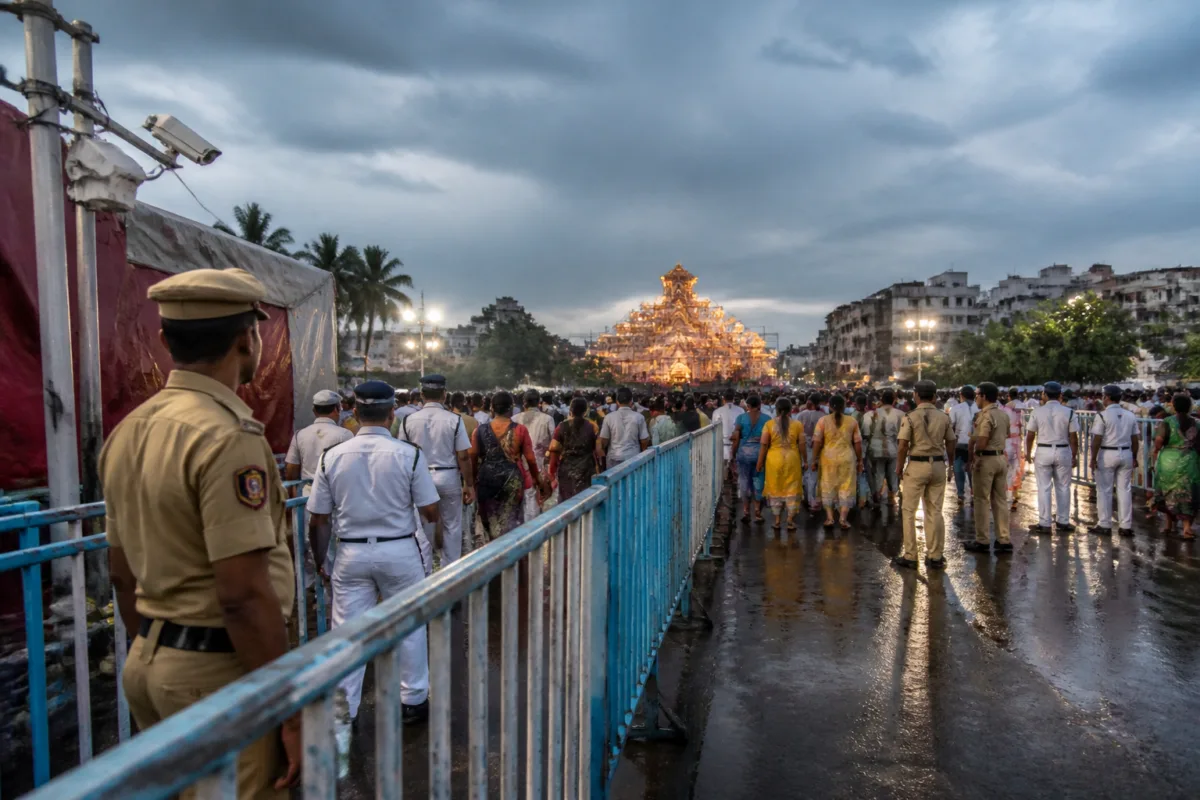
The stampede at Kolkata’s Chorbagan Durga Puja pandal, which killed 19 people and injured 25, has revived a question that India’s crowded public events can no longer avoid: can technology identify danger early enough for authorities to prevent a mass casualty incident? The answer is potentially yes, but only if crowd monitoring is connected to decisions on the ground. Cameras that merely record a disaster after it has happened do little to protect people before conditions become critical.
The Kolkata incident reportedly unfolded after heavy rain drove visitors towards the entrance. As people converged, the crowd became compressed and individuals fell over one another. That sequence is important because it shows how a stampede is not simply a problem of numbers. Weather, venue layout, entry management, crowd movement, communication and the availability of trained personnel can combine quickly to create unsafe conditions.
Artificial intelligence can help authorities identify some of these warning signs. The report describes systems that analyse live video feeds, estimate crowd density, track movement and flag sudden surges. In a venue with multiple entry points, such systems can count people entering and leaving, map congestion at individual gates and identify places where movement slows, stops or reverses.
The technological proposition is straightforward: convert surveillance infrastructure into an early-warning system. But the institutional proposition is more demanding. An alert has value only when it reaches the people responsible for controlling entry, redirecting visitors, opening dispersal routes or deploying emergency teams. Without a defined response, an algorithm can identify danger without changing the outcome.
This distinction separates crowd monitoring from crowd safety. Monitoring produces information. Safety requires a chain of decisions that begins with detection and ends with physical action. Police officers, event organisers and teams managing gates must know what an alert means, who is authorised to respond and which intervention should follow. If density crosses a pre-set threshold, officials may need to temporarily stop incoming visitors, redirect people away from a choke point or deploy personnel to relieve pressure.
The report also makes clear that a single crowd-count number cannot determine safety. The same number of people may be manageable in one venue and dangerous in another, depending on the width and location of exits, the arrangement of barricades, the direction of movement and the presence of bottlenecks. Thresholds therefore need to reflect the venue’s layout and the way people are actually moving through it.
That requirement has implications for how Indian cities plan temporary and permanent public spaces. Religious pandals, festival grounds, railway stations and other high-footfall locations are not interchangeable environments. Each has different entry patterns, physical constraints and emergency requirements. A monitoring system that treats every crowd as a uniform numerical mass may miss the local conditions that turn congestion into a crisis.
India has already used large-scale monitoring infrastructure for major gatherings. During the 2025 Maha Kumbh in Prayagraj, an integrated command and control centre monitored crowd density and movement using inputs from 500 AI-enabled cameras and drones, according to the report. This demonstrates the scale at which authorities are willing to deploy technology. It also raises the more important question of how such systems are evaluated: not by the number of cameras installed, but by whether warnings are issued clearly and acted upon in time.
The evidence supplied in the report points to several layers of a functioning crowd-safety system. Video analytics can identify unusual clustering, sudden changes in direction and people falling. People counters and digital ticketing can help organisers monitor occupancy. Entry gates can be connected to live capacity information. Public-address systems can carry instructions that are coordinated with crowd-control teams. Weather alerts can support precautionary measures during heavy rain, including temporary restrictions on entry and additional personnel deployment.
Each layer addresses a different failure point. Video analytics concerns movement. Counting systems concern occupancy. Public-address systems concern communication. Weather alerts concern an external factor that can change behaviour and crowd distribution. Emergency teams concern the ability to intervene. The system is effective only when these elements operate as part of one response framework rather than as separate technology purchases.
The Kolkata incident also shows why weather must be treated as a crowd-management factor rather than only as a general inconvenience. Heavy rain can alter where people gather, push visitors towards covered areas or entrances and reduce visibility. It can also affect the reliability of cameras and the ability of people to move through a venue. The report says weather alerts and precautionary steps could include temporary entry restrictions, additional personnel and clear directions for visitors.
However, technology cannot compensate for unsafe physical design. Narrow exits, badly placed barricades and inadequate evacuation plans remain direct risks even when a control room has access to live data. Cameras may also fail to capture activity in blind spots. Rain, poor lighting and dense crowds can affect the quality of readings. These limitations mean that an automated alert should support, not replace, a physical safety audit.
A credible safety plan therefore has to begin before an event opens. It needs clearly marked emergency routes, trained personnel, medical teams and regular evacuation drills. These are not substitutes for technology; they are the physical and organisational foundation that allows technology to be useful. An alert showing congestion at a gate matters only if the gate can be managed, an alternative route exists and staff are prepared to communicate with people under pressure.
This is also a governance problem. High-footfall events often involve multiple actors: police, municipal authorities, organisers, venue managers, emergency services and technology providers. The report calls for a common operating framework connecting CCTV analytics, entry counts, weather alerts and emergency-response teams across religious gatherings, festivals, railway stations and public events. Such a framework would need to clarify responsibilities before an incident occurs.
The need for common procedures is particularly evident in the difference between detection and accountability. Authorities should conduct post-event audits to establish whether alerts were generated, whether they reached the relevant teams and whether action was taken in time. Without that record, a system can be described as advanced while its practical performance remains unclear. An audit would shift attention from procurement and installation to outcomes.
The report’s focus on thresholds is equally significant. If thresholds are set too high, warnings may arrive after a crowd has already become difficult to control. If they are set too low, frequent alerts may be ignored. The appropriate level depends on the venue, its exits, its movement patterns and the event’s operating arrangements. This means that crowd safety cannot be fully standardised through a single software setting. It requires venue-specific planning and trained interpretation.
Privacy is another part of the policy landscape. As authorities expand the use of AI-enabled cameras, digital ticketing and occupancy monitoring, the systems will process information about people moving through public spaces. The report identifies privacy protections and independent verification of automated systems as critical as adoption grows. That places a responsibility on authorities and operators to establish how monitoring is governed and how the reliability of automated warnings is assessed.
The available evidence does not establish that any particular technology would have prevented the Kolkata stampede. It does show that tools now exist to count crowds, identify movement patterns and issue alerts, while also showing that these tools have operational limits. The central question is therefore not whether India should install more cameras. It is whether cities and event authorities can connect data to trained people, clear procedures and safe physical layouts.
The larger urban challenge is that public safety is often treated as an event-management issue, even though the same conditions appear across the city system. Railway stations, religious gatherings, festivals and other public venues regularly bring large numbers of people into constrained spaces. Their safety depends on the interaction between infrastructure, information, weather, human behaviour and administrative response.
The Kolkata tragedy makes that interaction visible in the most serious way. AI can strengthen preparedness by identifying crowd build-up and abnormal movement, but it cannot widen an exit, remove an unsafe barricade or make an absent response team appear. The test of India’s crowd-monitoring systems will be whether they help move people away from danger before a warning becomes a casualty count. That will require post-event audits, venue-specific thresholds, physical safety planning, coordinated communication and clear privacy safeguards alongside the technology.

