


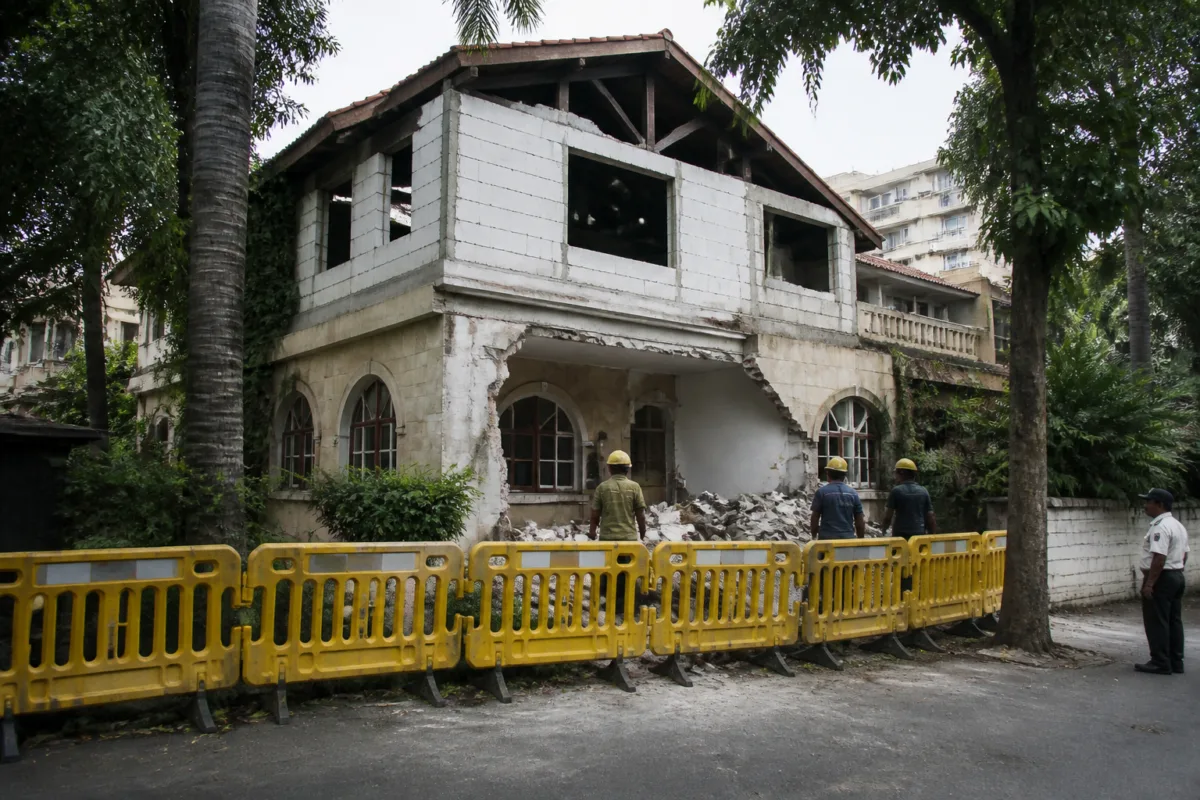
The Brihanmumbai Municipal Corporation’s demolition of unauthorised portions of a bungalow in Juhu has brought a familiar Mumbai urban problem into public view: construction activity can move ahead before the paperwork that is meant to authorise it is in place. The case involves a property owned by actor Ajay Devgn and his mother, Veena Devgn, but the underlying issue is institutional rather than celebrity-driven. It concerns how the city identifies unauthorised work, what owners must produce in response, and how a civic notice can move from warning to physical enforcement.
According to a report by the Times of India, the BMC demolished portions of ongoing work at the property on October 12 after rejecting a reply submitted by the owners. The bungalow is located in Kapol Cooperative Housing Society in Juhu, on N S Road No. 11, JVPD, Vile Parle (West). The civic action followed a speaking order dated October 6 from the BMC’s K/West ward office.
The corporation said the reply submitted on September 15 did not contain documents establishing that the construction had been authorised. It also said the owners had not produced a copy of permission granted by the competent authority. The work involved unauthorised additions and alterations using Siporex blocks at CTS No. 841, Plot No. 10, Kapol CHS Ltd.
The sequence described in the report illustrates the administrative structure of municipal enforcement. On September 10, the BMC issued a stop-work notice under Section 354A of the Mumbai Municipal Corporation Act. The notice directed the owner or occupier to stop the work immediately and submit the relevant permissions within 24 hours. It also warned that the unauthorised structure and construction materials could be removed at the owner’s risk and cost if the directions were not followed.
The corporation further directed the police to keep watch at the site and, if required, remove people carrying out the work. The subsequent speaking order recorded that because the construction was ongoing, the owner was required to possess permission from the competent authority. In the absence of documents, the BMC said the reply could not be accepted and treated the work as unauthorised.
That distinction between an ongoing alteration and a completed building is important to understanding the case. The BMC’s stated position was not simply that the property was associated with a prominent owner. Its action was based on the requirement that construction work underway should have the necessary permission and that such permission should be produced when demanded by the civic authority. The notice-and-order process provided the formal route through which the corporation moved to remove the work.
The case also shows why documentation is central to the regulation of Mumbai’s built environment. A property owner may occupy, own or rent out a premises, but those positions do not by themselves establish that additions or alterations are permitted. In this instance, the BMC said the owners’ response lacked the documents needed to demonstrate authorisation. The enforcement question therefore turned on permissions and records rather than on the identity of the owner.
Ajay Devgn’s office disputed one aspect of the public characterisation of the property. In a statement quoted by the Times of India, it said the property was not the actor’s residence but a separate property that had been rented out. The statement added that an application had been made to the BMC for the requisite permissions and that the owners were complying with applicable BMC rules, regulations and guidelines. It also said that the necessary changes, alterations and modifications required by the BMC had been carried out.
The statement introduces an important distinction between an application for permission and permission already granted. The BMC’s account focused on the failure to produce documents proving authorisation for the ongoing work. The actor’s office referred to an application and compliance with the corporation’s requirements. Based on the supplied material, the status of any later approval is not established beyond that statement, and the civic order’s finding relates to the documentation available when the authority considered the reply.
The proposed use of the property adds another layer to the dispute. Sources cited by the Times of India said the bungalow was intended to be rented out to a salon. Residents of the housing society had reportedly objected because they feared that a salon could open a private society premises to members of the public who would visit it. This concern moves the matter beyond a question of construction permission and into the regulation of activity within a residential setting.
A residential property being used for a business can affect access, visitor movement and the relationship between private society space and the wider public. The supplied report does not establish the final approval status of the salon or whether it began operating. It does, however, show that residents’ concerns formed part of the context around the property and that the proposed use was seen by them as potentially changing how the society functioned.
This is one reason municipal approval systems matter at the neighbourhood level. Permissions are not only a technical exercise involving plans, materials and paperwork. They can determine whether an alteration fits within the sanctioned use of a property and whether a change in activity may affect neighbours, common areas and access arrangements. When work begins before the relevant permissions are demonstrated, residents may be left responding to a physical change rather than participating in a clear approval process.
The case also highlights the role of the ward office as an enforcement institution. The K/West ward office issued the notice, assessed the reply and recorded its reasoning in a speaking order. The order, as reported, set out why the response was not accepted and why the work was treated as unauthorised. This written reasoning is significant because it creates an administrative record connecting the alleged violation, the owner’s response and the enforcement action.
At the same time, the episode shows the limits of what can be concluded from a demolition action alone. The removal of unauthorised portions does not, by itself, resolve every question relating to the property’s future use, later applications or society objections. The available material confirms the BMC’s enforcement action and the actor’s office statement, but it does not provide a final account of any subsequent permission, the proposed salon’s operating status or the outcome of all resident concerns.
Mumbai’s dense and valuable neighbourhoods routinely place private property decisions inside a wider urban system. A construction alteration can affect the building’s physical form, the society’s shared environment and the movement of people through a residential area. The administrative process is therefore expected to perform several functions at once: check whether work is authorised, provide the owner an opportunity to respond, coordinate enforcement where necessary and protect the surrounding urban setting from unapproved changes.
In the Juhu case, the BMC’s account shows that the process reached its enforcement stage because documents proving authorisation were not furnished in response to the notice. The owner’s office, meanwhile, said that permissions had been applied for and that required modifications had been made. Those positions underline a recurring governance question: how quickly and clearly can property owners, residents and municipal officers establish the legal status of work before construction changes the premises?
The immediate facts are clear enough to establish the sequence: a September 10 stop-work notice, a September 15 reply, an October 6 speaking order and demolition action on October 12. What remains outside the supplied record is the later status of the permission application and the proposed salon. Those developments will determine whether the dispute ends with the removal of the unauthorised work or continues as a question of permitted property use within the housing society.

