


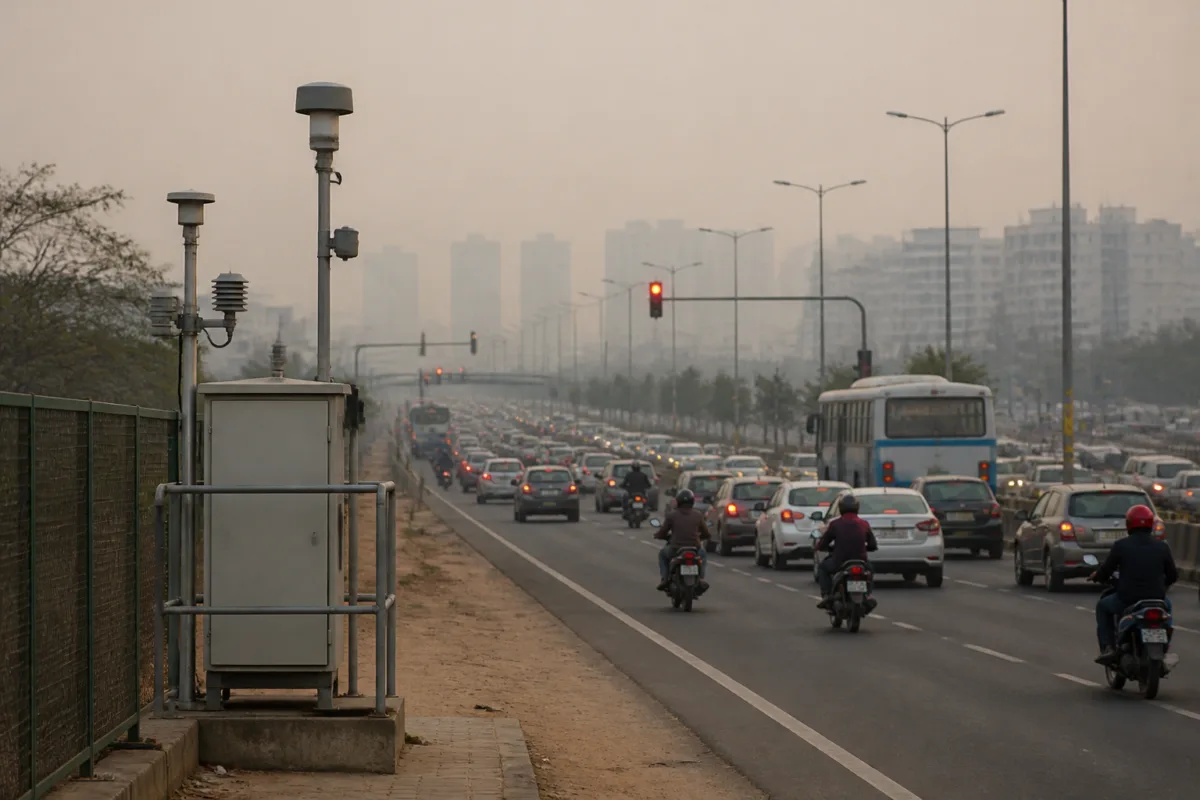
Delhi’s air quality deteriorated sharply over 24 hours, with the average AQI rising from 90 to 159 and 12 areas recording levels above 200, placing them in the poor category. The deterioration was reported on Saturday evening as weather conditions remained unfavourable for pollutant dispersion across Delhi and the National Capital Region.
The average AQI stood at 159 on Saturday, compared with 90 a day earlier, an increase of 69 points. The affected locations included residential neighbourhoods as well as areas with heavier traffic. AQI readings above 200 fall in the poor category under India’s air-quality classification system.
Data cited by the report from AQI.in showed that Delhi’s AQI had reached 135 at 10.30am on October 16 before improving temporarily to 65. The improvement did not last. As evening approached, the reading rose to 240. At 10.30am on October 17, the AQI was recorded at 216, indicating that pollution levels remained elevated through the following day.
The weather outlook is expected to keep pressure on air quality over the next few days. The report, citing the India Meteorological Department, said Delhi and nearby NCR areas were unlikely to receive rain for three to four days. Rain can help remove some pollutants from the atmosphere, while dry conditions can allow particulate matter to remain suspended.
Maximum temperatures in Delhi are expected to remain around 31 to 33 degrees Celsius on Sunday, with clear conditions during the day. Winds may reach 10 to 15 kilometres per hour in the afternoon, but speeds are expected to be lower during the morning and evening. The report said maximum temperatures could remain between 32 and 34 degrees Celsius through October 23.
The IMD outlook cited in the report said daytime wind speeds between October 19 and 22 could reach 15 to 20 kilometres per hour. However, slower winds in the morning and evening may coincide with higher pollution levels during those periods.
The report also cited the possibility of additional pollution pressure from increased traffic during Durga Puja and fireworks. It did not provide a separate quantified estimate for the contribution of either source, but identified traffic, dust and fireworks as factors that could affect air quality in the coming days.
Separately, Delhi Environment Minister Manjinder Singh Sirsa said, according to a PTI report cited by Live Hindustan, that the capital had recorded 211 days this year with air quality in the good, satisfactory or moderate categories. Excluding 2020, he described this as the best performance since 2016. The comparable figures cited were 200 such days in 2025, 209 in 2024, 206 in 2023, 159 in 2018 and 110 in 2016.
The immediate forecast remains focused on dry weather, daytime sunshine and weaker morning and evening winds. These conditions, along with local traffic, dust and festival-related activity, will determine whether Delhi’s AQI continues to rise or improves over the next several days.

