


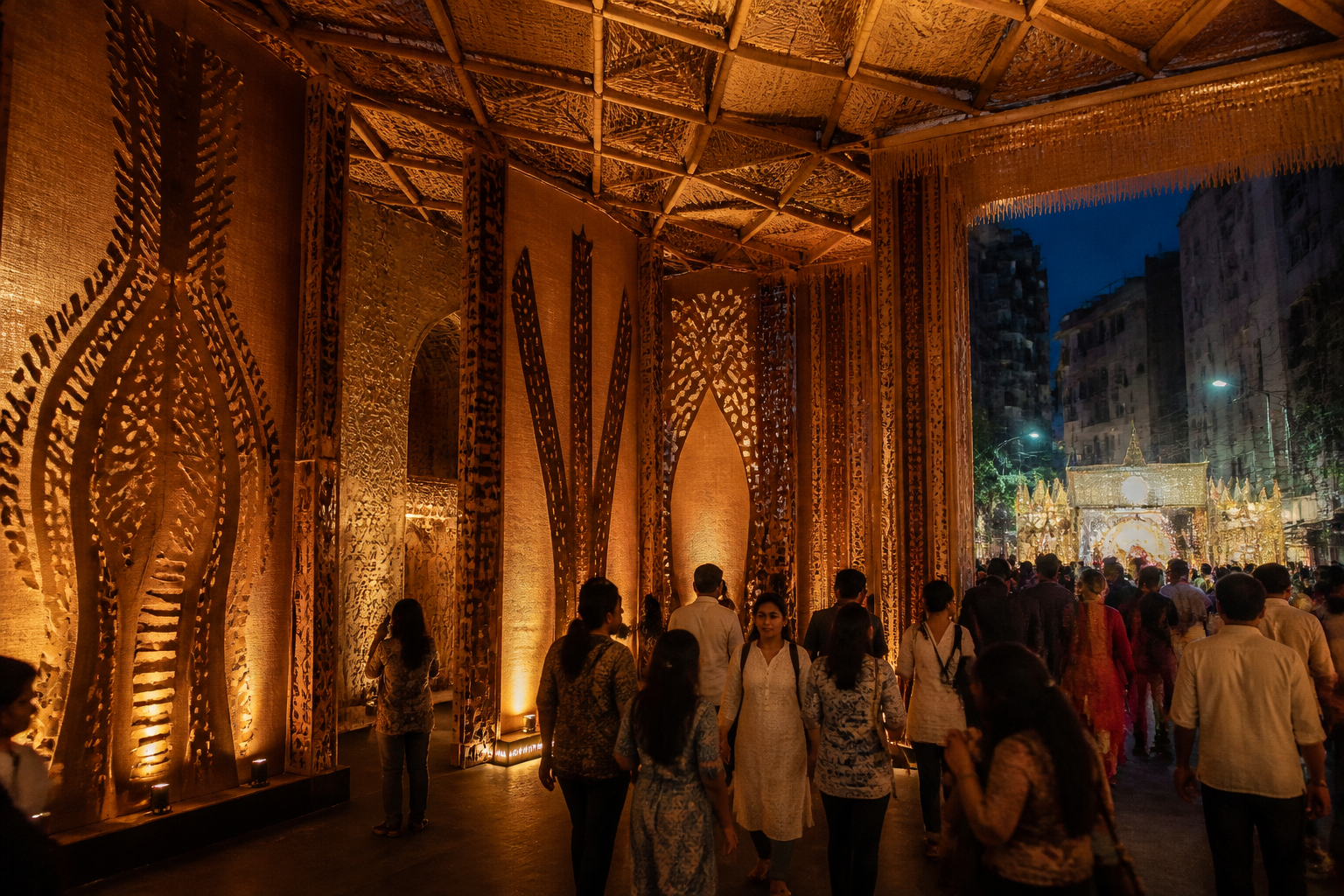
The Kolkata Durga Puja pandal is often treated as a temporary structure built for spectacle. Chaltabagan’s theme this year attempts something more demanding: it turns the pandal into a public space for remembering caste exclusion, interpreting bodily marks as acts of faith and resistance, and connecting a local festival to communities beyond the city.
The north Kolkata committee’s 84th edition is centred on “Nishan”, or mark, and celebrates the Ramnami community. The Ramnamis trace their sect to the late 19th century, when Dalits in present-day Chhattisgarh were denied entry to a temple. In response, a Dalit man named Parasuram tattooed “Ram” on his face and body. The act carried a direct message: divinity was not confined to a temple or controlled by those who could exclude others from it.
More than a century later, that history is being brought into a Kolkata neighbourhood through a temporary installation designed to be walked through. The significance of the project is not only in the subject it chooses, but in the way the city’s festival infrastructure becomes a vehicle for representing a community whose religious practice emerged from social exclusion.
### A pandal as an urban storytelling device
Chaltabagan Durga Puja was founded in Manicktala in 1943 and has become known for exploring creative themes in its pandals. Its organisers describe the structure not simply as a construction project, but as an idea that the city is invited to enter. That approach reflects a distinctive feature of Kolkata’s Durga Puja: the pandal temporarily changes the meaning of a street, neighbourhood or public gathering point.
The structure remains temporary, but the social memory it carries is not. For the duration of the festival, a local site becomes a setting where visitors encounter histories, artistic interpretations and communities that may otherwise remain outside their daily field of attention. In this case, the Ramnami story is placed at the centre of that encounter.
The theme was conceived by artist Aditi Chakraborty, who described tattooing, or godna, as an old act of faith, protection and quiet protest. Her narrative extends beyond the Ramnamis to other forms of bodily and cultural inscription. It includes the Baiga woman’s ornament, the healing “Jahar Ulki” tradition of Latehar, protective and magical designs from southern India, and fertility motifs whose geometry is connected in the theme to the nine plants of Bengal’s Nabapatrika worship.
This wider framing matters because it prevents the Ramnami story from being presented as an isolated curiosity. The marks are treated as part of a broader history in which communities have used the body, ornament and ritual to preserve identity, seek protection or express belief. The pandal therefore becomes a space for linking different geographies and practices through a common visual language.
### The politics of a visible mark
The Ramnami tradition began with a contradiction at the heart of religious life: people were denied access to a temple, yet they asserted that the divine could be carried on the body. Their tattoos transformed the body into a site of worship and made exclusion harder to enforce. The name of Ram was no longer located only inside a controlled institution; it was visible on the people who had been kept outside it.
The practice also shows how a community’s traditions change under social and economic pressure. According to the report, only a handful of Ramnamis now have tattoos extending from head to toe, known as nakh-sikh tattoos. Many younger members have migrated to cities for jobs, where extensive tattoos may create difficulties in workplaces unfamiliar with the history of the Ramnami community.
That shift raises an important urban question without requiring the festival to provide a simple answer. When communities move into cities for employment, what happens to practices that were developed in rural or closely connected social settings? Does adaptation help a tradition survive, or does it gradually remove the visible forms through which outsiders recognise it? The material supplied for the exhibition does not resolve that question, but it makes the tension visible.
Younger Ramnamis continue to recite the name of Ram and retain some tattoos. This flexibility may help preserve the central tradition, even as its physical form changes. The distinction between a fully tattooed body and a smaller number of marks also shows that heritage is not static. It can be maintained through sound, memory and association, even when economic realities alter how it appears.
### From bodily inscription to sound
The exhibition’s second major element is music. Hindustani classical musician Pandit Vishwa Mohan Bhatt composed a work in response to the theme. He described the connection between “nishan”, the mark, and “naad”, musical sound. The Ramnamis write the name on the skin, while a musical tradition writes its identity in sound and passes it from teacher to student.
The composition brings together a chant associated with the Ramnami community and the Mohan Veena, an instrument created by Bhatt. It was developed across three generations of the Bhatt family: Bhatt composed the music, his son Saurabh handled the arrangement, mixing and recording, and his grandson Atharva played the Mohan Veena with him.
This is not merely an accompanying soundtrack for the pandal. It extends the theme from a visible mark to an audible one. The visitor does not only see a representation of the Ramnami practice but encounters an attempt to translate its persistence into another artistic form. The use of family collaboration also introduces a second idea of inheritance: one tradition is carried through bodily inscription and recitation, another through musical training and performance.
The arrangement reflects how a contemporary urban festival can assemble different forms of expertise. The project brings together a puja committee, an artist, members of the Ramnami Samaj and a renowned musician. The resulting public experience depends on institutional coordination as much as on creative interpretation.
### The festival as a civic network
Chaltabagan’s organisers have also announced the Durga Puja Connect app, intended to extend the festival to people outside Kolkata. Shishir Bajoria, who is associated with the puja, described the festival as no longer belonging to one street, one city or one country. He referred to a scattered community that could include a family in Kolkata, a student in Berlin and a doctor in New Jersey.
Sandeep Bhutoria, the committee’s chairman, presented the theme, the music, the participation of the Ramnami Samaj and the app as parts of a single idea. In that formulation, the app becomes a modern version of the mark: a technological means of carrying the festival across distance.
The digital initiative changes the spatial reach of the event, but it does not replace the physical pandal. The local structure remains the anchor from which the story is communicated. This creates a layered public space: one part is located in Manicktala and experienced through movement, materials and sound; another is distributed through a digital platform to people who cannot be present in Kolkata.
The arrangement also reflects a broader institutional reality of contemporary festivals. A major puja is not only a religious gathering. It is a temporary system involving design, construction, artistic production, public communication, community participation and digital access. Each element shapes how the city presents itself and how its residents, visitors and diaspora communities relate to it.
### What the project reveals about urban memory
The Chaltabagan theme places a history of caste exclusion within a highly visible urban festival. That choice gives the story a significance beyond the aesthetics of the pandal. It demonstrates how public cultural spaces can bring marginalised histories into mainstream civic attention without separating them from everyday urban life.
At the same time, the project’s interpretation remains mediated by organisers and artists. The supplied account records the participation of the Ramnami Samaj, but it does not detail how the community itself shaped every aspect of the design or how visitors will respond to the representation. That limitation is important. A theme can raise the visibility of a community while still leaving questions about authorship, interpretation and institutional power.
The exhibition also links heritage to mobility. Ramnami families have migrated to cities for work, and the public festival is using technology to reach people who have migrated away from Kolkata. In both cases, urban life changes how traditions travel. The community’s marks may become fewer or less visible in professional environments, while the puja’s message may become more geographically expansive through an app.
The evidence supplied here confirms the project’s central components: the Ramnami theme, the historical account behind it, the musical composition, the participation of three generations of the Bhatt family, the festival’s institutional history and the proposed digital connection. It does not establish how widely the app will be used, how the pandal will be constructed or whether the project will alter public understanding of the Ramnami community. Those developments will require observation beyond the announcement.
For now, Nishan shows how a temporary Kolkata structure can function as more than a backdrop for worship. It can act as an archive, a performance space and a civic address. By placing a history of exclusion inside a public festival, Chaltabagan is asking visitors to consider how faith is carried when institutions deny entry, how traditions survive when their visible forms become difficult to maintain, and how a local urban celebration can create connections across communities and continents.

