


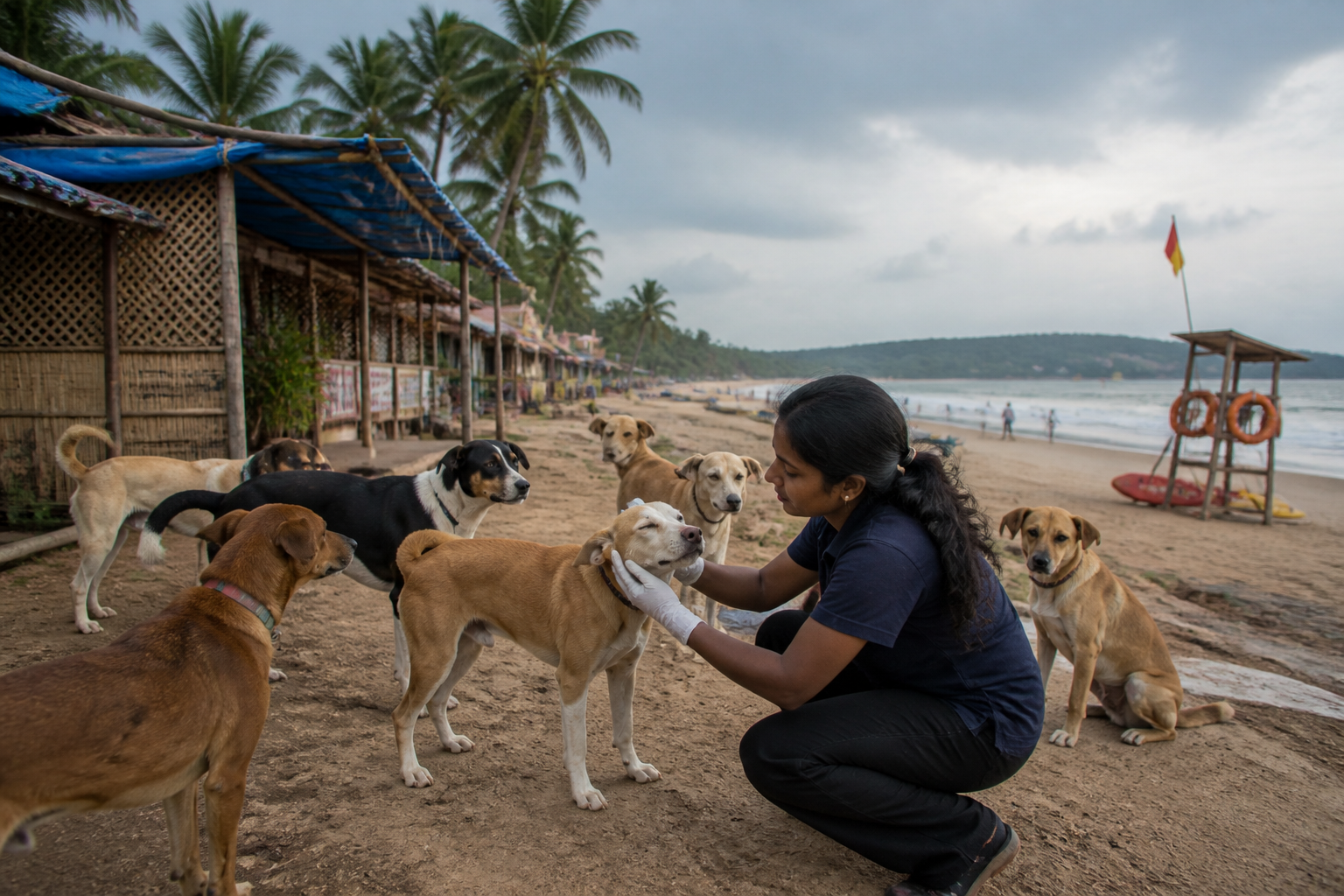
Goa’s new roadmap for managing stray and community dogs on its beaches is more than a response to a tourism department initiative. It is an attempt to address a fragmented urban and coastal governance problem involving local bodies, village panchayats, hospitality businesses, animal-welfare organisations, beach operators and state departments. The recommendations reported by the Times of India show that the immediate debate over adoption and relocation has exposed a deeper question: who is responsible for managing animals in public spaces, and what infrastructure exists to support that responsibility?
The recommendations were discussed at a meeting in Porvorim chaired by the animal husbandry secretary, following discussions with the chief minister. The meeting considered directions from the Supreme Court and the Bombay high court, as well as concerns raised after the tourism department began an initiative to place stray dogs on beaches for adoption and relocation. The department had issued a seven-day notice for the initiative, which was subsequently challenged by the District Society for Prevention of Cruelty to Animals, North Goa.
The dispute matters because relocation is not an administrative action that can be separated from shelter capacity, animal health, local government responsibilities and legal requirements. Animal-welfare organisations and non-governmental organisations reportedly objected to the tourism department’s proposal because Goa does not have designated shelters for the animals. Without a functioning shelter network, a relocation programme risks becoming a transfer of the problem from a visible tourist location to another area rather than a durable management system.
The government’s recommendations therefore begin with information. Authorities plan to conduct a detailed survey of stray and community dogs along beach stretches, with support from the lifeguard agency Drishti and local bodies. Dogs are to be categorised according to whether they have been sterilised. This is a significant administrative step because the state cannot plan treatment, vaccination, adoption or shelter requirements without knowing the approximate population and health status of animals across different beach belts.
The proposed survey also recognises that beaches are not governed by a single institution. Lifeguards observe beach conditions daily, local bodies carry municipal or panchayat responsibilities, and tourism businesses occupy a central role in the operation of the coastal visitor economy. Bringing these actors into the information-gathering process could create a more complete picture than relying on isolated complaints or short-term drives. However, the report does not establish the survey’s timeline, methodology, funding or system for making its findings public.
The next proposed intervention is sterilisation and vaccination. The recommendations call for cooperation with shack owners’ associations to sterilise and vaccinate unsterilised dogs. Murugan Appupillai, director of education at Mission Rabies, warned that partial sterilisation produces negligible results and urged a unified approach involving government departments, animal-welfare organisations and local bodies. His comment points to the difference between conducting isolated procedures and managing a population across an entire geographic area.
A partial programme can leave the overall system unchanged if untreated animals continue to reproduce or if vaccinated and unvaccinated dogs remain indistinguishable. The government’s decision to first identify animals by sterilisation status is therefore linked directly to the concern over incomplete coverage. The report does not provide current sterilisation or vaccination numbers, so it is not possible to assess the scale of the gap. What is clear is that the proposed plan treats coverage and coordination as more important than a one-time campaign.
The recommendations also include structured feeding arrangements, particularly during the tourist off-season. Village panchayats, shack owners and the hospitality sector are expected to participate in maintaining these arrangements. This shifts the issue from informal, individual feeding practices to a more organised system involving the businesses and communities that share the beach environment.
The off-season reference is important because coastal public spaces change function across the year. Tourist activity, food availability, staffing and local movement patterns may differ substantially between peak and low seasons. The report does not establish how feeding points would be selected, who would maintain them, how hygiene would be monitored or how conflicts with residents and visitors would be handled. Those details will determine whether structured feeding becomes a management tool or simply another uncoordinated activity.
Shelter capacity is the most visible institutional gap in the current dispute. Stakeholders agreed to explore clusters of village panchayats that could secure common land for permanent shelters in accordance with established guidelines. The proposal suggests that individual local bodies may not be able to provide an adequate solution on their own. A cluster-based approach could distribute land and administrative responsibilities across several panchayats, although the report does not specify which panchayats would participate or how construction and operating costs would be shared.
The absence of designated shelters also reveals the difference between announcing relocation and implementing it. A relocation programme requires identified sites, veterinary support, transport, records, staffing and an accountable authority. It also requires compliance with the legal and welfare framework referred to during the meeting. Until those elements are established, relocation remains an administrative intention rather than a demonstrated operational capacity.
The recommendations give priority to young dogs from beach areas for adoption after sterilisation and vaccination, before any relocation takes place. This sequence places adoption ahead of removal and links adoption eligibility to basic animal-health interventions. It also indicates an attempt to distinguish between animals that may be placed with families and those that would need to be managed through other arrangements.
Yet the report does not provide adoption targets, screening procedures, follow-up mechanisms or details of who would be responsible for animals after placement. Those omissions are important because adoption is not only a publicity exercise. It involves matching animals with households, recording ownership and ensuring that animals do not return to public spaces through abandonment. The proposed approach will need a system capable of tracking that chain if adoption is to reduce pressure on beaches rather than shift it elsewhere.
The meeting also highlighted mandatory pet registration. Stakeholders resolved to draft bylaws under the Goa Municipalities Act and the Goa Panchayat Raj Act to make dog registration compulsory. Free registration was suggested as an incentive. This proposal addresses the privately owned side of the same governance problem: public authorities may struggle to manage stray animals when ownership, abandonment and responsibility are difficult to establish.
Pet registration can create an administrative record linking dogs to households, but its effectiveness depends on implementation. The report does not state how many pets are currently registered, which authority would maintain the database, how compliance would be checked or what penalties would apply. It does, however, show that the government is considering a preventive measure alongside beach-level interventions. Registration could help clarify responsibility, provided local bodies have the capacity to administer and enforce the proposed bylaws.
The legal context makes institutional clarity especially important. The meeting reviewed Supreme Court and Bombay high court directions, while the North Goa DSPCA alleged that the tourism department’s initiative violated statutory provisions and court directions. These are allegations reported in connection with the seven-day notice; the supplied material does not include the text of the court directions or an adjudication on the dispute. The government’s response, as described, is to create a broader plan involving the departments and organisations responsible for implementation.
That response points to a recurring challenge in urban governance: a public-space problem can fall between departmental mandates. Tourism authorities may be concerned with beach conditions and visitor experience. Animal husbandry authorities may focus on veterinary management. Panchayats and municipalities may handle local services and bylaws. Welfare groups may monitor legal and treatment standards. Without a clearly assigned operating framework, each institution can address one part of the issue while the overall problem persists.
The recommendations attempt to build that framework through a chain of measures: survey the animals, identify sterilisation status, vaccinate and sterilise unsterilised dogs, organise feeding, develop shelter clusters, prioritise adoption and create mandatory pet registration. The sequence is more comprehensive than a relocation-only response because it combines population management, public-space administration, animal welfare and household accountability.
However, the evidence supplied in the report does not yet show that the roadmap has become an implemented statewide programme. It describes recommendations intended to guide the tourism department’s upcoming execution plan. The execution plan, its budget, responsible agencies, deadlines and monitoring arrangements remain unspecified. That distinction is central. A roadmap can establish direction, but public outcomes will depend on whether responsibilities are converted into funded and measurable tasks.
Goa’s coastal stray-dog debate therefore offers a useful test of how the state manages shared public spaces. Beaches are simultaneously tourism assets, neighbourhood environments, workplaces and habitats for community animals. Managing them requires more than removing visible symptoms during the tourist season. It requires reliable information, coordinated local administration, adequate facilities, consistent veterinary action and rules that apply to both public and privately owned dogs.
The immediate developments to monitor are the tourism department’s execution plan, the proposed beach surveys, the drafting of municipal and panchayat bylaws, progress towards shelter land clusters, and the response to the DSPCA’s objections. Until those steps are documented, Goa has a set of recommendations and a clearer statement of the problem, but not yet proof of a functioning statewide system.

