


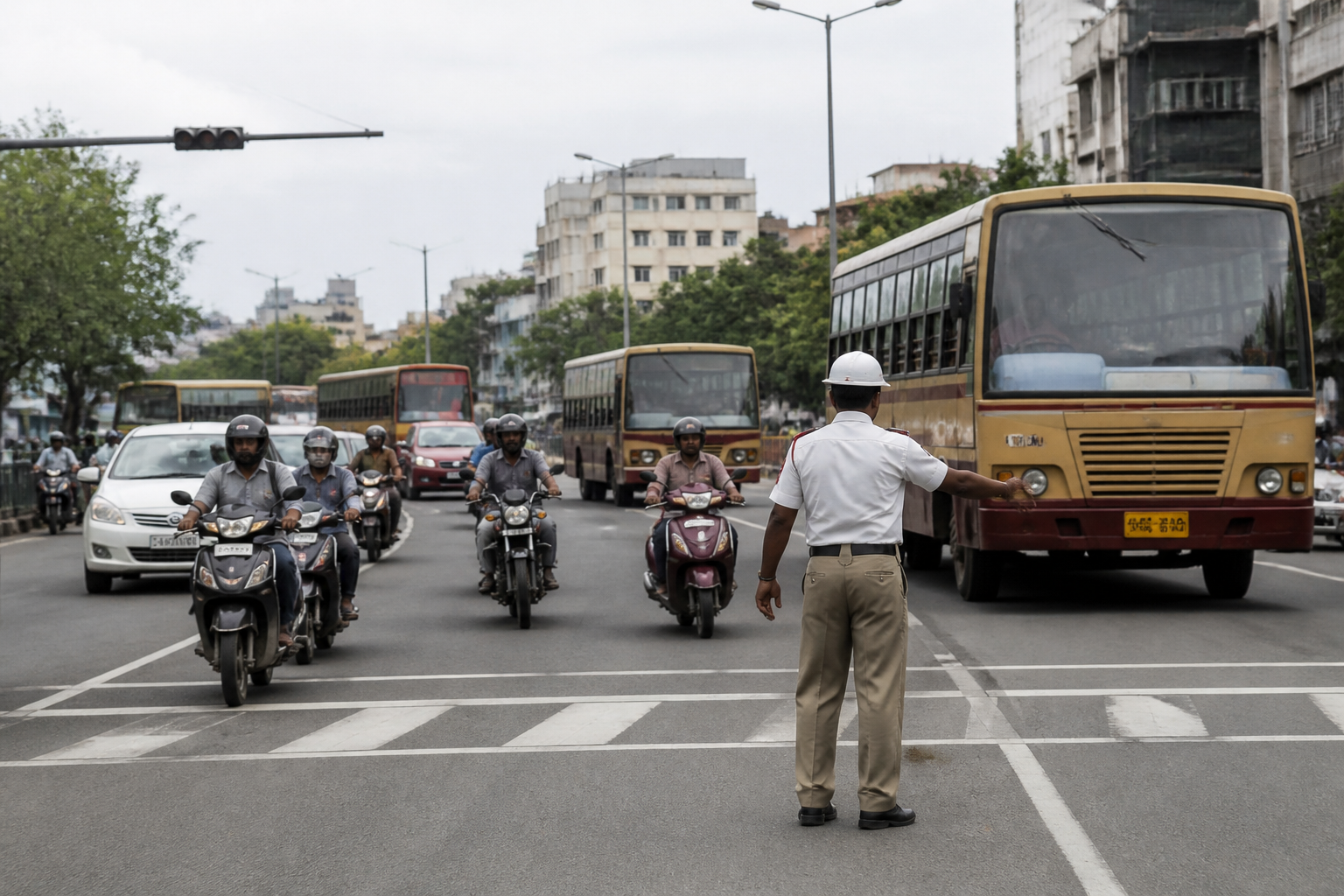
Road safety in Chennai and across Tamil Nadu came under renewed focus at a conference where government officials, researchers and civil society representatives called for stricter speed-limit enforcement, safer road design and dedicated lanes for buses and two-wheelers. The proposals were made at the Tamil Nadu Road Safety Conference: From Mission to Action, organised by the Citizen Consumer and Civic Action Group (CAG) in Chennai on Friday.
The conference took place against the backdrop of Tamil Nadu recording 67,526 road-accident cases and 18,449 road-crash fatalities in 2024, according to the figures cited at the event. Participants called for a comprehensive and effective State Road Safety Action Plan to address enforcement gaps, vehicle growth and infrastructure conditions that contribute to crashes.
Phanindra Reddy, chairperson of the Tamil Nadu Real Estate Regulatory Authority, said road engineering needed to play a greater role in controlling vehicle speeds. While the state has well-connected roads, it also has a high volume of vehicles, he said. Tamil Nadu ranks eighth in fatalities per 1,000 vehicles, according to his remarks.
“Roads must be designed to enforce safe speeds, rather than relying only on signboards,” Reddy said. The proposal places responsibility not only on drivers and enforcement agencies but also on the design and operation of the road itself. Separate lanes for buses and two-wheelers were among the measures proposed at the conference.
B Shamoondeswari, additional commissioner of police (traffic) with the Greater Chennai Police, said enforcement agencies were using technology such as automatic number-plate recognition to detect violations. However, she said fake number plates remained a challenge. She also urged vehicle owners to clear pending traffic challans.
More than 26,000 drunk-driving cases were registered between October 2025 and September 2026, Shamoondeswari said, adding that only about half of the offenders had paid their fines. The figures highlight the enforcement burden involved in converting detected violations into completed penalties.
Vignesh Dhurai of IIT-Madras proposed a graduated response to traffic violations. He said offenders should first be informed of the violation and have the warning recorded. Fines should be imposed if the same offence is repeated, he said. The proposal would create a documented warning stage before escalation for repeat violations.
S Saroja, executive director of CAG, said collaboration between government departments, enforcement agencies, technical institutions, researchers and civil society organisations was necessary to build a safer road transport system. The conference called for these stakeholders to work towards implementing the state road safety action plan, with speed management, road engineering, traffic enforcement and lane allocation forming key parts of the discussion.
