


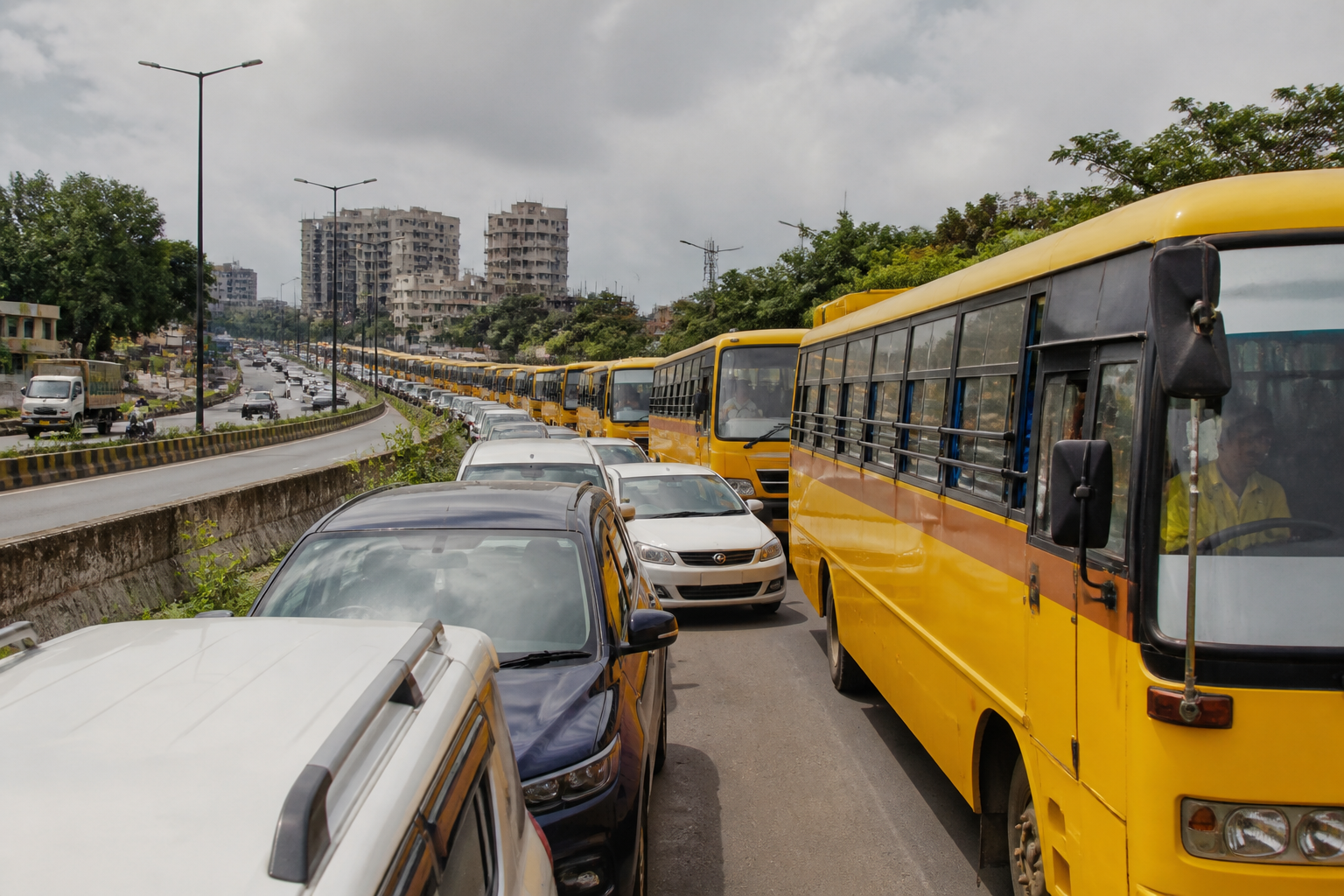
For children travelling to school along Bengaluru’s State Highway 35, the journey is not simply a commute. It can involve repeated stops, long delays and situations in which young passengers struggle to communicate basic needs while buses remain trapped in traffic. The experience described by a student travelling near Dommasandra Circle shows how congestion around schools has become a direct question of safety, dignity and access to education.
The Hindu’s report from East Bengaluru describes vehicles, including school buses, stuck in traffic on SH-35 in Varthur. Kashvee, a Grade 8 student at a school located near Dommasandra Circle, said she had previously comforted a nine-year-old boy who was crying because he needed to use the restroom. The child had expected to reach home in time, but the bus remained at the same point on the road for 20 minutes.
That account captures a problem that is often reduced to a familiar Bengaluru complaint about traffic. Around schools, however, congestion has consequences that extend beyond lost minutes. It affects children who cannot choose their routes, school buses operating on fixed schedules, parents planning work and care responsibilities, and residents sharing roads that were not designed to handle simultaneous school and general traffic.
The problem is particularly visible on corridors where schools have developed along major roads. SH-35 connects expanding eastern Bengaluru neighbourhoods and carries a mix of school buses, private vehicles and other traffic. The report identifies the stretch near Dommasandra Circle and Varthur as a location where vehicles can remain stationary for extended periods. The supplied account does not establish the total number of schools, buses or daily commuters using the corridor, but it shows how a delay that appears ordinary from outside can become acute inside a school bus.
The school journey also exposes an important difference between the way urban congestion is measured and the way it is experienced. Traffic assessments commonly focus on vehicle movement, road speed and junction capacity. A bus carrying children presents a different set of needs. Its passengers may be young, dependent on adults, unable to leave the vehicle and required to remain seated or controlled during a prolonged delay. A traffic queue therefore becomes a confined environment in which ordinary needs can become difficult to manage.
The incident described by Kashvee is also a reminder that school transport is part of the city’s public infrastructure, even when it is operated by private schools or bus contractors. A school bus is not merely another vehicle contributing to road demand. It is a service that connects residential areas to educational institutions and allows families to access schools at a distance from home. When the road system repeatedly fails that connection, the burden is transferred to children, drivers, attendants, parents and school administrators.
The report points to attempts to address the situation through micro-planning and restrictions on heavier vehicles. These measures indicate that the congestion is being treated not only as a matter of individual driving behaviour but also as a problem of traffic management. Micro-planning can involve organising vehicle movements, examining school arrival and departure periods and identifying points where buses and other vehicles conflict. Restrictions on heavier vehicles seek to reduce the effect of large or slow-moving traffic on a corridor already under pressure.
The effectiveness of such measures will depend on how closely they correspond to the actual rhythm of the school day. School traffic is concentrated into particular windows rather than distributed evenly across the day. A road that functions adequately at one time may become severely constrained when multiple schools release buses, parents arrive by car and regular commuter traffic continues at the same junction. Any intervention that does not account for those overlapping movements may simply shift the queue to another point.
The available report does not provide traffic counts, journey-time comparisons or details of the restrictions being considered. It therefore cannot establish how widespread the delays are or whether the proposed measures have already improved conditions. What it does establish is the human consequence of a delay on one identified corridor and the fact that traffic management responses are being considered for the area.
That distinction matters for urban governance. A school-zone traffic problem may involve several institutions with different responsibilities. Road agencies are responsible for the highway and junction operations. Traffic police manage movement and enforcement. Schools influence arrival and departure schedules, bus operations and access points. Local residents and parents experience the spillover. If these responsibilities are handled separately, each agency may see only one part of the problem: an obstruction, a bus-management issue, a school-gate conflict or a general congestion point.
The school bus brings those fragments together. Its route begins in residential neighbourhoods, uses a public road, approaches a private or institutional campus and eventually returns through the same network. A delay can arise from the highway, a junction, roadside activity, school access arrangements or the interaction of all of them. This is why a narrow focus on the immediate point where vehicles stop may not resolve the conditions that create the queue.
The report also raises a question about the location of educational institutions in a rapidly expanding city. Schools situated beside highways can serve growing residential areas, but the same roads must often accommodate through traffic, local access and commercial or construction activity. As urban development spreads, institutions that were once at the edge of the city may become embedded in dense daily travel patterns. The road then carries more than one urban function without necessarily gaining the space or management required to support them.
The source material does not include a historical account of SH-35’s capacity, the pace of development around Dommasandra or the number of schools along the corridor. Those gaps prevent a broader quantitative assessment. They also point to the information that would be needed for a durable response: traffic volumes by time of day, school-bus routes, average and worst-case delay, vehicle composition, crash and safety records, and the precise locations where queues form and clear.
For families, the consequences are practical. Unreliable school journeys can alter when children leave home and return, complicate childcare and reduce the predictability of the school day. For schools, delays can affect attendance, bus rotations and the time available for academic activities. For residents, school traffic can make local roads difficult to cross or use even when they are not travelling to the institutions themselves. These effects are not separate from mobility planning; they are the lived outcome of it.
The account of the nine-year-old boy is especially revealing because it shows the limits of designing transport systems around adult assumptions. A 20-minute stop may be treated as a minor delay in a city accustomed to congestion. For a child on a bus, it can become a stressful and humiliating experience. The difference between those two interpretations is precisely where ground-level urban reporting adds value to a traffic story.
The immediate policy response appears to be a combination of micro-planning and heavier-vehicle restrictions. Further details on the implementing authority, operating hours, enforcement mechanism and review process are not provided in the supplied report. Without that information, it is not possible to judge whether the measures will address school arrivals and departures, general corridor congestion or both.
What the evidence confirms is narrower but important. Traffic on the SH-35 stretch near Dommasandra Circle is affecting school buses and children, and the consequences extend beyond delay. The report also indicates that authorities or stakeholders are considering targeted management rather than leaving the problem entirely to individual road users. What remains unclear is the scale of the corridor-wide problem, the division of institutional responsibility and whether the proposed interventions will produce measurable relief.
Bengaluru’s school-traffic challenge therefore cannot be understood only through the speed of vehicles. It must also be assessed through the reliability and safety of the journeys made by children. The next meaningful test will be whether micro-planning and vehicle restrictions reduce stoppages at the identified locations, improve the predictability of school-bus travel and prevent routine congestion from turning basic needs into emergencies.
