


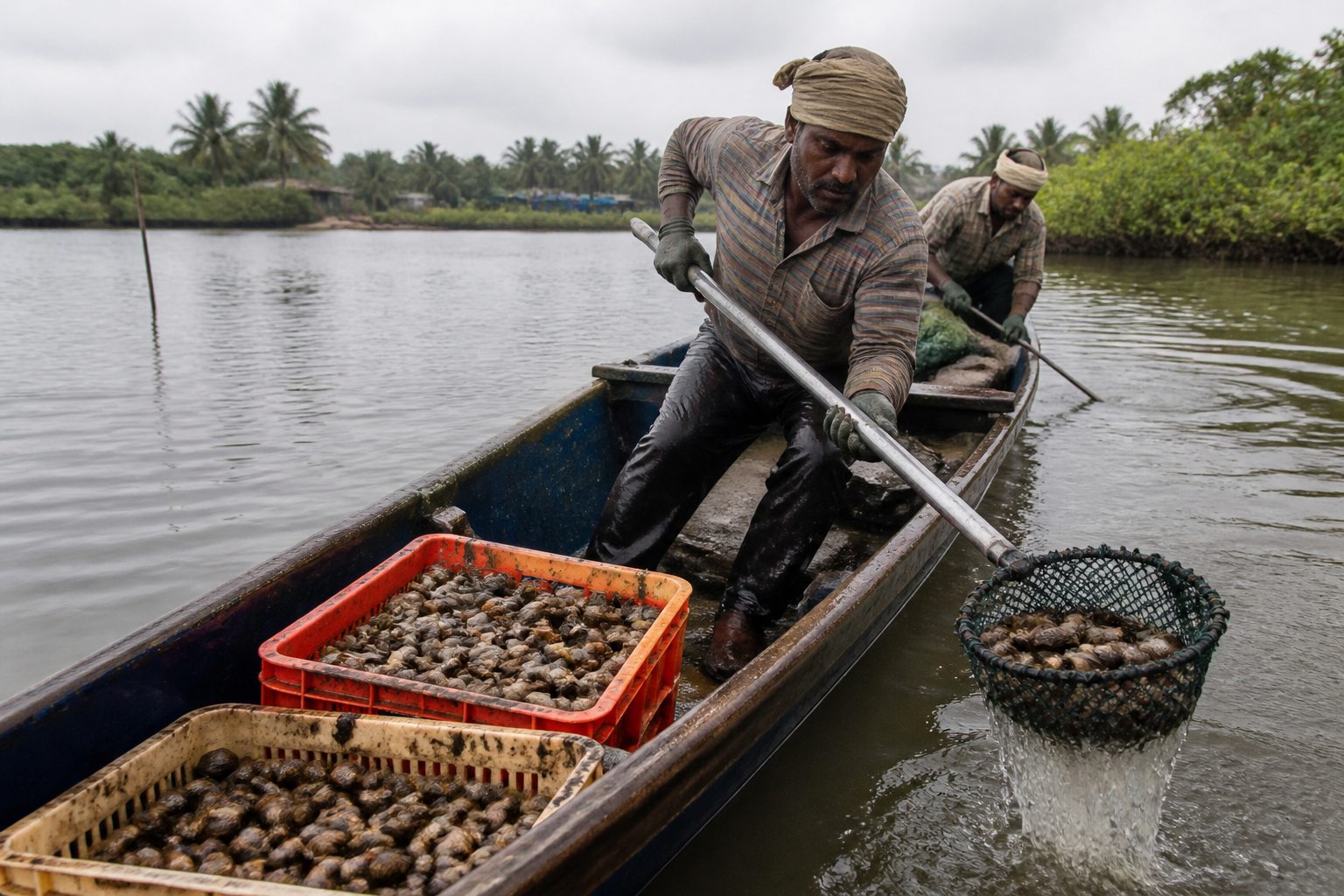
Clam harvesting in Vypin is drawing public attention, but the activity also reveals a less visible part of Kerala’s coastal economy: the network of workers, pond owners, processors, traders and hotels connected to brackish-water aquaculture. In the Kannanpillikkettu and Pathekhar areas of Vypin, workers from Muhamma, Kumarakom and Vaikom in Alappuzha district are collecting clams from shrimp-farming ponds, turning an unintended growth inside aquaculture infrastructure into a seasonal source of income and food.
The account published by Mathrubhumi – Kochi describes a system that is informal in appearance but organised in practice. Workers use small boats and attach a net to the end of an iron pipe. They identify areas where clams have accumulated, either by observing the water from the boat or by probing the pond bottom with the pipe. The workers call this method “vali kondulla kakkavaral”, or clam harvesting with a net. Once brought to the surface, the clams are washed repeatedly in the boat before being placed in boxes for transport.
The activity is permitted by pond owners because the clams are considered a hindrance to shrimp cultivation. At Kannanpillikkettu, the clam deposits are reportedly more than two feet thick in places. The report does not provide an estimate of the total area under harvesting, the volume collected, or the effect of clam accumulation on shrimp yields. It does, however, show how aquaculture ponds can support more than one economic use, particularly when the growth of one species becomes a problem for another.
## Vypin clam harvesting and the aquaculture landscape
Shrimp ponds are commonly understood through the primary crop they are designed to produce. In this case, the ponds are also functioning as sites of clam collection. That does not mean the two activities are formally integrated into a planned aquaculture model; the source describes clam harvesting as a response to an accumulation that interferes with shrimp farming. The distinction matters. The clam economy exists alongside shrimp cultivation, but is enabled by the management decisions of pond owners and the skills of workers who know where the shellfish are located.
This arrangement gives the ponds a second economic role without the report indicating that new land or separate infrastructure is required for clam collection. Small boats, nets, iron pipes, boxes and transport vehicles form the operational chain. After collection, the clams are sent to Vaikom and Alappuzha in larger vehicles. The movement of the catch therefore connects Vypin’s water bodies with processing and market locations beyond the immediate area.
The workers’ knowledge is central to this chain. The report says they can identify clam-rich areas while sitting in the boat. Where visual observation is insufficient, they probe the bottom with the iron pipe carrying the net. This is a form of occupational knowledge built through repeated engagement with the water body. It is not described as a mechanised or formally certified system, but it determines how efficiently workers can locate and collect the clams.
The source also notes that some local workers who have traditionally performed this work remain active in harvesting. At the same time, many of the workers arriving in the Vypin area come from Muhamma, Kumarakom and Vaikom. This combination of local experience and inter-regional labour movement is significant because it shows that the seasonal economy is not confined to one settlement. Workers travel to locations where the resource and permission to collect it are available.
## From pond to hotel kitchen
The clam trade extends well beyond the boat. According to the report, the shellfish are valued because clams growing in ponds used for fish farming are considered large and distinctive in taste. The report says they have strong acceptance on hotel tables. Their route from water to market involves sorting, cleaning, boiling or machine processing, meat extraction and transport.
Some facilities use special machines to separate the shell from the meat. Where such machinery is unavailable, workers boil the clams in large aluminium vessels over a stove. The boiling can continue for up to one and a half hours, after which the meat is separated from the shell. This processing stage is important to the economics of the trade because the weight of the raw shellfish does not translate directly into an equivalent quantity of edible meat.
The report gives a clear conversion figure: boiling 10 kilograms of clams produces only about one kilogram of meat. Clam meat is priced at an average of Rs 220 to Rs 250 per kilogram. These figures describe the value of the processed product, but the supplied account does not specify the purchase price paid to harvesters, the costs of fuel and transport, the wages of processing workers, or the margins earned by traders and hotels. Those missing details would be necessary to calculate how the final price is distributed across the supply chain.
The shells themselves are also widely sold, according to the report. This indicates that the material removed during processing is not treated entirely as waste. However, the source does not explain the destination or end use of the shells, nor does it quantify the share of earnings generated by shell sales compared with clam meat. The distinction between meat and shell markets remains an area requiring further reporting.
## A seasonal livelihood shaped by water management
The harvesting season described in the report began in the last week of September and is expected to continue until the end of October. December to February is identified as the main breeding season for clams. The timing suggests that the activity is shaped by both the availability of the resource and the seasonal calendar of the water bodies. The report does not state whether the end of the harvesting period is imposed by regulation, ecological practice, pond operations or customary arrangements.
This uncertainty is important. A breeding season mentioned in a local report is not, by itself, evidence of a formal conservation rule. Nor does the report establish whether clam collection during other periods is restricted. It records the operational season observed by the workers and pond owners, but not a wider management framework governing the resource.
Pond owner M.A. Radhakrishnan of Edavanakkad told Mathrubhumi that the work enables a labourer to earn a good daily income. The report does not state the exact daily earnings, the number of workers involved, or how income changes according to the size of the catch. Even without those figures, the account makes clear that clam harvesting is more than a visual attraction for visitors. It is an income-generating activity that depends on access to ponds and on the physical ability to work from small boats.
The role of pond owners is therefore central. They allow the workers to enter the ponds because the clams obstruct shrimp farming. This creates a practical exchange: workers gain access to a resource, while pond owners reduce the concentration of clams in production areas. The report does not describe a written agreement, fee arrangement or conflict-resolution system between the two groups. Those institutional details would determine how secure the livelihood is and how consistently workers can access the ponds.
## What the account reveals—and what it does not
The Vypin example offers a ground-level view of how coastal production spaces are used. A pond created or maintained for shrimp cultivation can simultaneously become a source of clams, seasonal employment and food for hotels. The system is connected through a chain of small boats, manual tools, processing vessels, machines, boxes and road transport. Its economic footprint is therefore larger than the harvesting scene visible from the shore.
At the same time, the available evidence is limited. It does not establish the total clam population, the ecological condition of the ponds, the effect of harvesting on water quality, or whether the collection method changes the pond bottom in ways that affect shrimp cultivation. It also does not provide information about licensing, food-safety controls, labour protections, insurance, market demand beyond the reported hotel acceptance, or the number of people dependent on the activity.
Those gaps should not obscure the central fact documented by the report: clam growth inside Vypin’s shrimp ponds has created a seasonal livelihood and supply chain involving workers from several parts of central Kerala. The process combines inherited knowledge with simple equipment and links a coastal water landscape to markets in Vaikom, Alappuzha and hotel kitchens.
The larger urban question is how such informal and semi-formal economies are counted in the planning of coastal settlements. The report presents the activity through its immediate details—workers in boats, clams gathered with nets, boiling vessels and transport vehicles—but those details point to a wider relationship between water management, rural-to-coastal labour movement, food processing and urban consumption. Further reporting would need to establish the scale of the trade, the terms under which workers access the ponds, the regulatory position of the breeding season and the environmental consequences of continued harvesting.
For now, the Vypin clam harvest confirms that aquaculture landscapes support layered economies. Their value is not limited to the crop for which a pond was originally prepared. It also lies in the seasonal work, processing activity and food networks that emerge around the water body when local knowledge and market demand meet an unintended resource.
