


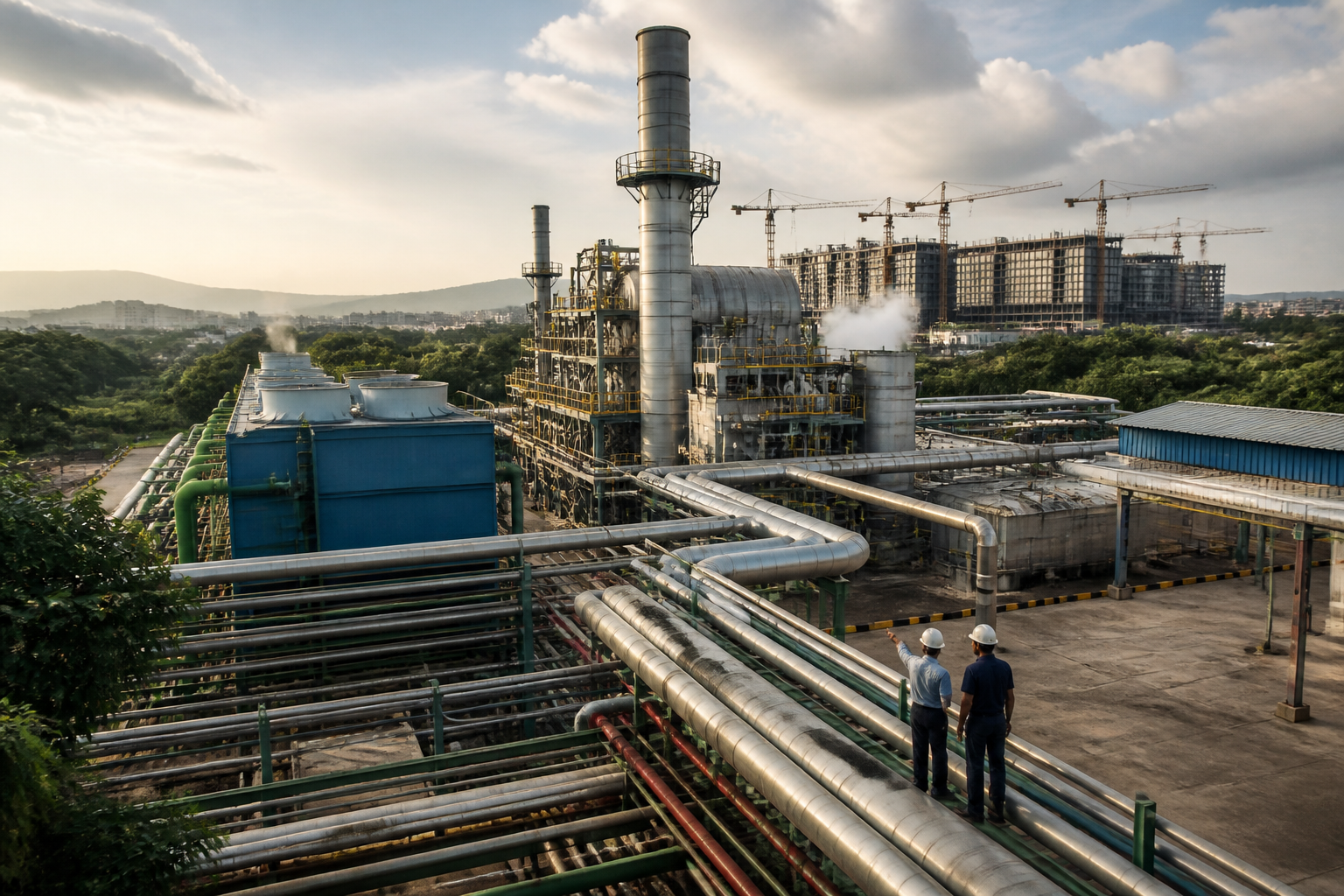
Thermax’s plan to raise revenue by about 22 per cent in FY27, to nearly ₹13,000 crore, is more than a company growth target. It provides a useful window into the changing systems behind India’s infrastructure expansion: data centres require dependable power and cooling, industrial facilities need water and wastewater solutions, and large projects increasingly depend on equipment suppliers that can manage both energy efficiency and execution risk.
The Pune-based engineering company supplies industrial boilers, power equipment, cooling systems and water-treatment solutions. Its reported ₹14,045-crore order book, up 23 per cent year on year, gives the company a substantial base for future revenue conversion. But the gap between a large order book and recognised revenue also reveals the operational challenge facing infrastructure suppliers: projects must be executed, equipment must arrive on time, and contracts must remain financially viable as costs change.
Thermax’s expected acceleration follows a slower FY26. Revenue grew 3.64 per cent during the year to ₹10,694 crore, while consolidated profit rose 15 per cent to ₹720 crore. Revenue in the June quarter increased 7 per cent to ₹2,303 crore. However, profitability was affected by a ₹91-crore cost revision on a legacy infrastructure project, underlining how fixed-price and long-duration contracts can expose engineering companies to inflation and execution risks.
Ashish Bhandari, Thermax’s Managing Director and CEO, told The Hindu BusinessLine that the company was becoming more selective about such contracts. That shift is significant for the infrastructure market because the commercial structure of a project can influence whether a supplier accepts, delays or reprices work. A project may be technically feasible and supported by demand, but rising input costs, delayed deliveries and changes in site conditions can still weaken the financial outcome for the contractor and equipment provider.
## Data centres are changing the equipment market
The strongest new demand signal in Thermax’s outlook comes from data centres. The company has secured two significant orders in the United States, including one worth more than ₹400 crore for boiler pressure parts and another for absorption chillers for facilities with captive power generation. These orders show how data-centre infrastructure extends beyond servers and buildings. Reliable electricity, heat management, backup systems and water-use controls are essential parts of the operating model.
For Indian cities, the data-centre connection matters because these facilities bring together several infrastructure pressures in one location. They require stable power, specialised cooling, water management and high standards of operational reliability. The source material does not establish the size or location of specific Indian data-centre projects, but it identifies domestic data-centre demand as one of the areas supporting Thermax’s expected FY27 growth.
The company is also seeing opportunities in hybrid cooling towers, water treatment, chemicals and wastewater recycling for semiconductor plants and other water-intensive industries. These requirements point to a broader shift in industrial infrastructure. As manufacturing becomes more resource-intensive and cities face competing demands for water, industrial systems that reduce freshwater dependence or improve recycling become part of the infrastructure conversation rather than a separate environmental add-on.
Thermax’s introduction of the UltraPac-i range of intelligent boilers and heaters adds an energy-efficiency dimension to this transition. The company says the product uses its EDGE Control technology to adjust to changing fuel characteristics and operating conditions. Pilot installations demonstrated fuel savings of up to 10 per cent, and the system can be retrofitted to suitable existing boilers. These are company-reported results, and the supplied material does not provide independent performance verification or details of the sites where the pilots were conducted.
## Growth depends on converting orders into working projects
The order book offers visibility, but it does not remove the implementation risks associated with infrastructure delivery. Thermax said geopolitical disruptions had delayed overseas equipment deliveries and domestic project execution. The company expects stronger revenue conversion as these bottlenecks ease, but the timing of that conversion remains dependent on procurement, logistics, site readiness and customer approvals.
That distinction is important in reading infrastructure-sector growth forecasts. A large backlog can indicate demand, but revenue is recognised only as work progresses. Delays can push expected income into later periods, while prolonged execution can increase costs and reduce margins. Thermax’s experience with the ₹91-crore legacy project cost revision illustrates how these pressures can persist after a contract has been secured.
The company’s financial position provides some capacity to manage this execution cycle. At the end of March, it held ₹2,467 crore in cash, bank balances and current investments against borrowings of ₹2,288 crore. Operating cash flow was ₹542 crore in FY26, reflecting higher project retention and lower customer advances. These figures suggest that working capital and cash conversion remain central to the company’s ability to expand, particularly when infrastructure projects require long delivery periods.
The estimates also show that the growth outlook is not uniform. Bhandari indicated that Thermax could reach nearly ₹13,000 crore in FY27, implying growth of about 22 per cent from FY26 revenue. PL Capital’s forecast is lower at ₹12,286 crore, or approximately 15 per cent growth. The difference does not establish which estimate will prove accurate, but it demonstrates the uncertainty involved in translating demand, orders and sector opportunities into annual revenue.
## Exports are becoming a larger part of the infrastructure strategy
International business is another important part of Thermax’s expansion. Overseas revenue rose 33.4 per cent to ₹3,084 crore in FY26 and accounted for about 29 per cent of total sales. Overseas orders represented roughly 30 per cent of the backlog. The company also said it was becoming systematically qualified with large Middle Eastern oil and gas companies after previously being ineligible for many of their major orders.
Qualification is an institutional barrier that is often invisible in headline infrastructure spending numbers. Suppliers may have products and technical capacity, but access to large projects depends on approvals, standards, prior experience, financial capability and customer-specific vendor processes. Thermax’s comments indicate that expanding internationally is not only about exporting equipment; it also involves building the credentials required to participate in major industrial ecosystems.
At the same time, a larger overseas share exposes the company to international logistics and geopolitical disruptions. The reported delays to equipment deliveries show how global supply chains can affect both domestic and international project schedules. For an infrastructure supplier, competitiveness therefore includes manufacturing capability, delivery reliability, contract discipline and the ability to manage external disruptions.
## The energy-transition opportunity remains operationally difficult
Thermax’s bio-CNG business illustrates the difference between a promising policy direction and a mature operating model. The company said the business had faced nearly three years of technological challenges involving agricultural residue, moisture management and gas purification. Bhandari said that scaling the process had involved substantial learning and that better government support for pricing and operational efficiency could help the business improve.
This experience reflects the complexity of converting waste and agricultural residue into a dependable commercial fuel. Feedstock quality, collection systems, moisture content, purification and plant-scale operations all affect performance. The source does not provide production volumes, plant-level economics or details of government support, so the business’s eventual contribution to revenue cannot be assessed from the available information.
The company’s priorities—energy transition, international competitiveness, innovation and stronger project execution—are therefore connected. Energy-efficient boilers, wastewater recycling, data-centre cooling and bio-CNG are different product and business areas, but each requires more than a technology sale. They require functioning supply chains, capable operators, stable project economics and customers willing to adopt or retrofit new systems.
The larger urban question is whether India’s infrastructure growth can be delivered with lower energy and water intensity while remaining financially and operationally reliable. Thermax’s outlook suggests that demand is emerging across data centres, power, industrial manufacturing, semiconductor-related facilities and water-intensive industries. It also shows that the next phase of growth will be tested by execution delays, contract structures, resource constraints and the ability to convert innovation into dependable performance.
What the available evidence confirms is a strong order pipeline, rising international revenue and a set of infrastructure-linked opportunities supporting Thermax’s FY27 target. What remains uncertain is the pace at which those orders convert into revenue, whether efficiency claims scale beyond pilot installations, and how quickly the company’s newer businesses overcome operational challenges. Those indicators will determine whether the projected growth represents a temporary order-cycle upswing or a durable shift in the infrastructure systems market.
