


Amazon, Flipkart and Myntra are using the Diwali shopping season to push rapid delivery beyond groceries, turning a familiar retail promise into a broader urban infrastructure contest. Their expansion into electronics, home products, fashion and gifting shows how Indian e-commerce is beginning to combine the reach of conventional marketplaces with the immediacy of quick commerce.
The shift is visible in the scale of the platforms’ festive plans. Amazon’s Great Indian Festival and Myntra’s Big Fashion Festival begin on October 8, followed by Flipkart’s Big Billion Days on October 9. But the important development is not simply the timing of the sales. It is the operational infrastructure being assembled to deliver a much wider range of products in minutes, on the same day or the next day.
Flipkart Minutes will offer more than 77,000 products across over 1,400 categories. Amazon is integrating Amazon Now into the Great Indian Festival for the first time, while Myntra’s M-Now is offering 1.5 lakh styles from 1,500 brands through rapid delivery. These figures indicate that quick commerce is no longer being defined only by convenience-store items and household staples. It is becoming a delivery layer that marketplaces can apply to categories traditionally associated with large warehouses, scheduled shipments and longer consideration periods.
That change has consequences for how urban logistics is organised. Conventional e-commerce depends heavily on large fulfilment centres and a distributed delivery network. Quick commerce relies on smaller micro-fulfilment centres placed closer to consumers, allowing orders to travel shorter distances. The festive push brings these systems closer together: marketplaces are retaining their broad catalogues while adding the localised inventory and rapid dispatch associated with quick commerce.
Amazon’s expansion illustrates the transition. Amazon Now, which began primarily with grocery, has added kitchen, dining, small appliances and some small furniture over the past three to four months. Aman Deep Lohan, Director, Home, Kitchen and Outdoors at Amazon India, told BusinessLine that products in these categories on Amazon Now are growing three-to-five-fold.
Amazon Now operates in about 120 cities through more than 800 micro-fulfilment centres and offers delivery in 10 to 15 minutes. Across Amazon’s wider network, more than one million products are available for same-day delivery and four million for next-day delivery. The distinction between these services is operationally important: rapid delivery requires inventory to be positioned near demand, while same-day and next-day fulfilment can depend on a larger regional network.
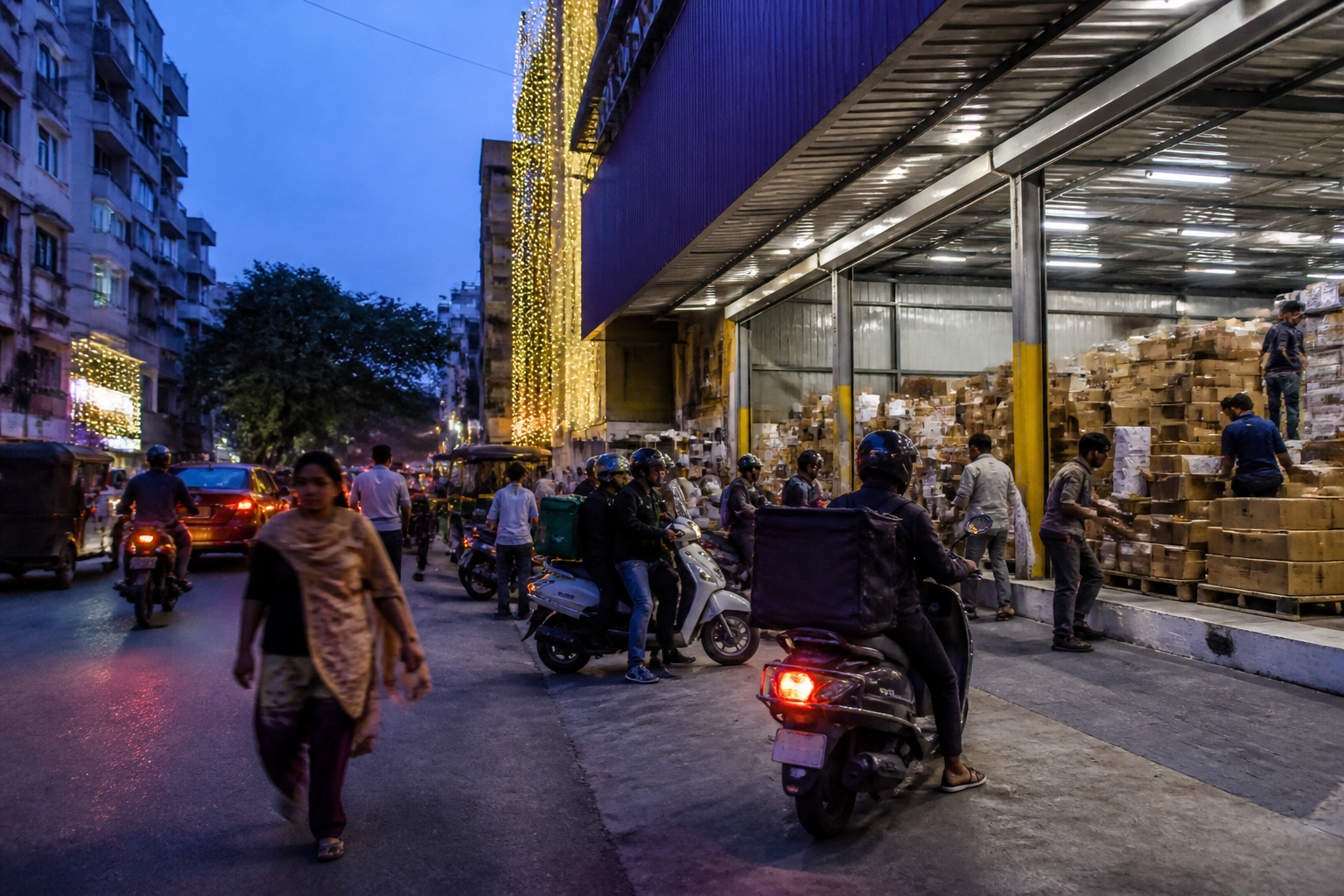
For cities, this means that the location of warehouses and fulfilment facilities is becoming as important as the size of the online marketplace. A product can be available digitally to millions of customers, but the promised delivery time depends on whether it is stocked close enough to the buyer and whether the last-mile network has enough capacity. The growth of micro-fulfilment centres therefore changes the physical geography of retail, moving part of the shopping system into neighbourhood-scale logistics spaces.
Flipkart’s numbers point to a similar expansion. Flipkart Minutes has grown fourfold year on year and now reaches more than 150 cities and 9,000 PIN codes through nearly 1,200 micro-fulfilment centres. Its festive assortment includes groceries, premium electronics, fashion and gifting. The company has also added 14 million cubic feet of warehousing, increasing storage capacity by 50 per cent, and more than 900 delivery hubs.
The wider Big Billion Days assortment is reported at 150 million products. Flipkart Group CEO Kalyan Krishnamurthy described the company’s digital commerce network as infrastructure and cited 500 million registered customers and 1.4 million sellers. That claim is supported in the report by the scale of the physical network: more than 8,200 fulfilment and delivery facilities across the company’s operations.
The numbers also show that rapid delivery is not replacing conventional e-commerce. It is being layered on top of it. A large marketplace still requires extensive storage, sorting, inter-city movement and seller integration. Quick commerce adds a more localised system for selected products and locations. The result is a hybrid model in which the same company can offer a very large catalogue while attempting to make a growing portion of that catalogue available almost immediately.
Myntra’s experiment is particularly significant because fashion is a discovery-led category rather than a routine replenishment category. M-Now will offer 1.5 lakh styles across 12 cities, with delivery beginning in 30 minutes. At the same time, Myntra’s Big Fashion Festival assortment has doubled to more than eight million styles, with 21,000 emerging brands and labels participating.
The operational challenge is different from grocery delivery. Fashion inventory involves multiple sizes, colours, styles and seasonal preferences. Making it available quickly requires not just proximity but accurate inventory visibility and a delivery network capable of handling returns and exchanges. The supplied report does not provide performance data on these aspects, but Myntra’s decision to test rapid delivery in fashion indicates that the platform believes immediacy can be extended to a category where customers traditionally browse, compare and wait for delivery.
The festive season is therefore functioning as a large-scale test of urban logistics capacity. Amazon has added 20 fulfilment centres and 150 last-mile delivery centres. Flipkart’s network now spans more than 8,200 fulfilment and delivery facilities. Myntra says faster deliveries cover 98 per cent of its serviceable PIN codes. These investments are not limited to promotional campaigns; they expand the underlying capacity that platforms can use beyond the festival period.
The timing adds another layer to the competition. By beginning their major sales a month before Diwali, the platforms are extending the period in which they can capture festive demand. This creates a longer operating window for warehouses, delivery hubs and micro-fulfilment centres. It also makes logistics performance a sustained competitive factor rather than a final-week requirement.
The institutional structure behind this system is distributed across companies, sellers, warehouse operators, delivery hubs and local facilities. Marketplaces control the customer interface and much of the inventory coordination, while sellers supply the products and logistics networks move them through different layers of fulfilment. The report does not identify specific municipal permissions, land-use arrangements or labour conditions for the new facilities. What it does establish is that the physical network is expanding rapidly and is being treated by the companies as a core part of their retail proposition.
This expansion also changes the meaning of access in smaller markets. Flipkart Minutes now reaches more than 150 cities and 9,000 PIN codes, while Amazon Now operates in about 120 cities. The companies are not limiting rapid delivery to the largest metros. Their networks indicate an attempt to extend faster fulfilment into a wider geography, although the supplied material does not establish whether product availability or delivery times are uniform across locations.
For consumers, the immediate promise is convenience and faster access to a larger range of goods. For sellers and emerging brands, the networks could provide more routes to customers during the most important shopping period of the year. For cities, however, the expansion creates a less visible layer of activity: more inventory stored closer to neighbourhoods, more sorting and dispatch points, and more movement by delivery vehicles through already dense urban areas.
The report does not provide data on traffic, emissions, delivery-worker conditions, rents or the effect on local retailers, so those questions cannot be resolved from the festive announcements alone. Nor does it establish whether rapid delivery will be economically sustainable across all product categories. The evidence does show that the platforms are committing physical capacity and extending the model beyond its original grocery focus.
The larger urban question is whether India’s cities are prepared for retail systems in which speed depends on a dense network of facilities embedded within or near residential markets. The answer will depend not only on consumer demand but also on how warehouses, delivery hubs and micro-fulfilment centres interact with land, roads, labour and local governance. Those systems are becoming part of the built environment of consumption, even when customers experience them only through an app.
The Diwali push confirms a structural change in Indian e-commerce: the marketplace is no longer competing only on assortment and discounts. It is competing on the physical ability to place products closer to consumers and move them faster. What remains uncertain is how far the model can extend beyond the festive season and how its urban costs will be measured. The next indicators to watch are the durability of the new facilities, the categories that retain rapid-delivery demand and the extent to which the networks continue expanding into smaller cities.

