


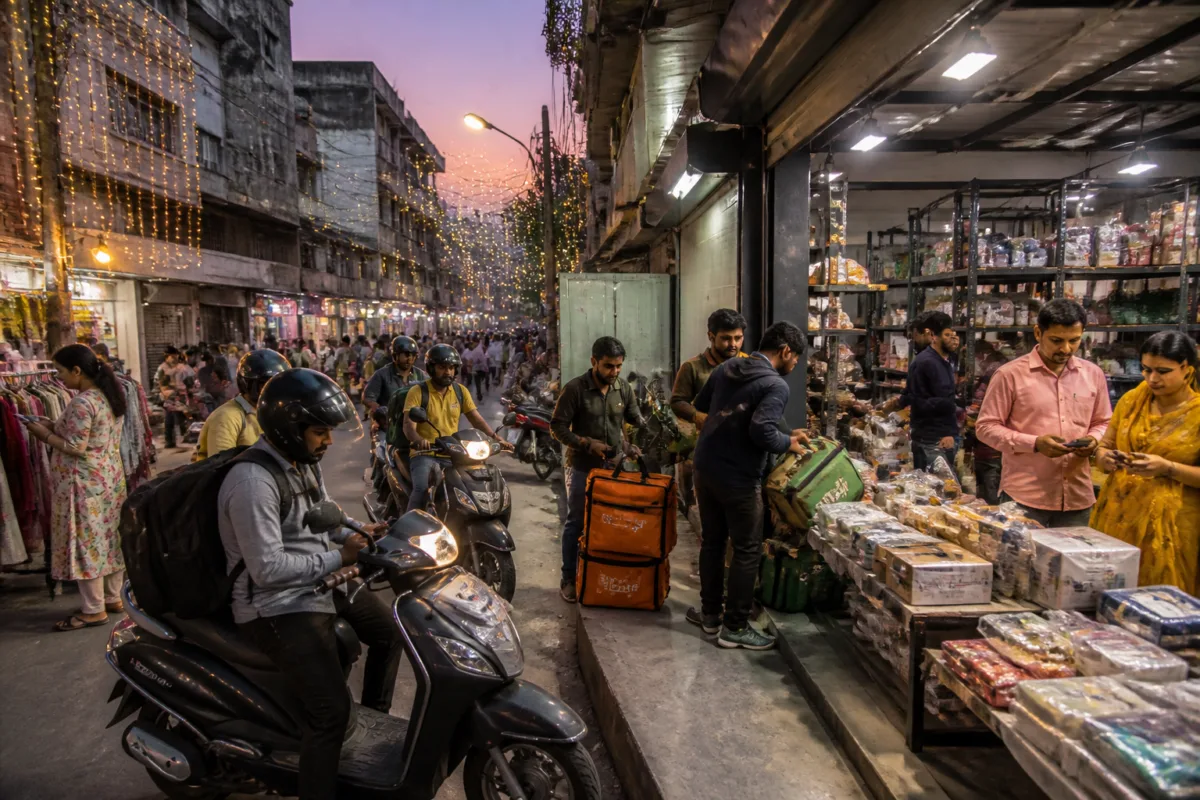
India’s online festive sales grew by 13-15% around Diwali, below the 20-25% increase expected by the industry and reportedly the weakest growth in five years. But the slowdown was not uniform. High-value electronics lost momentum, while smaller cities, fashion, grocery, quick commerce and low-priced products gained importance, revealing a consumer market that is becoming broader but more cautious.
The figures, reported by Aaj Tak Business, point to a change in the composition of demand rather than a simple collapse in festive shopping. Online orders rose by 10-15%, yet the value of sales grew more slowly because consumers shifted towards cheaper products. This distinction is important for e-commerce companies: higher order volumes do not necessarily translate into stronger revenue quality or easier profitability.
The report says online festive sales recorded a gross merchandise value growth of 13-15% this year. The industry had expected growth of 20-25%. In 2025, festive-season online sales were estimated at around Rs 1.2 lakh crore, representing annual growth of 25%. The comparison suggests that this year’s market expanded, but at a markedly slower pace.
One explanation cited in the report is the difference in the pricing environment. Last year, a reduction in Goods and Services Tax rates provided some relief to shoppers. This year, higher input costs and rising prices placed greater pressure on household budgets. Companies also found it harder to offer the deep discounts that had helped drive earlier festive campaigns.
That pressure was most visible in smartphones and electronics, categories that traditionally account for a substantial share of festive online spending. Smartphones represented 24-25% of total festive gross merchandise value this year, down from 35.2% last year, according to the figures cited by Aaj Tak Business. Discounts on smartphones, laptops and large electronic goods were reportedly 35-40% lower than in the previous year.
The report links smartphone price pressure partly to a shortage of memory chips. As expensive devices became costlier, some consumers appear to have postponed purchases. Bank offers and equated monthly instalment schemes also failed to attract customers as strongly as they had previously. This suggests that financing can support demand, but it cannot fully offset a rise in the underlying price of a product.
The shift has consequences beyond e-commerce sales charts. Smartphones, laptops and large appliances are high-value purchases that can lift the total value of a shopping season even when the number of orders remains limited. When these categories weaken, companies may record more transactions without achieving the same gross merchandise value. The market then becomes more dependent on lower-priced, higher-frequency consumption.
## Online festive sales move towards lower-value baskets
The report identifies grocery and fashion as two of the categories that benefited from this change. Grocery sales grew by around 40%, while fashion discounts increased from an average of 34% to 46%. The average fashion order value, however, was about Rs 1,643. That combination—more orders, greater discounts and a relatively modest basket size—shows why volume growth can coexist with pressure on margins.
Consumers were not necessarily withdrawing from online shopping. They were reallocating spending. Instead of buying a premium smartphone or a large appliance, they appeared more willing to purchase lower-priced products, fashion items, groceries and festive goods. The data supplied in the report does not establish whether this was caused primarily by lower disposable income, higher prices, weaker consumer confidence or a combination of these factors. It does, however, show a clear difference between order growth and value growth.
This is also a story about the geography of consumption. Online shopping is expanding beyond India’s largest metropolitan markets. During Amazon’s festive sale, the company recorded 3.93 billion visits, with more than 70% of customers reportedly coming from outside metro cities. The figure was presented by the company and is not independently assessed in the supplied report, but it reflects the growing importance of smaller cities in the online retail network.
The smaller-city trend is particularly visible in electronics. The report says that equated monthly instalments accounted for around 50% of mobile, television and appliance purchases in smaller cities during the festive period. This indicates that demand for expensive goods exists outside the metros, but access to that demand is closely tied to financing. For retailers and platforms, the opportunity is therefore linked not only to product availability but also to credit, delivery and after-sales service.
The rise of smaller cities changes the operational map of e-commerce. A sale made outside a metro may require longer transport routes, different warehouse locations and more complex last-mile delivery. The supplied report does not provide details on logistics costs by city tier, so the precise profitability of this expansion cannot be established here. It does say, however, that delivery costs, higher fuel prices and increasing fashion returns placed pressure on company expenses.
That cost structure creates a tension at the centre of the market. Platforms need to reach more customers in smaller cities and offer prices attractive enough to convert them. At the same time, longer delivery distances and higher service costs can reduce the value of each order. The growth of lower-priced products intensifies that problem because the revenue available to absorb fulfilment and returns costs is smaller.
## Quick commerce changes the festive retail map
The report also highlights the growing role of quick-commerce platforms during the festive period. Zepto and Swiggy Instamart reported selling more than 14,000 gold and silver coins every hour on Dhanteras. The platforms also estimated that more than 75% of grocery and festive-gifting sales shifted to quick commerce. These figures are company claims cited in the report, rather than an independently verified market-wide measurement.
Even with that limitation, the category mix is significant. Quick commerce is commonly associated with grocery and urgent household purchases, but festive demand is expanding its role into gifting and traditional seasonal purchases. The sale of gold and silver coins through rapid-delivery platforms shows how digital retail is being inserted into occasions that were once closely linked to neighbourhood markets, jewellers and physical shopping streets.
This does not mean that physical retail has disappeared. The supplied material focuses on online sales and does not provide comparable data for brick-and-mortar stores. It does show that consumers are using multiple channels: large e-commerce platforms for planned purchases, fashion marketplaces for discounted products and quick-commerce services for immediate or time-sensitive needs. The festive market is therefore becoming more fragmented by product type, price and delivery expectation.
For cities, this fragmentation has a practical dimension. A larger online retail system requires warehouses, sorting facilities, delivery workers, road access and dense networks of local fulfilment points. The report does not quantify the infrastructure footprint of festive e-commerce, but its figures point to a retail economy increasingly dependent on urban and peri-urban logistics. The shift from large-ticket shopping to frequent, low-value orders may increase delivery activity even when total sales growth slows.
That model also puts pressure on labour and operating costs. The report cites higher delivery expenses, more expensive petrol and diesel, and rising fashion returns as factors affecting profitability. Companies avoided passing all cost increases to consumers during the festive period, but the report suggests that higher prices for FMCG and other consumer products could appear in December or January. This is presented as a possible business response in the source, not an established outcome.
## What the sales data confirms—and what it does not
The available figures confirm four broad movements. First, online festive sales continued to grow but at a slower rate than expected. Second, smartphones and electronics lost share of the total value of sales. Third, lower-priced categories such as grocery and fashion gained order momentum. Fourth, smaller cities and quick-commerce platforms became more visible in the festive retail system.
The figures do not establish a complete picture of household consumption. There is no detailed income-wise breakdown, no city-level comparison, no independent assessment of the company-reported traffic and coin-sales figures, and no information on whether postponed electronics purchases will return later. Nor does the report provide a consolidated profitability figure for the industry. Those gaps matter because sales growth, order growth, gross merchandise value and profit measure different parts of the retail economy.
The central urban question is therefore not whether Indians have stopped shopping online. The evidence points instead to a more selective form of digital consumption. Buyers are still active, but they are weighing prices more carefully, using instalment finance for expensive products and shifting some spending towards smaller baskets and immediate-delivery categories.
For e-commerce companies, the festive season has exposed the limits of a strategy built mainly around premium electronics and deep discounts. For smaller cities, it has confirmed growing participation in the digital retail economy, while also showing the importance of financing and delivery networks. For urban infrastructure, it reinforces the need to understand retail not only through malls and high streets, but also through warehouses, fulfilment centres and last-mile movement.
The evidence supplied in the report supports a picture of transition rather than retreat. Online festive sales are still expanding, but the value of growth is moving away from premium electronics towards frequent, lower-priced and geographically dispersed consumption. Whether this shift becomes a lasting pattern will depend on prices, household budgets, financing costs, logistics expenses and the ability of platforms to serve smaller cities without eroding margins.

