


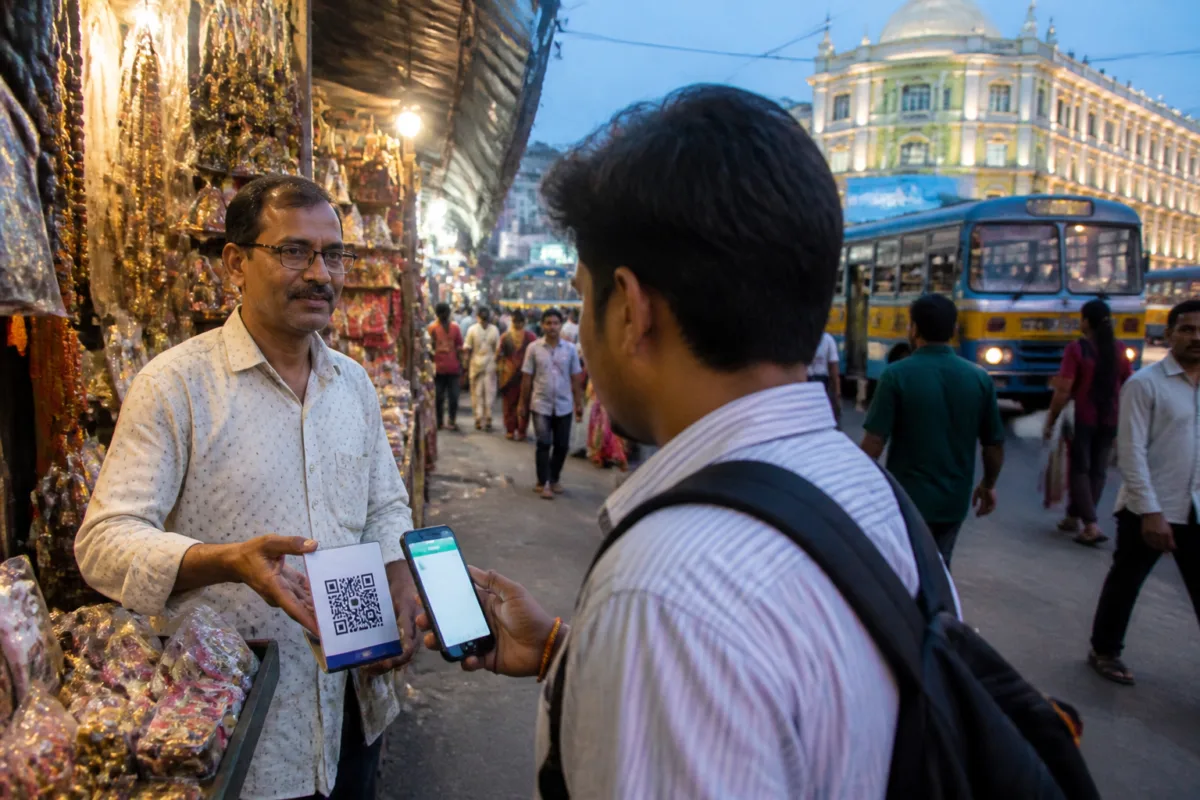
The story of UPI digital payments is no longer only a story about replacing cash at shops. It is a story about how shared technological infrastructure, regulation and institutional coordination can create a payment system used at a national scale. A book launched in Calcutta on Saturday has now documented that journey, at a moment when UPI is reported to have more than 55 crore users and is processing more than 80 crore transactions a day.
Cashless Nation, authored by Santanu Paul and B. Sambamurthy, traces the multi-decade process that culminated in the creation of the Unified Payments Interface. Its launch at Bengal Club brought together former administrators, financial-sector leaders and people closely associated with the development of India’s payments infrastructure. The event therefore offered more than a discussion around a new publication: it brought together several perspectives on how a national digital system was built, regulated and expanded.
The figures cited at the launch show the scale of the system. The Centre said in July that UPI had more than 55 crore users. National Payments Corporation of India data for October 2026, as cited in the report, showed more than 80 crore transactions a day. Ashok Lahiri, vice-chairman of NITI Aayog and the chief guest at the launch, said UPI was approaching one billion transactions per day. These are different measures of scale, but together they indicate the extent to which digital payments have become part of everyday economic activity.
The more important institutional question is how that scale was made possible. Lahiri identified four features: scalability, shared technological infrastructure, freedom of choice and the principle of public good. These features distinguish UPI from a payment product operated only as a private commercial service. The system’s growth, as described at the launch, was linked to an infrastructure that allowed multiple participants to connect to a common framework while retaining choice in how they accessed and used digital payments.
That arrangement matters because payment systems sit beneath many urban activities. A transaction at a neighbourhood shop, a payment made by a small merchant or a digital transfer between individuals all depend on systems that are largely invisible to the user. When those systems work, the interface may appear simple. The underlying structure, however, involves standards, participating institutions, regulation, authentication and the ability to process large volumes reliably. The book’s central subject is therefore also a story about the often unseen infrastructure of the urban economy.
The launch discussion connected UPI’s present scale to earlier moments in the construction of that infrastructure. Basudeb Banerjee, former chief secretary of Bengal, recalled November 8, 2016, when Prime Minister Narendra Modi announced demonetisation in a televised address. Banerjee was Bengal’s chief secretary at the time and recalled meeting chief minister Mamata Banerjee the following day, when she decided to stage a protest at the Reserve Bank of India’s headquarters in Calcutta.
That recollection places the development of digital payments within a period of exceptional disruption. The report does not establish that demonetisation alone created UPI or explain the precise contribution of each policy decision to its later growth. It does, however, show how the political and administrative experience of 2016 formed part of the public memory surrounding India’s move towards digital payments. The episode also illustrates that payment infrastructure is not separate from governance: decisions made by governments, central banks and administrators can quickly affect how citizens and businesses transact.
The figures on merchants provide another way to understand the reach of the system. Paul said India had 10 crore merchants, of whom 6.5 crore had UPI acceptance. He described this as two-thirds of the way towards universal merchant acceptance, while saying that the country was halfway towards universal user participation. The figures were presented as part of his assessment of the distance still to be covered, rather than as evidence that the transition is complete.
This distinction is important. A large number of users and transactions does not mean that every resident, business or locality participates in the same way. The supplied report does not provide a breakdown by income, age, geography, gender, business size or connectivity. It also does not state how many people use UPI exclusively, how frequently individual users transact or how merchant acceptance is distributed across formal and informal businesses. The available numbers establish scale, but they do not by themselves describe equality of access or quality of experience.
The difference between user accounts and actual use is also relevant. The report cites both more than 55 crore users, as stated by the Centre, and half a billion UPI user accounts, as cited by Paul. Those figures are broadly similar but are not necessarily identical measures. The material supplied does not explain the methodology behind either number. Likewise, the report cites more than 80 crore transactions a day in October 2026 and Lahiri’s statement that UPI was approaching one billion daily transactions. These figures should be read as indicators of rapid expansion, while the precise relationship between them is not established in the report.
The institutional architecture described at the launch combines innovation and regulation. Paul said he approached the book from the perspective of innovation, while Sambamurthy brought the perspective of banking, compliance and regulation. Paul compared the two to an accelerator and brakes in a car, arguing that the book required both viewpoints. The analogy captures a central tension in any large public-facing digital system: expansion creates value only when it is accompanied by rules, oversight and operational discipline.
Sambamurthy’s background is significant in this context. He is described as a career banker, former chairman of Corporation Bank and former chairman of the NPCI. Paul is described as a technocrat, entrepreneur and researcher, a public interest director at the Bombay Stock Exchange and former chairman of the NPCI Innovation Council. Their involvement connects the book to institutions that helped shape the payments ecosystem, while their differing perspectives underline that UPI’s development was not simply a software exercise.
The report also presents UPI as part of India’s external economic and technological engagement. Sambamurthy said UPI had placed India at the top table of global payment systems and that the technology was being exported to several countries. He said it was being given to foreign central banks as a goodwill gesture. The report does not identify those countries, specify the arrangements or detail the technical and institutional conditions attached to such transfers. What it does establish is the ambition to treat the system as a form of public technological capability with relevance beyond India’s borders.
That claim changes the meaning of the UPI story. It is not only about the convenience of scanning a code or transferring money through a mobile phone. It is also about whether a country can build a common digital layer that supports large numbers of competing participants and then present that layer as a model for other public institutions. Lahiri’s emphasis on shared infrastructure and public good points to the same idea: the value of the system lies partly in the network created around it, not only in any single application or company.
For cities, the merchant numbers are especially important. Urban commerce depends on millions of small exchanges, many of which occur outside large organised businesses. A payment system that reaches 6.5 crore merchants can alter how transactions are recorded, settled and accessed, even though the supplied material does not quantify those effects. It can also bring questions of regulation and resilience closer to street-level commerce. The report does not provide evidence on failed transactions, service outages, fraud, fees or access barriers, so those issues cannot be resolved from the launch discussion alone. They remain part of the wider institutional questions raised by the system’s scale.
The evidence in the supplied report therefore supports a measured conclusion. UPI has achieved extraordinary reach, with more than 55 crore users cited by the Centre, 6.5 crore merchants said to accept UPI and more than 80 crore daily transactions reported for October 2026. Senior figures associated with public policy, banking and the NPCI attribute that expansion to a combination of scalable technology, shared infrastructure, choice and public-purpose design. At the same time, the material does not establish that participation is universal or evenly distributed, nor does it provide enough detail to assess the system’s operational performance across different users and locations.
The book launch in Calcutta has brought those two sides together: the achievement of scale and the unfinished work of understanding what that scale means. The next stage of the UPI story, as indicated by the figures and statements presented at the event, will be defined not only by whether transactions approach one billion a day, but by how the system’s institutions document participation, reliability and access. Those are the questions that determine whether digital payments function merely as a widely used technology or as durable public infrastructure.

