


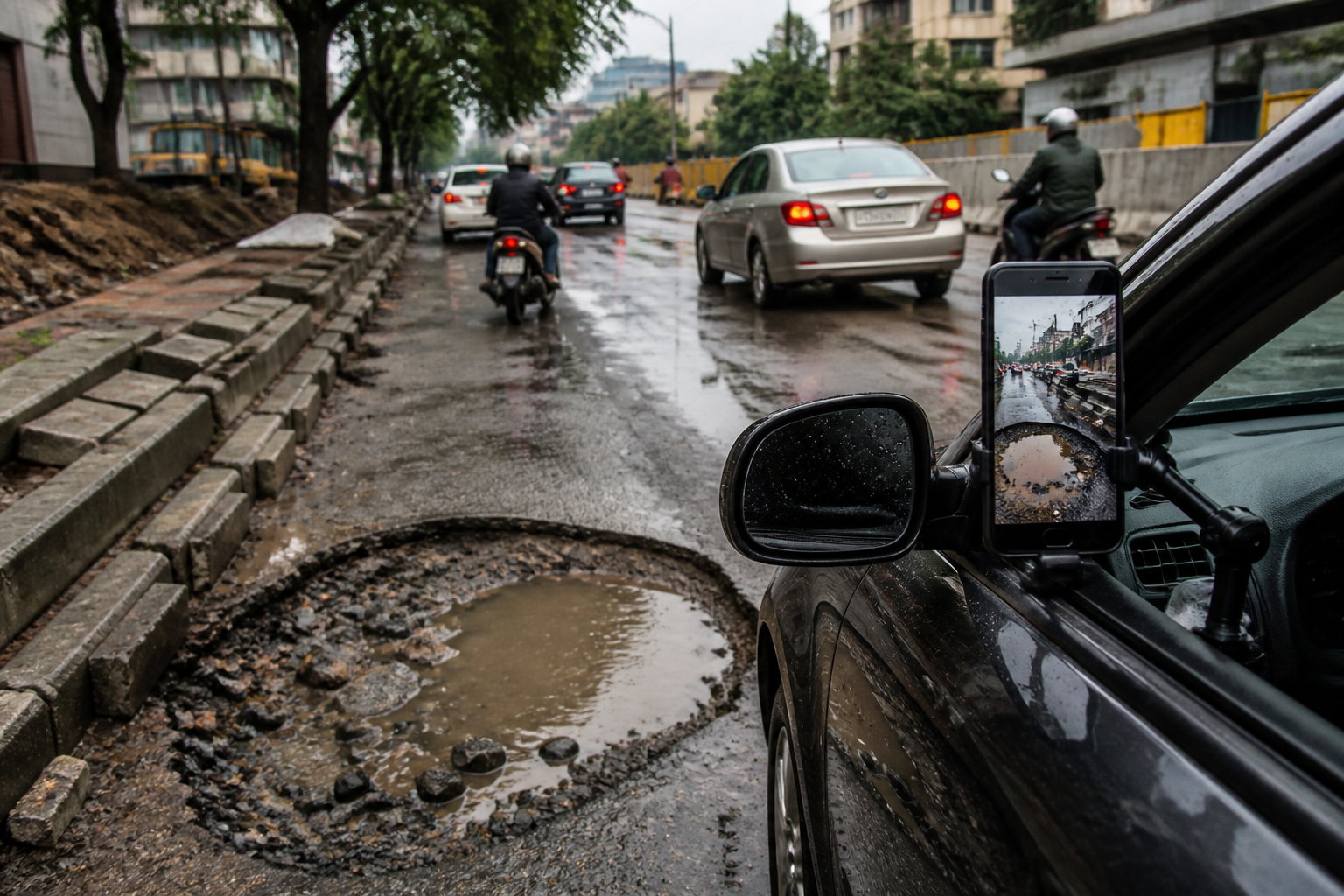
Potholes are easy to photograph but difficult to govern. Bengaluru engineer Gaurav Sen’s Pothole Reporter, an AI-powered Android app now available to the public, attempts to close that gap by detecting damaged road surfaces, locating them and identifying the municipal body and likely contractor responsible. Its significance lies less in the novelty of using artificial intelligence to recognise potholes than in what happens after a complaint is made: whether it reaches the right authority, enters an official workflow and can eventually be linked to the contract that financed the road.
That challenge has become more visible as utility and pipeline excavation by the Bangalore Water Supply and Sewerage Board has left stretches of Bengaluru’s roads damaged, according to the report. The result described by motorists includes broken footpaths, uneven road surfaces and repeated potholes. A pothole-reporting application cannot repair those roads by itself. It can, however, expose the administrative chain between a defect appearing on the street and an agency being expected to fix it.
Sen, a 33-year-old software engineer and founder of the upskilling platform AIEngg, built Pothole Reporter after encountering pothole-ridden roads while driving. The Android beta version entered Google Play’s testing track on September 21 with about 200 testers and was subsequently made available to the public. The code had been published on GitHub on August 18 and had been updated more than 200 times by the time of the report.
The app operates through two modes. It can capture individual photographs of a road or continuously photograph the route in a Drive mode. A vision model examines each frame for potholes. The application then maps the location to the responsible municipal body and matches the reported defect against publicly available road contracts to identify a likely contractor. The complaint includes the location, an image, the pothole’s dimensions and the relevant tender number before being sent by email to the concerned municipal commissioner.
This workflow reflects a basic weakness in many civic complaint systems: identifying a problem is not the same as assigning responsibility for it. A photograph may show the condition of a road, but a useful administrative record also needs a location, an accountable authority, a repair obligation and a way to establish whether the work was completed. By attempting to attach tender information to a pothole report, Pothole Reporter is designed to make the complaint more specific than a general notification about a damaged street.
The system is deliberately cautious about detection. Sen said the app is designed to report potholes only when the model assigns them high confidence scores. That approach may miss some defects, but it is intended to reduce false reports. He built the first version using OpenAI’s Codex for coding and OpenAI vision models for pothole detection, while an in-house detection model is being developed to reduce running costs. He also said the technical tools make it possible for people without prior coding experience to build similar applications.
The limits of automation become clear at the point where the complaint leaves the app. Since August, Pothole Reporter has recorded 100 complaints and shared them with commissioners of Bengaluru’s South, North and Central city corporations, according to Sen. The Integrated Command and Control Centre asked for a demonstration, which took place on August 24. Sen also participated in a Greater Bengaluru Authority citizen consultation on Sahaaya 3.0, the civic grievance portal, on September 9.
The most important institutional request to emerge from those interactions is for application programming interface access to Sahaaya. At present, Sen said, the absence of an API means that Pothole Reporter can draft an email but cannot directly push a complaint into the civic grievance system. Direct integration would change the app’s role. Instead of operating as an external reporting layer that depends on an official reading an email, it could become a structured intake tool within the authority’s own system, subject to whatever validation and workflow rules the civic body applies.
That distinction matters because email is a weak endpoint for a citywide maintenance process. An email can carry evidence, but it does not necessarily create a public status record, assign a deadline, show the responsible officer or confirm completion. The report does not establish that Sahaaya currently provides all those functions either. It does show, however, that the app’s creator sees integration with the official grievance platform as the next step rather than treating a privately built dashboard as a substitute for municipal administration.
The same issue appears in the relationship between roads and public contracts. Sen’s proposal is that every repair should be linked back to the contract that paid for the road. The app’s attempt to identify a likely contractor from publicly available tender records points towards that model, but a likely match is not the same as a confirmed contractual liability. Establishing responsibility would still require the authority to examine the tender, work order, maintenance terms, site conditions and the history of excavation or repair at that location. The supplied report does not say that the app independently verifies those matters.
This is particularly relevant in a city where several agencies can affect the same road. The report attributes much of the recent damage to BWSSB utility and pipeline excavation, while the application maps complaints to the responsible municipal body and searches public road contracts for a likely contractor. That combination illustrates the administrative complexity behind a seemingly simple pothole. The agency that opens a road, the authority responsible for the surface, the contractor that executed the work and the body receiving the complaint may not be the same entity.
A digital complaint system can make those relationships more visible, but it cannot resolve overlapping mandates without institutional cooperation. The effectiveness of Pothole Reporter will therefore depend on whether civic authorities accept the data, verify the location and defect, route it to the correct agency and record the outcome. In the current arrangement described by Sen, the largest blocker is precisely this response from the authority: the app can prepare and forward the complaint, but the relevant authority is expected to act on it.
The proposal to combine Pothole Reporter with NammaKasa, an AI-powered platform created by Jyothish VM to report garbage blackspots, expands the question beyond roads. Both potholes and garbage complaints require a photograph, a location, identification of the relevant authority and a record of whether the problem was fixed. Sen and Jyothish have discussed creating a single civic complaint and observability platform in which citizens and officials could see complaints on one map and track their status.
The common platform idea is significant because city services are often experienced as a connected street-level system rather than as separate departmental databases. A damaged road may be associated with excavation, uncollected waste, blocked drains or footpath obstruction. Yet each issue can be routed through a different institutional channel. A shared record could make it easier to see the accumulation of unresolved problems, although the report does not establish that such a platform has been built or adopted by any authority.
Pothole Reporter has also received requests from West Bengal, Andhra Pradesh and Bihar, according to Sen, and is designed to work across India. The application’s geographic reach is not the same as integration with state or municipal systems. Each city or state would need its own authority mapping, grievance platform, contract records and administrative agreement. The experience in Bengaluru suggests that the harder part of scaling may not be detecting the defect but connecting the detection to the public institution responsible for acting on it.
The app’s development also highlights a change in the economics of civic technology. Sen said the basic application was built in a day, with the fundamentals working within an hour and a complete model created in about six hours. That does not mean a reliable municipal system can be built in the same time. Detection accuracy, data protection, system maintenance, authority integration, verification and public accountability remain separate requirements. But low-cost development tools can reduce the barrier to creating prototypes that expose gaps in existing systems.
The evidence in the report points to a clear division between visibility and resolution. Pothole Reporter can make a road defect visible, attach a photograph and location, and search public records for a possible contractual link. It has already generated 100 complaints and engaged with civic institutions. What remains unresolved is whether those complaints enter a formal workflow, how quickly they are acted upon, how responsibility is determined when multiple agencies have worked on a road, and whether citizens can see the final outcome.
That unresolved link is the larger urban question. Bengaluru does not merely need more ways to report damaged roads; it needs complaint systems that connect street-level evidence to administrative responsibility and verified closure. AI can assist with detection and classification, but repair accountability still depends on public agencies, official records and institutional responses. Pothole Reporter’s next test will therefore be its proposed integration with Sahaaya and the authorities’ ability to turn a well-documented complaint into a completed and traceable repair.
