


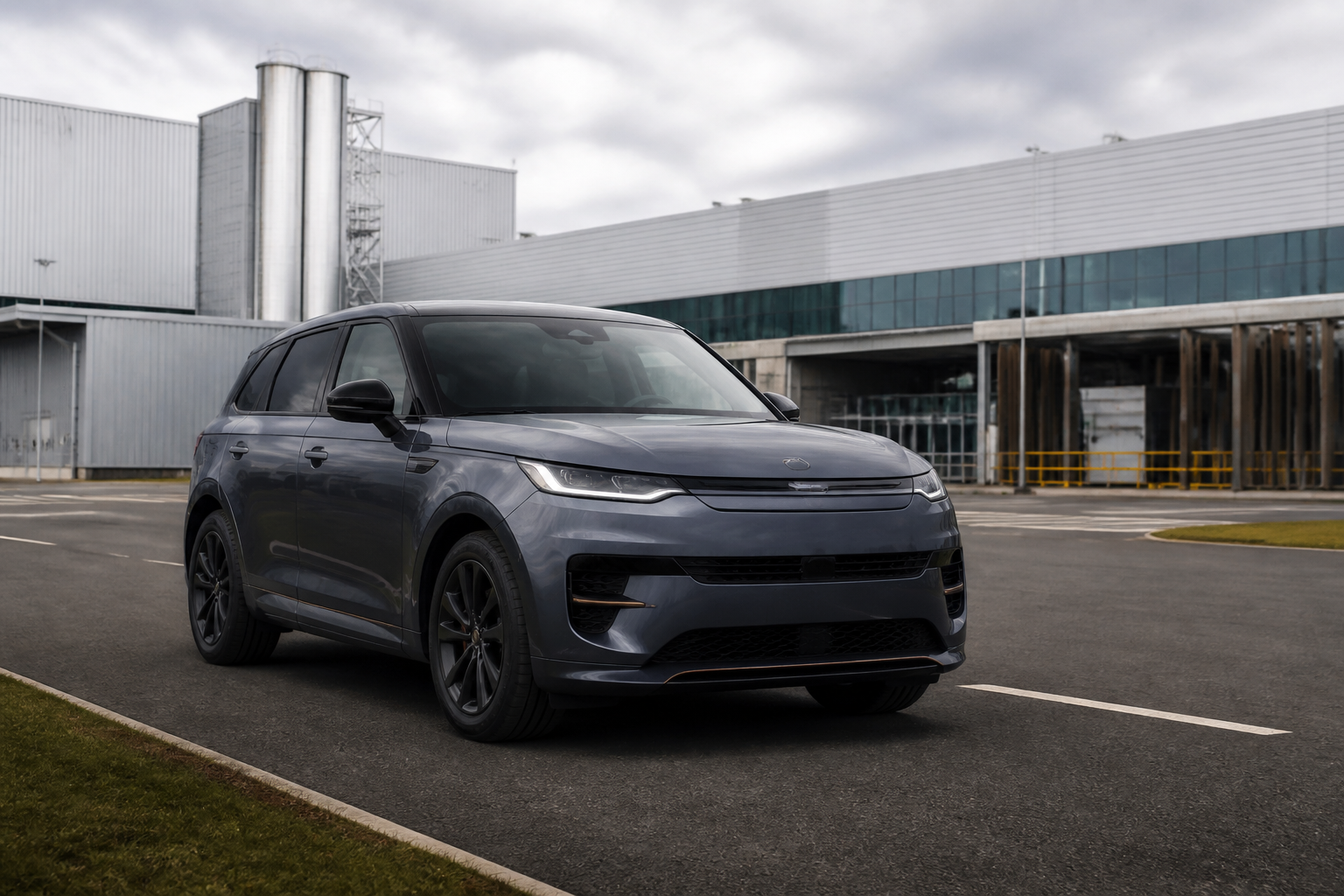
Jaguar Land Rover’s opening of India bookings for the Range Rover Sport Electric is more than the arrival of another luxury battery-powered SUV. It is a test of whether the Tata Motors-owned company can turn electrification from a limited product exercise into a scalable manufacturing system built around the brands that carry its business. The vehicle brings together three changes JLR could not fully achieve with the I-PACE: production within its own manufacturing network, a newer 800V electrical architecture and a direct electric version of the Range Rover Sport.
That combination matters because the I-PACE demonstrated that JLR could produce a premium electric vehicle without creating a durable template for the rest of its portfolio. The model entered the luxury EV market in 2018, but production was contracted to Magna Steyr in Austria. It remained largely separate from the manufacturing and product logic of JLR’s larger SUV businesses. The Range Rover Sport Electric takes the opposite approach. It is being assembled at Solihull in the UK, while its electric drive units and battery packs are assembled within JLR’s UK manufacturing network.
The distinction is industrial rather than cosmetic. An electric vehicle programme becomes strategically important when it can share production capabilities, supply-chain knowledge and factory capacity with the wider business. The I-PACE was an early entry into a new market, but its separation limited its ability to become the foundation for electrifying JLR’s strongest franchises. The new Range Rover programme attempts to place electric technology inside the company’s core manufacturing system.
From a standalone EV to a flexible factory system
The key manufacturing instrument is MLA-Flex, JLR’s vehicle architecture capable of accommodating internal-combustion, plug-in hybrid and battery-electric powertrains. That flexibility gives the company a way to manage an uncertain transition. Instead of committing a factory to only one propulsion technology, JLR can adjust production according to customer demand across powertrain types.
This is particularly relevant for a luxury vehicle maker whose buyers may not shift to battery-electric vehicles at the same pace or in the same markets. A factory that can produce multiple powertrain versions has more options when demand changes. It can continue serving customers who choose combustion or plug-in hybrid models while expanding battery-electric production as demand develops. The supplied report describes this as a hedge that the I-PACE did not provide.
For urban and industrial systems, this flexibility has a second implication. Electrification is not only a question of vehicle design; it requires changes in factories, energy systems, component production and charging-related technology. By assembling electric drive units and battery packs within its UK manufacturing network, JLR is attempting to connect the product with a broader domestic industrial capability. The report does not establish the scale of that network’s investment or its employment impact, but it does show a shift away from a fully separate electric vehicle manufacturing route.
The technology must preserve the Range Rover proposition
The second test concerns the electrical architecture. The Range Rover Sport Electric moves from the I-PACE’s 400V system to an 800V architecture and uses a 118.5-kWh battery. JLR claims a WLTP range of up to 609 km and DC charging from 10 to 80 per cent in about 22 minutes, with charging at up to 350 kW.
These figures address two familiar constraints in the luxury EV market: charging time and usable driving range. But they do not, by themselves, define whether an electric Range Rover succeeds. The vehicle must also retain the performance, all-terrain capability and brand identity associated with the Range Rover name. According to the supplied report, two electric motors produce 550 PS and 850 Nm, while software-controlled torque delivery allows the drivetrain to respond rapidly as grip changes.
The vehicle also retains a 900 mm wading capability, matching its combustion-powered siblings. That detail is important because it shows where the engineering challenge lies. JLR is not simply adapting a luxury SUV for road use or adding a battery to an existing format. It is attempting to transfer the expected capabilities of a Range Rover into an electric drivetrain, including the ability to operate in demanding conditions.
Software therefore becomes part of the vehicle’s mechanical proposition. In the account supplied by The Hindu BusinessLine, software-controlled torque delivery takes over some of the work traditionally performed by mechanical four-wheel-drive systems. That does not eliminate the need for hardware, but it changes how the vehicle manages traction and performance. The success of the programme will depend on whether customers experience those technologies as a continuation of Range Rover capability rather than as a compromise introduced by electrification.
Why the core franchises matter
The strongest evidence of the programme’s strategic importance is JLR’s sales mix. Range Rover, Range Rover Sport and Defender accounted for 77.6 per cent of the company’s global wholesales in the second quarter of FY27. During the same period, shipments rebounded about 25 per cent year on year to 82,400 vehicles.
Those numbers explain why electrifying a core Range Rover model carries greater significance than adding another standalone EV. The company’s transition will be judged not only by the number of electric vehicles it can launch, but by whether it can move its most commercially important nameplates into the new powertrain era without weakening their appeal. A successful electric Range Rover programme would connect electrification to the areas of the business where JLR already has the strongest customer recognition and sales concentration.
It also exposes the company to a more consequential test. If the electric version does not meet the expectations attached to the Range Rover brand, the problem would not be confined to a niche product. The supplied evidence does not establish customer response or sales performance for the new model, so its market outcome remains unproven. What can be established is that JLR has chosen to place its latest electric technology in a central franchise rather than keep it at the edge of the portfolio.
The financial pressure behind the transition
JLR is pursuing this industrial reset while facing pressure to generate cash. In the first quarter of FY27, the company recorded a pre-tax profit of £109 million and free-cash outflow of £998 million. Those figures make the manufacturing strategy especially important. Electrification requires investment in vehicle platforms, batteries, software, factory systems and charging capability, while the company must continue funding its existing combustion and plug-in hybrid businesses.
MLA-Flex is consequently not just a technical architecture. It is also a way of managing capital and capacity during a transition in which demand is not assumed to change completely at once. A multi-powertrain platform can allow existing facilities to support different products, but the supplied material does not quantify the savings, utilisation gains or investment required. The evidence supports the strategic logic, not a conclusion about financial success.
The figures also clarify why the I-PACE experience matters. The earlier vehicle arrived when JLR was among the first luxury manufacturers to enter the modern EV market, but it did not provide the manufacturing scale, electrical architecture or connection to the company’s strongest SUV franchises needed to make electric vehicles central to the business. The Range Rover Sport Electric is designed to address all three gaps in one programme.
### The larger industrial question
The launch places JLR within a wider built-environment and manufacturing challenge: how established vehicle makers can reorganise factories and supply networks while cities, consumers and infrastructure systems move gradually towards electrification. An electric SUV requires more than a battery and motors. It depends on manufacturing locations, component assembly, charging performance and software integration, all of which must work together at commercial scale.
The Range Rover Sport Electric provides evidence of a more integrated approach. Its assembly at Solihull, UK-based production of electric drive units and battery packs, flexible MLA-Flex architecture and 800V system show an attempt to connect vehicle development with industrial capacity. The India booking announcement makes the product visible to one market, but the larger test is whether the underlying system can support repeated electrification across JLR’s main portfolio.
What remains uncertain is equally important. The supplied material does not provide booking numbers, customer demand, production volumes, pricing, charging-network availability in India or evidence of how the vehicle performs in real-world use. It also does not establish whether the reported range and charging claims will translate into sustained customer adoption. The next meaningful evidence will therefore come from production, deliveries and the company’s ability to extend the architecture across its core models without weakening factory flexibility or financial performance.
