


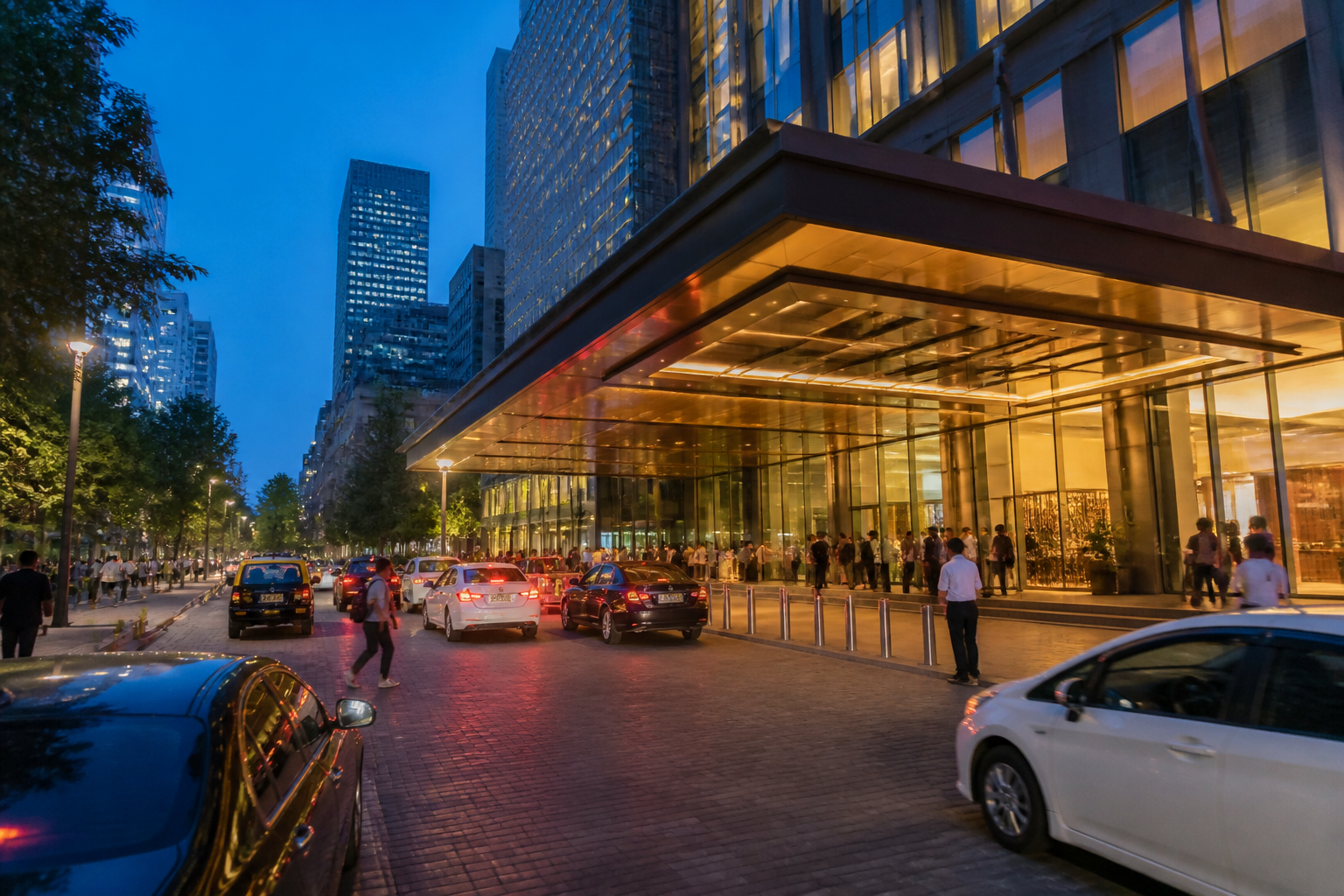
City hotels in India are beginning to depend less exclusively on weekday business travel, as staycations, short breaks, domestic travel and extended business trips lift weekend occupancy and room rates. The shift is visible in the latest market figures from hotel operators and STR, and points to a broader change in how urban hospitality assets are being used after the Covid-19 pandemic.
Karan Mahesh, regional director for South and Southeast Asia at STR, CoStar Group, said nationwide Friday-Saturday occupancy reached almost 67% during the January-August period in India. That was the highest level recorded since 2023, according to the report. Sixteen of the 17 Indian markets tracked in the dataset recorded higher weekend occupancy in 2026.
The figures are significant because weekends have historically been a weak period for city hotels in India. Unlike global gateway cities such as London, New York, Sydney and Melbourne, Indian urban hotel markets were more closely associated with weekday corporate travel. A stronger weekend market therefore changes the commercial role of hotels located in business districts and major urban centres. Their performance is no longer determined only by offices, conferences and weekday corporate movement.
Mumbai and New Delhi illustrate the change. Mumbai’s weekend occupancy rose by 2.9 percentage points to 77.2%, compared with a 1.3 percentage point increase on other days. New Delhi recorded a 3.9 percentage point increase in weekend occupancy to 77.4%, slightly ahead of its improvement on weekdays. Mahesh described a business destination’s ability to attract weekend demand as an important indicator of market maturity.
The distinction between weekend and weekday performance matters for the way hotels manage rooms, pricing and services. A hotel whose demand is concentrated around corporate travel may face weaker utilisation once the working week ends. Rising leisure and staycation demand allows the same property to serve a wider customer base without changing its location. The available evidence does not establish how much of this demand is entirely new or how much has shifted from other forms of accommodation, but it does show that weekend use is becoming more commercially important.
Data from Ibis and Ibis Styles provides another measure of the change. Properties under the two brands recorded a 5-7% increase in weekend occupancy in September this year, while average daily rates on weekends rose 16-18% year on year. Occupancy measures how many available rooms are sold; average daily rates indicate the price achieved for occupied rooms. Together, the figures suggest that the improvement was not limited to filling more rooms. Hotels were also able to charge higher rates during the period cited in the report.
Animesh Kumar, commercial head for Ibis and Ibis Styles India, attributed the increase to guests taking short breaks and to business travellers extending their stays into the weekend. This creates two distinct forms of demand. One comes from residents or domestic travellers using city hotels for short leisure experiences. The other comes from people already travelling for work who add private time to an existing business trip.
That overlap is important for cities because it reduces the separation between business and leisure travel. A hotel room can serve a corporate visitor during the week and a short-break traveller over the weekend. The same central location, transport access and surrounding urban amenities can support both uses. The report does not provide property-level information on how many guests are local residents, domestic visitors or international travellers, but the operator comments identify staycations, local experiences and domestic travel as important parts of the expanded customer base.
Radisson Hotel Group reported a similar pattern. Nikhil Sharma, managing director and chief operating officer for South Asia, said staycations, short breaks and local experiences had expanded the customer base for city hotels after the pandemic. Between April and June 2026, compared with the same period a year earlier, occupancy at Radisson’s Delhi hotels rose by 4-6 percentage points and average rates increased by 3-5%. In Mumbai, occupancy was up by 2-4 percentage points and average room rates by 5-7%.
These figures cover the full week rather than weekends alone, and Sharma said they nevertheless provided an indication of the wider demand environment. The distinction is useful. Weekend gains may be the most visible part of the change, but a full-week improvement would indicate that the effect is not confined to two days. At the same time, the information supplied in the report does not allow a direct comparison of the performance of every hotel category, city or brand.
Revenue per available room offers another way to understand the market. The measure combines occupancy and room rates, showing how much revenue a hotel generates from each available room whether or not that room is occupied. Sayaji Hotels reported a 9.5% year-on-year increase in weekend revenue per available room this year. Its first-quarter weekend revenue per available room grew 14.3% year on year, according to managing director Raoof Dhanani.
The numbers from Ibis, Radisson and Sayaji are not identical measures and cover different time periods. They should therefore not be treated as a single industry-wide estimate. Their value is directional: multiple operators are reporting stronger weekend demand, higher rates or improved revenue performance. STR’s market-level data adds a broader frame, with 16 of 17 tracked Indian markets recording higher weekend occupancy.
ITC Hotels described the change as a structural shift in consumer travel behaviour, with leisure, staycation and bleisure demand increasingly complementing traditional business travel at city hotels. Bleisure, in this context, refers to business trips that incorporate leisure time. The term captures a change in the demand pattern rather than a new type of urban property. Hotels are being used more flexibly by travellers whose reasons for staying do not fit neatly into either business or tourism.
For hotel operators, the shift changes the question of when urban rooms can generate value. A property located in a business district may once have been judged mainly on weekday corporate demand. Stronger weekends give operators an additional period in which to sell rooms, food and beverage services and local experiences. The supplied report does not provide details of hotel redevelopment, new facilities or changes in staffing, so it cannot establish how operators are adapting their properties operationally. It does show that the commercial opportunity is being recognised by several major chains.
For cities, the trend also highlights the importance of proximity and connectivity. Staycations and short breaks depend on the ability to access an urban destination without a long journey, while business travellers extending their trips depend on hotels being connected to both work locations and leisure activities. The report does not identify the transport modes or neighbourhoods driving the demand, and it does not provide evidence on the role of public transport, airports or road networks. What it does establish is that city hotels are benefiting from demand that is tied to the experience of the city itself, not only to the office or conference venue.
The commercial data also points to a more nuanced recovery from the pandemic. The change is not described simply as a return of earlier business travel. Operators are identifying staycations, domestic travel, local experiences and bleisure as additional sources of demand. This broadens the market served by city hotels, although the report does not quantify the relative contribution of each category or show whether the pattern is equally strong across different income groups.
The evidence has limits. STR’s figures cover 17 tracked Indian markets, while the hotel-company figures relate to particular brands, cities or reporting periods. September data from Ibis and Ibis Styles is not directly comparable with Radisson’s April-June figures or Sayaji’s quarterly revenue measure. The report also does not provide absolute room inventories, the number of properties covered by each operator, or a city-by-city breakdown beyond Mumbai and New Delhi. Those gaps matter when assessing the scale of the market shift.
Even with those limitations, the direction is consistent. Weekend occupancy is rising in most tracked markets; Mumbai and New Delhi are recording stronger weekend gains; selected operators are reporting higher average daily rates; and weekend revenue per available room is increasing. The central change is therefore not merely that hotels are fuller on Saturdays. It is that weekend demand is becoming a more reliable part of the urban hotel business model.
The larger urban question is how cities are used when work is no longer the only reason to enter or remain in them. Hotels have traditionally been linked to business districts, transport gateways and commercial activity. The growth of staycations and short breaks adds another layer to that relationship, making local experiences and urban accessibility more relevant to hotel demand. The available evidence does not yet show whether this shift is altering land use, hotel construction or neighbourhood economies, but it provides a clear signal that the value of a city hotel is increasingly tied to more than weekday business traffic.
For now, the evidence confirms a sustained improvement in weekend performance across the markets and operators cited by the report. What remains uncertain is how durable the trend will be, how widely it extends beyond the tracked markets and brands, and how much demand comes from new travel behaviour rather than a redistribution of existing hotel stays. Those questions will depend on longer-term occupancy, room-rate and revenue data across a broader set of Indian cities.
