


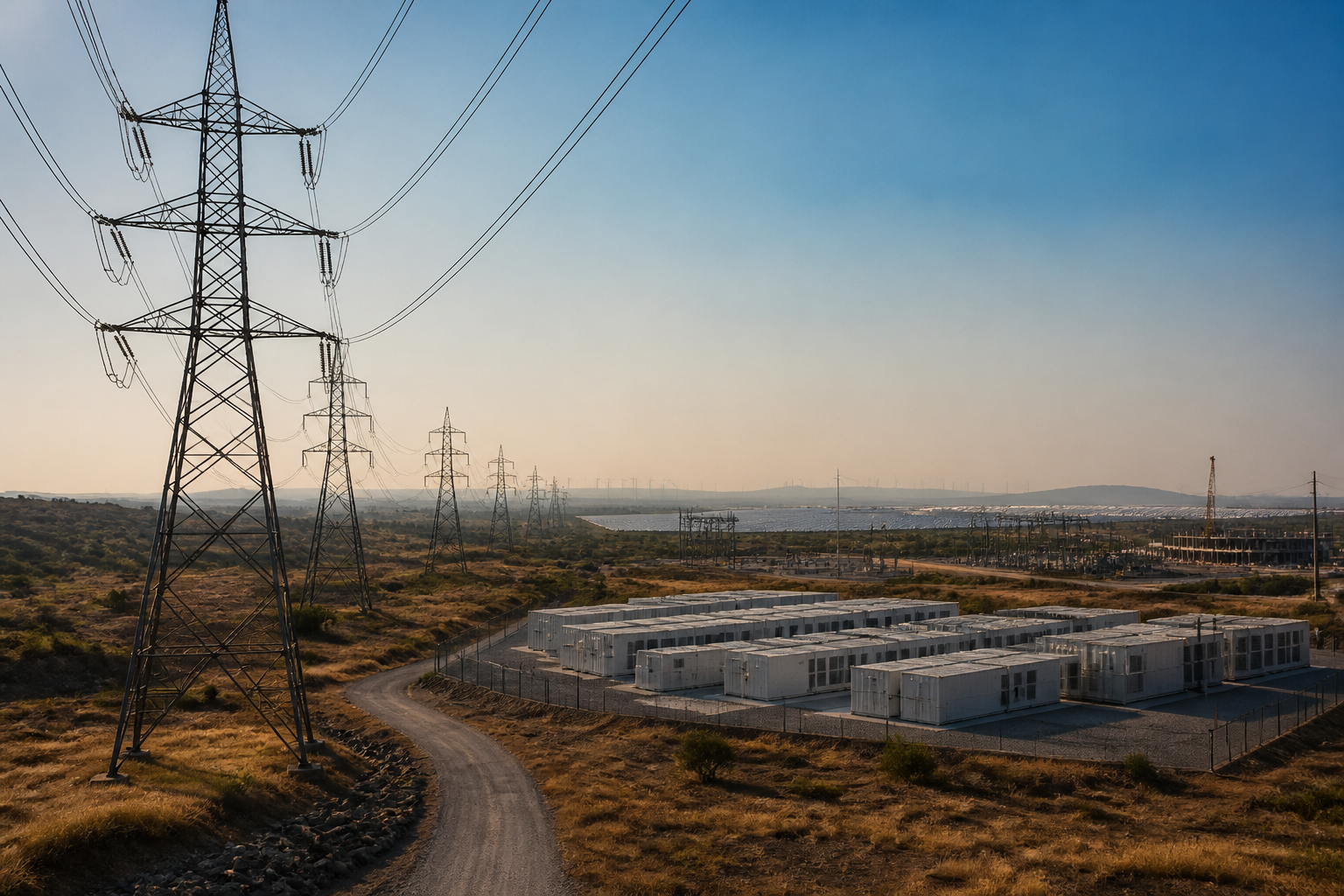
The approval of the Green Energy Corridor Phase-III scheme places transmission capacity and battery storage at the centre of India’s renewable-energy expansion. The Union Cabinet cleared the scheme on Wednesday, with an intended capacity to evacuate 135 GW of renewable power through an intra-state transmission system supported by battery energy storage.
The decision is significant because adding renewable generation is only one part of building a functioning clean-power system. Electricity produced by solar and wind projects must reach consumers through a grid that can manage changing output. When the network cannot absorb or transport all available renewable electricity, grid operators may limit generation to maintain stability. This process, known as curtailment, reduces the effective use of installed renewable capacity.
GEC-III is designed to address that infrastructure constraint. Its project outlay is Rs 1,86,405 crore, including Rs 1,36,378 crore for the intra-state transmission system and Rs 50,000 crore for 50 GWh of battery energy storage systems. The scheme also includes central financial assistance of Rs 54,082 crore to offset intra-state transmission charges.
The structure of the investment shows that the programme is not limited to building more generation capacity. It combines the physical network needed to move electricity with storage intended to help balance supply and demand. For renewable energy, this combination is important because generation is not constant. Solar output changes through the day, while other renewable sources can also vary. The supplied announcement does not provide a project-wise breakdown of the transmission assets or the locations of the planned storage systems, but it identifies both as core components of the scheme.
The 135 GW evacuation target also indicates the scale of the coordination challenge. Renewable projects, transmission networks, storage facilities, state-level electricity systems and consumers must operate as parts of one connected chain. If one link develops more slowly than the others, the capacity of the wider system to use renewable electricity can be constrained. GEC-III therefore treats the intra-state grid as a central part of renewable-energy policy rather than as a secondary network behind generation projects.
The financial design is equally important. The scheme’s total outlay combines public assistance with expenditure on transmission and storage. The central financial assistance is intended to reduce intra-state transmission charges, which can affect the cost of moving power through state networks. According to the statement carried by PTI, this support is intended to help keep power costs down.
That mechanism gives the programme two stated objectives. The first is technical: improve the ability of the grid to evacuate renewable electricity and reduce curtailment. The second is economic: limit the cost impact of transmission investment on power users while expanding clean-energy infrastructure. The source report does not specify the final tariff effect for households, businesses or individual states, so the practical outcome will depend on how the assistance is applied and how the projects are implemented.
UNFCCC Executive Secretary Simon Stiell described GEC-III as a step that would help harness India’s growing renewable-energy capacity. He said stronger power grids and battery storage could support daily electricity needs, economic growth and India’s position as a global solar power. Stiell also said battery storage offers major economies such as India an opportunity to pursue energy security and economic growth together.
The institutional message behind the scheme is clear: renewable-energy growth increasingly depends on grid architecture. Generation capacity can be developed at one location while demand is distributed across cities, industrial areas and other consumption centres. Transmission makes that electricity available beyond the point where it is produced, while storage can provide an additional mechanism for managing timing differences between generation and demand.
This also brings construction and manufacturing into the energy transition. Stiell said the investment in grids and storage could create jobs in manufacturing, construction and energy storage. Those sectors would be involved in different parts of the programme: building transmission infrastructure, supplying equipment, constructing storage systems and maintaining the assets after commissioning. The source material does not provide employment estimates or identify the companies and states expected to participate, but it links the infrastructure programme directly to industrial activity.
For urban India, the relevance of the scheme lies in the reliability and cost of the electricity systems that support homes, offices, transport networks, water supply, communications and industry. The announcement does not claim that GEC-III will immediately change supply conditions in any particular city. Its urban significance is instead tied to the less visible networks that allow cities to function: power transmission, grid balancing and the movement of electricity between generation and demand.
Battery storage adds another layer to this infrastructure system. The planned 50 GWh of storage is a substantial component of the scheme’s Rs 1,86,405-crore outlay, accounting for Rs 50,000 crore of the stated project cost. The supplied report does not specify the technology, operating duration, procurement model or geographic distribution of these systems. Those details will be important in determining how the storage capacity supports renewable-energy evacuation and grid stability.
The programme also highlights the division of responsibilities in India’s power sector. The transmission system covered by GEC-III is intra-state, while central financial assistance is being used to support the investment and reduce transmission charges. This means implementation will require coordination between central institutions, state authorities, transmission agencies, grid operators, storage developers and equipment suppliers. The source report does not identify the implementing agencies or provide a delivery schedule, leaving those administrative details to subsequent project documents and approvals.
The immediate policy question is therefore not only how much renewable capacity can be connected, but how quickly supporting infrastructure can be planned and delivered. The scheme’s 135 GW target establishes the intended scale of evacuation. Its financial structure establishes the broad allocation between transmission, storage and central assistance. The remaining implementation details will determine how those commitments translate into working assets.
GEC-III represents a shift in the way renewable expansion is understood. The central challenge is no longer simply adding clean generation; it is creating a system capable of transporting, balancing and paying for that electricity. By combining intra-state transmission with battery storage, the scheme addresses two constraints identified in the announcement: limited evacuation capability and renewable-energy curtailment.
What is confirmed is the Cabinet approval, the project outlay, the 135 GW evacuation objective, the 50 GWh storage component and the Rs 54,082-crore central assistance. What remains to be established is the implementation timetable, the locations and design of the transmission and storage projects, and the eventual effect on power costs and renewable-energy utilisation. Those will be the milestones that determine whether GEC-III becomes a functioning grid upgrade or remains primarily a large financial commitment on paper.
