


Haryana’s reported farm fires have fallen to around 600, but the state’s attempt to eliminate stubble burning will be decided less by headline numbers than by whether the smallest farmers can access machines and buyers during the narrow harvest window. In villages such as Bhuthan Kalan and Mohammadpur Rohi, paddy residue is beginning to move from fields to factories, creating a potential economic alternative to burning. Yet the emerging model remains uneven, informal and vulnerable to peak-season costs.
That makes Haryana’s residue problem more than a question of farmer behaviour. It is also a test of how agricultural machinery, private logistics, industrial demand and state administration can work together across thousands of dispersed farms. The state has around 16 lakh hectares under paddy this year, with estimated crop residue of about 80 million tonnes. Moving even a portion of that material requires collection systems that can reach fields quickly, especially when harvesting is staggered and the period between harvesting and the next crop is limited.
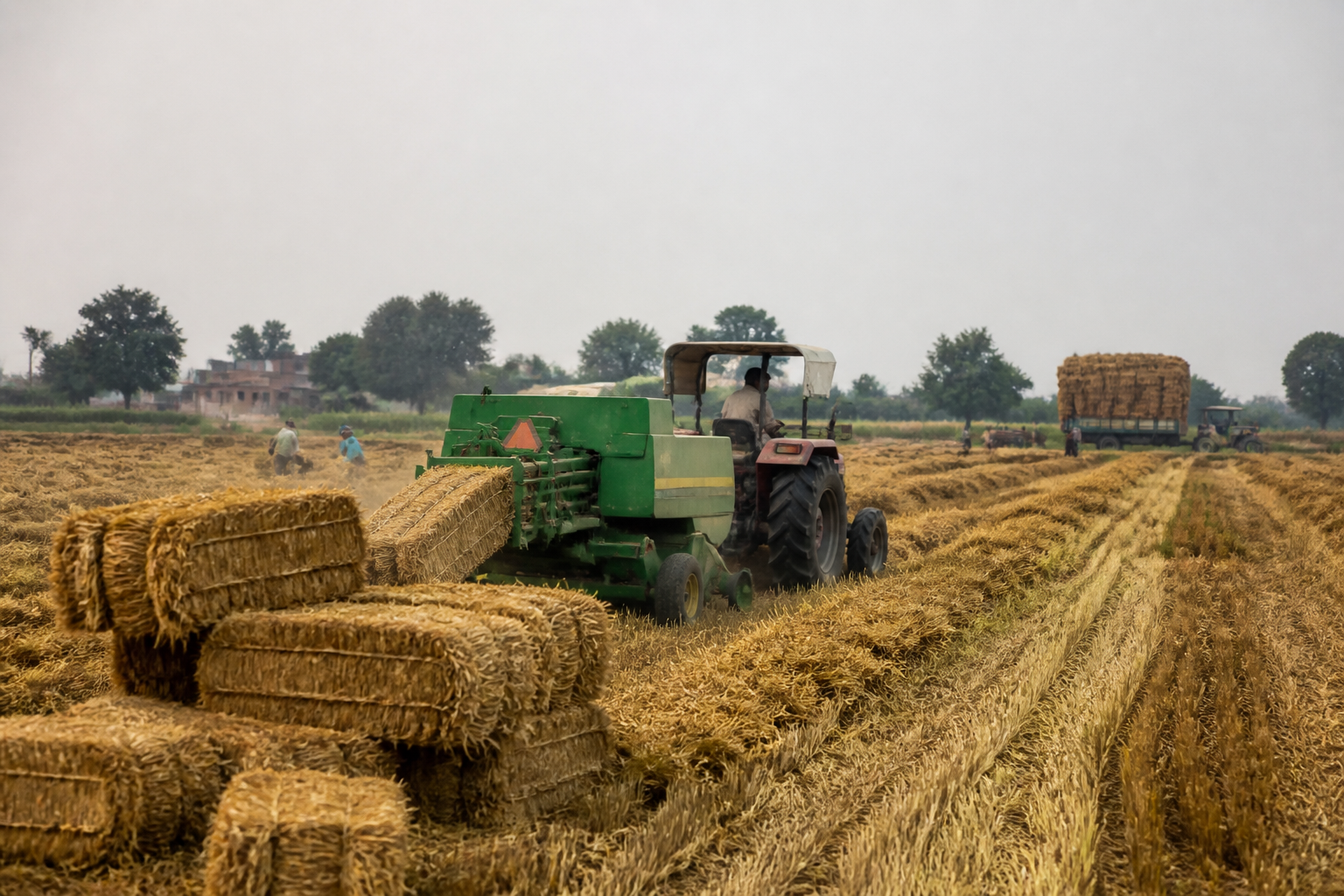
The current transition is visible in villages that were previously associated with high levels of crop-residue fires. In Bhuthan Kalan, balers have reached some small farmers, while straw collection businesses are emerging. At nearby Mohammadpur Rohi, entrepreneur Mahinder Singh is operating 13 tractors and covering around 30 acres a day. He transports straw to factories, including bottling, cardboard and dyeing units, where it is used as biomass fuel and for other purposes.
Singh said more than 30 factories in the area are buying straw bales and that he charges Rs 200 per quintal for paddy straw. In Suniyana, farmers Gureninder and Bajinder Singh, who together own 90 acres, have harvested their first paddy crop with combine harvesters and are using balers to collect the residue. Singh said he does not charge farmers for removal because he earns from selling the bales to companies.
The economics are important because collection becomes more viable when the residue has a buyer. Paddy straw is increasingly being used as feedstock in 2G ethanol plants, as biomass for biogas units, and in pellets and briquettes for industrial and power-plant fuel. Paper and cardboard manufacturers are also among the buyers. These uses create a value chain in which farmers do not necessarily have to pay for residue removal, while aggregators can earn by collecting, processing and transporting it.
However, the market is not yet a fully organised system. Agriculture official Girish Nagpal described it as an emerging arrangement between farmers, aggregators and industrial buyers. Companies place orders for specified quantities, aggregators collect the material from farmers, and the residue is moved to industrial users. The model depends on coordination between demand and harvesting schedules, but the report does not establish a standardised statewide procurement or pricing system.
That informality has direct consequences for smaller farms. Amarjeet Singh, who farms 10 acres, said access to a baler depends on having the right connections. He reported that machine rentals were currently around Rs 700 per acre, but expected costs to rise to about Rs 2,400 an acre during peak demand. The difference is not marginal for farmers operating on small holdings, particularly when they are already facing crop losses, higher fertiliser costs and an indifferent monsoon.
Karamveer, who farms four acres in Jind, said he could not afford machine rentals after spending heavily on crops. Balbir Singh, a farmer from Narwana, said private operators often preferred larger farms because travelling to one- or two-acre plots could make fuel costs uneconomic. This is the central infrastructure problem within the residue economy: a machine may exist in the district, but that does not mean it is practically available to every farm.
The distinction between aggregate capacity and last-mile access is crucial. Government data cited in the report shows that around 9,000 additional machines are ready for deployment this season. The equipment includes happy seeders, balers, hay rakes, crop reapers and rotary slashers, covering both harvesting and residue-management operations. But machine numbers alone cannot show whether equipment will reach the right village on the right day, at a price that small and marginal farmers can pay.
Haryana’s agriculture department says it is attempting to address that coordination problem by identifying vulnerable farmers and matching machinery availability with harvesting schedules. Field staff are locating small and marginal farmers to determine when they need machines. The department is also tracking staggered harvesting across districts and maintaining a calendar of which blocks will harvest first and which will follow.
This administrative function may become as important as the equipment itself. Paddy harvesting does not occur simultaneously across the state. Demand for balers and other machines will rise when harvesting peaks, creating the possibility of queues, higher rentals and selective service by private operators. A machinery network that works during the early part of the season may still fail when every field requires service at the same time.
The state’s fire data indicates progress but does not settle the question of whether the system can reach zero. Haryana recorded around 600 farm fires last year. Its red-zone villages, defined as those reporting the highest number of farm fires, fell from 14 in 2024 to three in 2025. Yellow-zone villages declined from 273 to 145. These changes suggest that the combination of machinery access, enforcement or awareness and residue demand may be reducing burning, but the supplied evidence does not isolate the contribution of each factor.
The figures also show why a zero-fire target is administratively difficult. Additional chief secretary for agriculture Vijayender Kumar said it was too early to predict a fire-free season, noting that Haryana has many farmers and several issues are involved. His caution reflects the difference between reducing incidents and eliminating them. A fall in the total number of fires can coexist with persistent failures affecting particular villages, farm sizes or harvest periods.
The developing straw market therefore operates across two policy systems. The first is the state’s machinery and agricultural extension network, which must identify farmers, schedule equipment and manage peak demand. The second is the industrial market for biomass, pellets, briquettes, ethanol feedstock, biogas inputs and paper or cardboard production. The first system determines whether residue can be collected in time; the second determines whether collection has enough economic value to continue.
Neither system appears complete. The market is described as largely unorganised, while farmers report unequal access to machines and rising costs during peak demand. The state’s role is not limited to distributing equipment. It also has to make the machinery network responsive to fragmented landholdings and ensure that the existence of industrial buyers translates into field-level collection.
This is where the issue becomes relevant to the wider built environment and urban economy. Factories are becoming end users of an agricultural residue stream, and transport operators are linking rural fields with industrial facilities. A successful model could reduce open burning while creating business for aggregators and providing industries with an alternative biomass input. But the material has to be collected, baled, stored and transported reliably; otherwise industrial demand will remain disconnected from the farms producing the residue.
The evidence from Haryana confirms that stubble burning is not being addressed through a single intervention. The decline in fires coincides with more machinery, a growing market for straw and targeted administrative mapping of vulnerable farmers. It also shows the limits of each intervention on its own. Machines without affordable last-mile access leave small farms exposed, while buyers without collection logistics cannot prevent field burning.
The next test will come in mid-October, when farmers expect harvesting to peak. That period will reveal whether the state’s machine deployment calendar can match demand, whether private operators serve smaller plots and whether factories and aggregators can absorb the available straw. Haryana’s path towards zero farm fires will depend on how that rural infrastructure performs under pressure, not only on the number of machines listed for deployment or the number of fires recorded after the season ends.
