


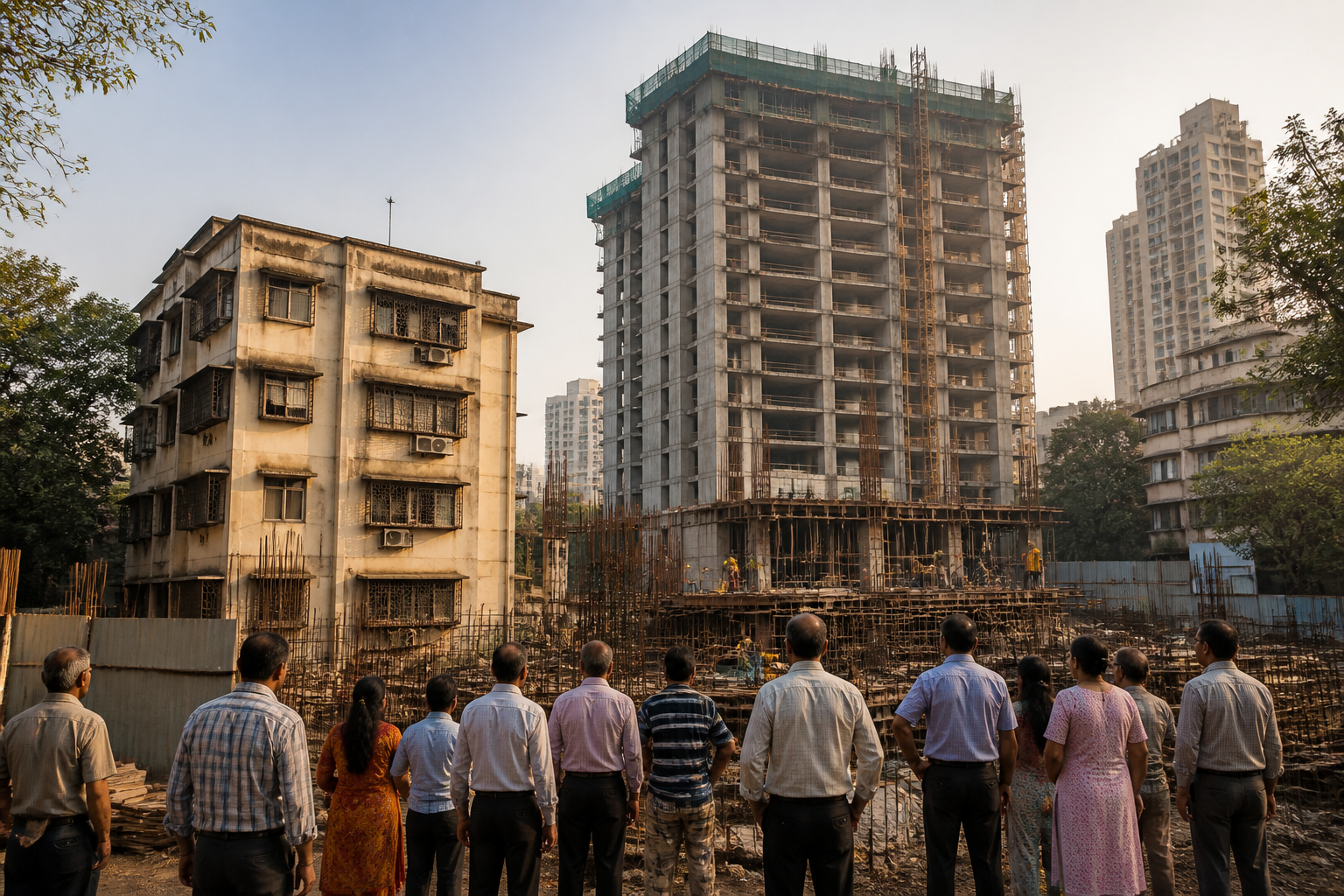
Maharashtra has introduced tighter redevelopment rules for cooperative housing societies, making video recording compulsory during key meetings and requiring projects to be completed within two years of the first or plinth erection certificate, except in approved exceptional circumstances.
The revised framework was issued by the Cooperation Department on September 30. It replaces the government resolution of July 4, 2019, along with subsequent circulars issued under that framework. The rules are intended to bring greater supervision and transparency to decisions that affect society members, developers and residents awaiting replacement homes.
Under the new procedure, only the elected managing committee can take a decision to initiate redevelopment. At least one-fifth of the society’s members can submit an application seeking a Special General Body Meeting to consider a redevelopment proposal. The meeting requires a two-thirds quorum, while a preliminary decision to proceed requires the support of at least 51 percent of the society’s total members who are physically present.
The rules also prescribe a more formal process for appointing architects and Project Management Consultants. Societies must seek quotations from at least three architects or PMCs drawn from panels maintained by government or local authorities. One of them must be selected by the Special General Body Meeting, after which the appointed PMC has two months to prepare a project report.
The tendering process has also been specified. A society should ordinarily receive at least three bids from developers. If fewer bids are received, it must first provide a 15-day extension and, if necessary, a further one-week extension before proceeding with the available bids. The list of bids must be displayed on the society’s notice board and then presented to a Special General Body Meeting along with a comparative statement prepared by the architect or PMC.
The meeting to select a developer must be video recorded and held in the presence of an authorised officer appointed by the Registrar. Within 14 days of the meeting, the society must submit the minutes, written consents from members, the developer’s consent and the attendance sheet to the Registrar. Members may also demand that the decision be taken through a secret ballot.
After a developer is selected, the development agreement must ordinarily be executed within three months. The agreement must require completion of the redevelopment within two years from the date of the first or plinth erection certificate. In exceptional circumstances, the completion period may be extended to three years.
The framework requires developers to provide alternative accommodation or mutually agreed rent during construction. It also states that members do not have to vacate their homes merely because a developer has been selected. All legal approvals must be obtained and the Permanent Alternative Accommodation Agreement must be registered before members vacate their premises.
The rules additionally prescribe how homes are to be allocated after redevelopment. Flat allocation must be carried out through a Special General Body Meeting. Where a lottery is required, it is to be conducted by the developer after completion of the building. The new framework therefore places formal deadlines and documented decision-making at several points, from consultant appointment and bid evaluation to the execution of agreements and relocation of residents.
