


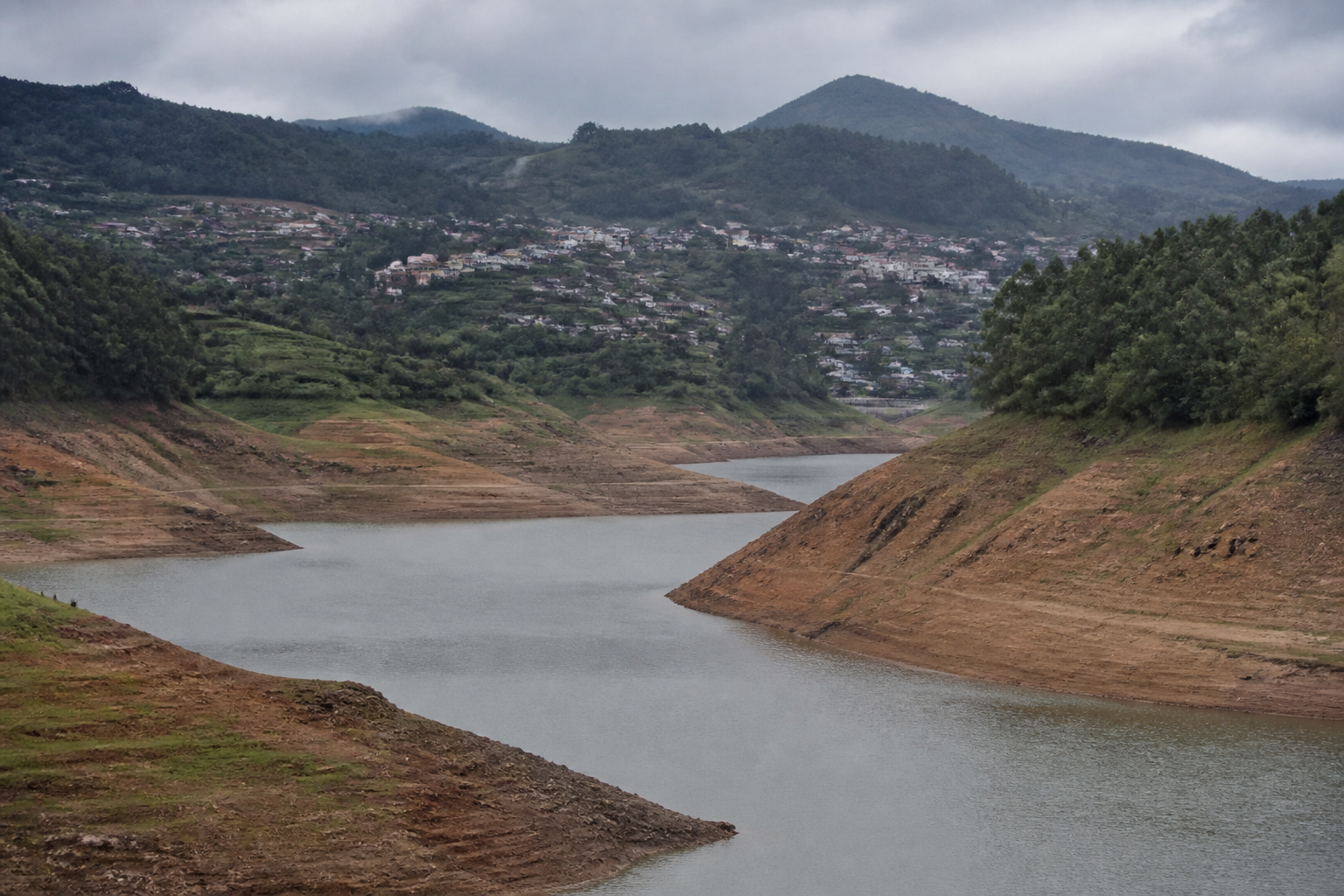
Ooty’s rainfall deficit has exposed how dependent a hill town can be on the uneven geography of its water sources. The Nilgiris recorded 572 mm of rain during the southwest monsoon against a normal 842 mm, a shortfall of nearly 32 per cent, while Ooty town received just 253 mm against its normal 530 mm, according to India Meteorological Department data cited in the report. The immediate pressure is moderated by better precipitation in the Parson’s Valley reservoir catchment, but the wider pattern has left major reservoirs supporting hydropower generation short of their expected levels.
The figures matter because the Nilgiris does not function as a single rainfall system. The district’s central and western areas receive different amounts of precipitation, and the report identifies Ooty, Kundah, Gudalur and Pandalur as parts of the region that normally benefit from substantial southwest monsoon rainfall. This season, western Nilgiris received more rain than central Nilgiris. That unevenness means a district-level average can conceal a sharper shortage in the urban area where people depend on a limited drinking-water network.
For Ooty, the contrast is particularly stark. The town’s 253 mm of rainfall was less than half its normal southwest monsoon average. The report describes the town as having faced a rain-parched season, a condition that can affect more than immediate water availability. In a hill settlement, the functioning of reservoirs, catchments and distribution systems is closely tied to the timing and location of rainfall. Water falling outside the urban limits may still sustain the town if it reaches a protected source, while heavy rain in another part of the district may do little to replenish Ooty’s local water position.
That distinction explains why the Parson’s Valley reservoir has become central to the near-term assessment. The reservoir’s catchment received appreciable precipitation, more than the Ooty urban limits, and water managers believe its levels can help sustain supply to the town. The report therefore presents a mixed picture: Ooty itself experienced a severe rainfall deficit, but the reservoir that serves as a major drinking-water source received enough rain to provide some operational cushion.
This is not the same as saying that the town’s water security is unaffected. A favourable reservoir catchment can reduce immediate stress, but it does not remove dependence on a narrow set of sources. The report does not provide the reservoir’s storage level, live capacity, consumption rate or projected duration of supply. Without those figures, the precise length of the cushion cannot be established. What is clear is that the town’s resilience depends not simply on how much rain falls across the district, but on where it falls and whether that water enters the systems that supply residents.
The same rainfall pattern has produced a more direct concern for the Nilgiris’ hydropower infrastructure. Avalanche, Upper Bhavani and Emerald reservoirs did not fill up during the southwest monsoon, according to the report. These reservoirs support hydropower generation, making their levels relevant beyond the immediate geography of Ooty. Their under-filling indicates that the deficit has affected infrastructure with a different function from the Parson’s Valley drinking-water system, even though all are shaped by the same monsoon cycle.
The institutional issue is therefore one of differentiated water management. Drinking-water managers are watching Parson’s Valley because it is the major source for Ooty town. Hydropower systems depend on other reservoirs, including Avalanche, Upper Bhavani and Emerald. A district can experience a relatively manageable position for urban drinking water while facing a weaker position for energy-related storage. Treating rainfall as one district-wide number risks overlooking these separate operational realities.
The reported figures also show why monsoon performance cannot be assessed only through the presence or absence of rain. The southwest monsoon lasted four months, from June to September, but the distribution of rainfall was not uniform. The Nilgiris received 572 mm against a normal 842 mm, while Ooty received 253 mm against 530 mm. In percentage terms, the town’s deficit was considerably sharper than the district’s. The difference is important for planning because the population and services of Ooty rely on urban supply arrangements, not on the district average as an abstract measure.
The report attributes the erratic and insufficient rainfall to the El Niño effect. That attribution is presented in the source as an explanation for the season’s conditions, rather than as a detailed assessment of the climate system. The supplied material does not provide a longer rainfall series, a comparison with previous El Niño years or an independent assessment of how much of the deficit can be assigned to that factor. The evidence available here supports the rainfall deficit and its spatial unevenness, but not a broader conclusion about a permanent change in Ooty’s climate.
The next pressure point is the northeast monsoon. The Nilgiris is looking towards excess rainfall during that season to compensate for the southwest monsoon shortfall. That expectation highlights the limits of seasonal balancing. A later spell of rain may improve reservoir levels, but the report does not establish whether it will occur, how much would be required or whether rainfall would reach the same catchments that need replenishment. Nor does it establish how the town’s water managers would respond if the northeast monsoon also proved weak or uneven.
For the urban administration, the immediate monitoring task is consequently catchment-specific. Parson’s Valley needs to be watched for drinking-water security, while Avalanche, Upper Bhavani and Emerald require attention for hydropower storage. The distinction is not merely technical. It determines which infrastructure is exposed, which authority or operating team must respond and what kind of shortage could emerge if rainfall remains inadequate.
The Ooty case also raises a wider planning question for hill towns: whether water resilience can be measured through rainfall totals alone. The report shows that the town received far less rain than normal, yet its principal drinking-water reservoir catchment performed better than the urban limits. It also shows that other major reservoirs failed to fill. These facts point to a fragmented risk profile in which urban supply, reservoir storage and hydropower capacity may move in different directions during the same season.
The available evidence confirms three things. The Nilgiris ended the southwest monsoon with a district-wide rainfall deficit; Ooty’s shortfall was substantially more severe; and the effects differed between drinking-water and hydropower reservoirs. What remains uncertain is the actual storage position of the reservoirs, the duration of Parson’s Valley’s supply buffer and whether the northeast monsoon will provide enough rain, in the right places, to compensate for the deficit. Those are the measurements that will determine whether this season remains a warning or becomes a more serious urban water-management problem.
