


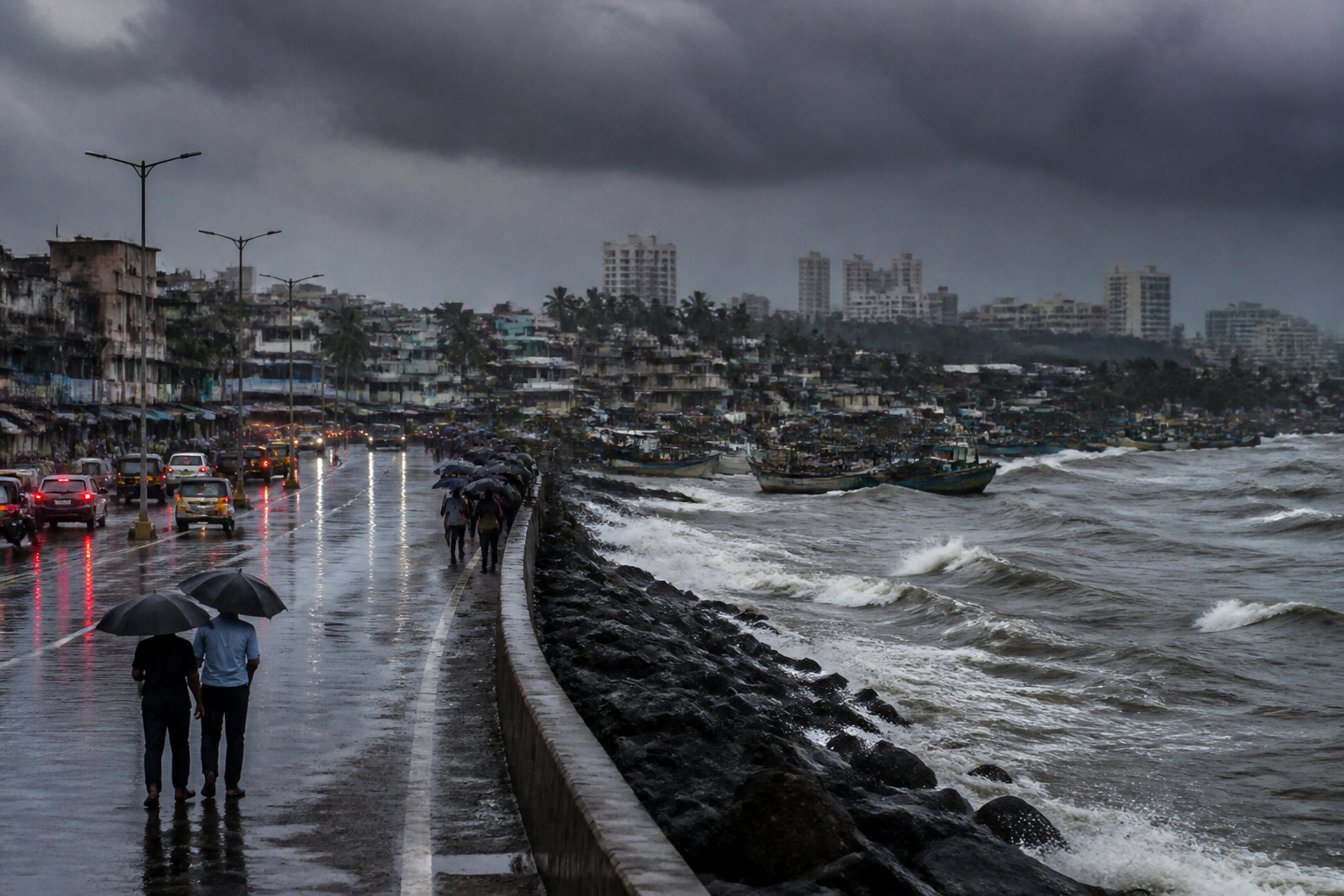
A powerful El Niño developing over the Pacific is expected to influence India’s weather through the coming months, but scientists say its effects cannot be understood through the traditional drought narrative alone. A rapidly warming Indian Ocean is changing the background conditions in which monsoon failures, heat stress, marine heatwaves, extreme rainfall and cyclones may unfold.
That matters to India’s cities because weather risk is not produced by one climate signal in isolation. Rainfall depends on the interaction between large ocean-atmosphere patterns and smaller systems such as low-pressure areas and monsoon depressions. The result is a more difficult planning environment for urban administrations, coastal communities, transport agencies, water utilities and emergency-response systems.
At a media dialogue organised by IIOE-2 ECSN, climate scientist Roxy Mathew Koll of the Indian Institute of Tropical Meteorology in Pune said the ongoing El Niño was already exceptionally strong and could intensify further. Sea-surface temperatures in the central Pacific were around 2.6 to 3 degrees Celsius above normal in some areas, he said, with climate models suggesting that anomalies could approach 4 degrees.
The event is expected to peak in November and weaken by April-May 2027, according to Koll. However, residual heat could continue influencing global climate conditions after the event itself begins to decline. The latest assessment from the US National Oceanic and Atmospheric Administration also indicates a strengthening El Niño, with more than a 90% probability of a very strong event persisting through the Northern Hemisphere autumn and winter.
The immediate policy challenge is that a strong El Niño provides a broad signal, not a precise local forecast. Historically, El Niño has been associated with weaker monsoon rainfall in India. Drawing on more than 150 years of monsoon records, Koll said roughly half of all El Niño years experienced drought, while nearly 80% recorded below-normal rainfall. Those figures establish a significant historical relationship, but they do not determine how rainfall will be distributed in every region or city during a particular season.
That distinction is important for urban planning. A year with below-normal rainfall overall can still include short periods of intense rain, local flooding and drainage failures. Conversely, a city may avoid a major rainfall deficit while facing extended heat, water stress or disruptions to infrastructure. The traditional question of whether the monsoon will be “normal” is therefore less useful than examining how rainfall, temperature and storm intensity may be distributed over time and across locations.
Climate change is making that assessment harder. Koll said climate change was amplifying some of the impacts traditionally associated with El Niño, with El Niño signals now being overlaid on a much warmer climate background. Himadri Saini, a researcher at the University of Melbourne, said warming oceans and the atmosphere were steadily changing what should be considered normal weather. Events treated as exceptional several decades ago, she said, are becoming increasingly common in a warmer climate.
For cities, a warmer baseline can turn familiar infrastructure assumptions into weak points. Roads, drainage networks, buildings, power systems and public spaces are designed and operated around expectations of rainfall, heat and wind. When those conditions shift, the infrastructure may still exist, but its margin of safety can narrow. The supplied evidence does not establish that a specific Indian city will face a particular failure, but it does show why climate risk cannot be reduced to a single seasonal forecast.
The Indian Ocean is central to this changing risk profile. Koll said weaker winds during El Niño reduce evaporation, allowing the Indian Ocean to retain more heat. Studies discussed at the dialogue indicate that ocean temperatures can remain unusually high during and after El Niño events, increasing the likelihood of marine heatwaves.
Marine heatwaves are not only an ecological concern. Scientists said they can cause widespread coral bleaching, disrupt marine ecosystems and affect fish stocks. For coastal cities and communities, the consequences can move through the food system and local economy. Disruption to fish availability can affect fishing livelihoods, markets and the cost and reliability of marine food supplies, even though the scale and location of any future impact cannot be established from the current report.
The warmer ocean may also influence cyclone behaviour. Scientists warned that abnormally warm waters could create favourable conditions for the rapid intensification of cyclones during the October-November-December cyclone season. Koll cautioned that the impact of such a strong El Niño on this year’s cyclone activity remained to be seen. That qualification is significant: the evidence points to a risk-enhancing environment, not a confirmed prediction of a particular cyclone or landfall.
For coastal urban regions, rapid intensification is an administrative problem as much as a meteorological one. Authorities may have less time to move people, secure construction sites, protect vulnerable infrastructure and suspend transport operations when a storm strengthens quickly. The report does not provide city-level preparedness assessments, evacuation figures or infrastructure-capacity data. It does, however, indicate why warning systems and response protocols must account for changing ocean conditions rather than rely only on historical storm patterns.
The climate signal also reaches below the water’s surface. Smitha BR, a scientist at the Centre for Marine Living Resources and Ecology in Kochi, said weaker winds associated with El Niño could suppress coastal upwelling in the Arabian Sea. Upwelling brings nutrient-rich water to the surface and supports marine productivity. If it weakens, fishery production and fish spawning could be affected, particularly because rainfall and upwelling create favourable conditions for commercially important species during the monsoon.
Smitha said that without upwelling, food availability drops, potentially leading to starvation and mortality across parts of the marine ecosystem. This connects atmospheric circulation to an urban and economic chain that is often absent from city-level climate discussions: ocean conditions affect fisheries, fisheries affect livelihoods and food systems, and those pressures can be felt in coastal settlements and urban markets.
The evidence also challenges the way government institutions divide responsibility. Weather forecasting, disaster management, coastal regulation, fisheries, municipal services and public health are generally handled through different administrative systems. Yet the risks described by scientists cross these boundaries. A marine heatwave is not only an environmental event; extreme rainfall is not only a drainage issue; and heat stress is not only a health department concern.
This makes coordination a central part of resilience. The supplied material does not identify a new government programme, funding allocation or institutional reform linked to the forecast. It does show that the relevant risks span the Indian Meteorological and oceanographic systems, municipal infrastructure, coastal livelihoods and emergency response. Any effective administrative response will therefore depend on translating climate information into decisions across multiple agencies, rather than treating each impact as a separate incident.
The uncertainty around rainfall is especially important. Saini said El Niño and other large-scale ocean-atmosphere patterns create the broader climate backdrop, while actual rainfall depends on smaller weather systems, including low-pressure systems and monsoon depressions. Ocean warming changes how heat is transferred to the atmosphere and can influence weather thousands of kilometres away, she said.
In practical terms, this means seasonal averages may not fully describe the risks experienced by residents. A city’s population may face heat stress during dry periods, intense rainfall in short bursts and disruptions to transport or utilities when weather systems shift rapidly. The report does not supply local rainfall projections or heat-mortality data, so those impacts should not be presented as confirmed outcomes. But the interaction between the large-scale signal and local weather systems explains why urban agencies need more granular and continuously updated information.
The most important shift is therefore conceptual. El Niño remains a major climate driver, and the historical record shows a strong association with below-normal monsoon rainfall. But the Indian Ocean’s warming means that the same global pattern is operating in a different physical environment. The risks may include drought in some periods, extreme rainfall in others, stronger heat stress, marine ecosystem disruption and more difficult cyclone management.
For India’s cities, the coming seasons will test whether resilience planning is based on historical averages or on a climate system whose baseline is moving. The scientists quoted in the report do not offer a definitive city-by-city forecast, and the effect of the current El Niño on cyclone activity remains uncertain. What the evidence confirms is that urban risk is becoming more interconnected: Pacific warming, Indian Ocean heat, monsoon behaviour, coastal ecosystems and city infrastructure can no longer be considered separate planning questions.
The developments that warrant close monitoring are the El Niño peak expected in November, its possible weakening in April-May 2027, the persistence of residual ocean heat, seasonal rainfall patterns, marine heatwaves and cyclone behaviour during the October-November-December period. Those indicators will determine how the broad climate signal translates into actual risks for India’s cities and coastal communities.
