


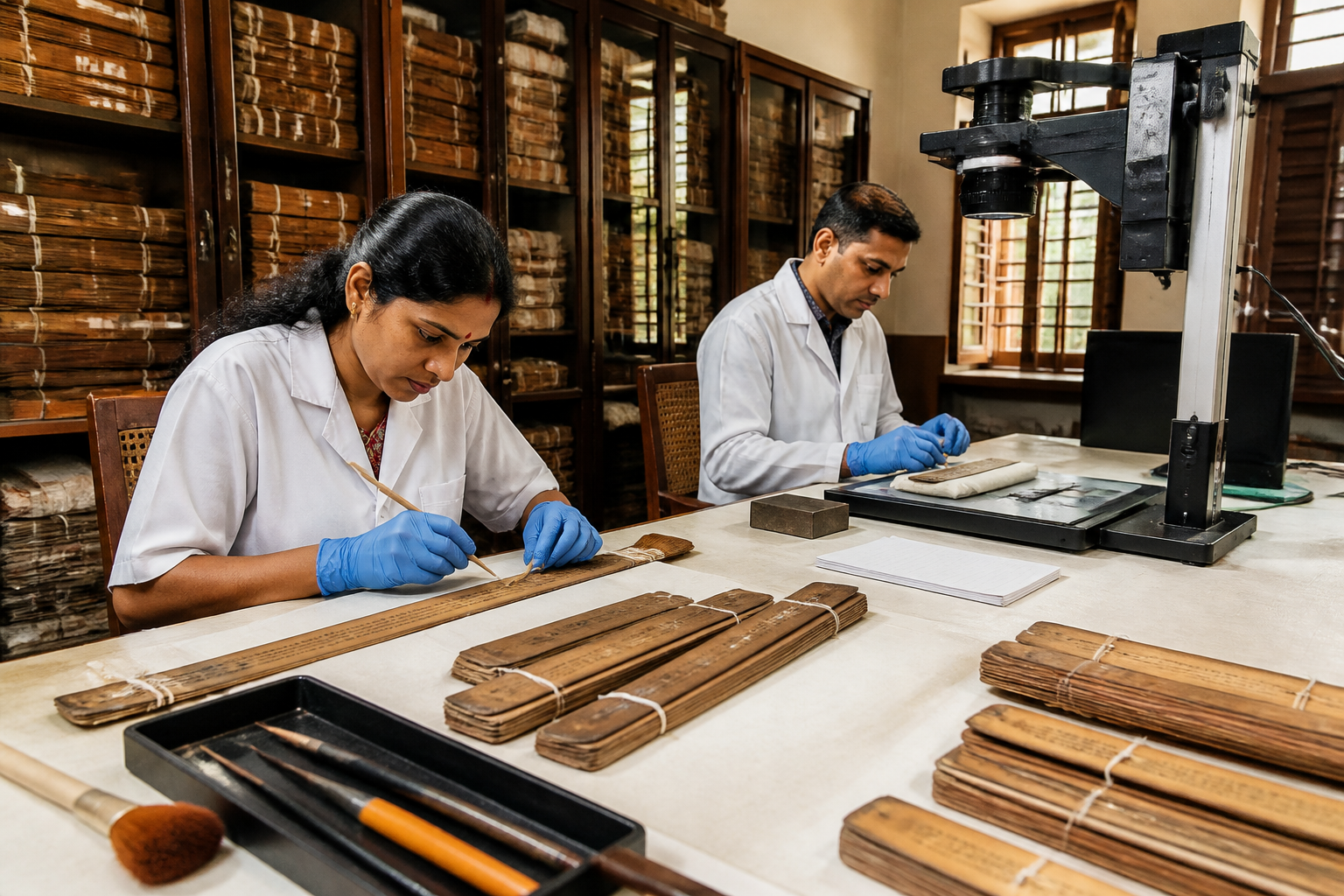
The Mysuru manuscript digitisation project at the Oriental Research Institute is doing more than converting fragile palm leaves into digital files. It is creating a second form of protection for a collection that contains texts on science, medicine, diplomacy and governance, while changing who can handle, study and access India’s knowledge heritage.
The scale is substantial. The Oriental Research Institute, or ORI, has about 25,000 manuscript bundles containing nearly 70,000 titles and around 26 lakh individual leaves. More than 90% of the collection has now been digitised under a project launched in 2022. The work has also expanded beyond palm leaves to include more than 7,000 paper manuscripts.
That progress matters because the original manuscripts are not simply old books. They are physical artefacts whose material condition is inseparable from the knowledge they carry. A damaged folio can affect the continuity of a text, while incorrect sequencing during re-bundling can compromise the integrity of an entire manuscript. Preservation, therefore, is not a preliminary administrative task before scanning. It is the central condition that makes digitisation reliable.
At ORI, the process begins with the careful opening of manuscript bundles. Each folio is cleaned, examined, documented and photographed. The images are then checked and processed before being connected to metadata recording details such as title, script, language and other identifying information. Once the work is complete, the physical folios are arranged in their original sequence and returned to their designated bundles and storage spaces.
This procedure makes the project different from the mass scanning of modern books. The manuscripts vary in material, size, script, foliation and format. Some are thick bundles of closely written palm leaves; others are smaller manuscripts tied with individual cords or larger bundles extending across considerable lengths. The writing may be tiny and densely packed, requiring the operator to protect both the surface and the legibility of the text.
The technology used is consequently only one part of the system. Folios are captured using high dynamic range digital scanners, but the resulting images undergo quality checks and processing. Metadata gives the files an institutional identity, making them easier to catalogue and retrieve. Without that layer, a digital image could preserve the appearance of a page without making the collection meaningfully searchable or usable.
The physical preservation work is equally deliberate. Ageing manuscripts are vulnerable to deterioration and fungal infestation. When fungal growth is identified, the institute uses paradichlorobenzene and thymol for treatment, with the process generally lasting between 21 and 28 days depending on the nature and extent of the infestation. Visible fungal deposits are then removed manually under ultraviolet lighting.
ORI researcher Diddigi Vamsi Krishna said citronella oil and black powder are used to clean the leaves. The black powder helps highlight letters carved into the folios, making them easier to read and scan. In palm leaf manuscripts, writing was scratched, engraved or etched into dried leaves with a stylus, after which lampblack or carbon ink was rubbed into the grooves to make the text visible.
These details reveal why the project is fundamentally a conservation programme supported by digitisation, rather than a digitisation programme with a conservation add-on. Every digital record depends on the physical manuscript being correctly identified, treated and positioned. The digital copy can reduce repeated handling, but it cannot remove the need for skilled care of the original.
That relationship is especially important for manuscripts written in different Indian scripts and formats. ORI director DP Madhusudana Acharya cited a 600- to 700-year-old manuscript of the Sundarakanda of the Ramayana written in Nandi Nagari script as one example that has been digitised. The value of such work is not only that a rare text becomes available as an image. It also means scholars can examine the manuscript without repeatedly exposing the original to handling.
The collection includes one of the institute’s most recognised holdings: the oldest extant manuscript copy of Kautilya’s Arthashastra. Scholar and librarian Rudrapatnam Shamasastry discovered it in 1905 and published the text in 1909, helping bring the ancient treatise back to scholarly attention. The manuscript’s digitisation places a record of that physical object within a new chain of preservation and access more than a century after its discovery.
The institutional arrangement behind the project is significant. ORI, as custodian of the manuscripts, facilitates access to the collection, identifies and handles the material, and coordinates the digitisation work. Mythic Society, an institutional partner, has provided about Rs 3 crore so far. V Nagaraj, the society’s president, said the initiative began after reports in May 2022 drew attention to the poor condition of manuscripts that had not been conserved.
Nagaraj said the society decided to take up conservation and restoration because the University of Mysore lacked funds. This places the project within a familiar institutional challenge: collections may have high cultural and scholarly value but still depend on external financial support for specialised preservation. The arrangement also shows that digitisation is not automatically delivered by the possession of a collection. It requires funding, technical capacity, custodial responsibility and a process for long-term access.
The project’s employment model adds another layer. Instead of hiring an outside agency, Mythic Society trained 35 local women, with schooling between Classes IX and XII, for work including manuscript cleaning and fumigation. S Ravi, the society’s former chairman and current honorary secretary, said the initiative was also intended to provide women with employment and specialised skills in manuscript handling and conservation.
That choice connects heritage preservation with local capability. The women are not described merely as data-entry workers. Their work includes physical handling, cleaning and treatment, tasks that require familiarity with the material and its vulnerabilities. The model therefore combines a conservation objective with a skills and employment objective, while keeping operational knowledge close to the institution and the collection.
The project has also evolved in response to the scale and diversity of the archive. It was initially intended to cover only leaf manuscripts but was later extended to paper manuscripts. More than 7,000 paper manuscripts are now being digitised. That expansion indicates that the archive’s preservation challenge cannot be reduced to a single material or a single technical workflow.
Access is the final test of whether digitisation becomes a public knowledge system or remains an internal storage exercise. According to Acharya, scholars can request digitised manuscripts from the institute in PDF format for a nominal fee and can also visit ORI to consult the originals. The institute is receiving requests from Indian and foreign scholars for digitised copies, and its stated ambition is to conserve Indian knowledge while sharing it globally through joint initiatives and collaborations.
The distinction between digital access and unrestricted access is important. The supplied details establish that scholars can request copies and consult originals, but they do not establish that the full collection is available through an open online database. The project’s next institutional challenge will therefore involve making the growing digital archive discoverable, accurately catalogued and usable without weakening the custodial safeguards that protect the originals.
The numbers show both achievement and unfinished work. More than 90% of approximately 26 lakh leaves have been digitised, but the remaining collection still includes fragile material requiring the same careful treatment. The presence of about 25,000 bundles and nearly 70,000 titles also means that completion is not the only measure of success. Metadata quality, image quality, correct folio sequencing, preservation of the originals and reliable mechanisms for scholarly access will determine the lasting value of the archive.
Mysuru’s experience also demonstrates that heritage infrastructure is not limited to buildings, galleries or monuments. It includes storage conditions, conservation practices, trained personnel, funding arrangements, imaging equipment, cataloguing systems and access protocols. These less visible systems decide whether knowledge survives as an object that can be studied or becomes inaccessible as its physical carrier deteriorates.
The project’s larger urban significance lies in this institutional ecosystem. A century-old research institute, a university-linked collection, a cultural organisation, local workers and digital technology are being brought together around a public knowledge resource. The effort shows how preservation can support scholarship while creating specialised local work, but it also exposes the dependence of such work on sustained funding and administrative coordination.
The evidence supplied confirms that ORI has made substantial progress and that its conservation process extends well beyond scanning. It does not establish the final timeline for completing the remaining manuscripts, the long-term cost of maintaining the digital records or the form of any future global collaboration. Those developments will determine whether Mysuru’s manuscript digitisation becomes a durable and widely usable knowledge infrastructure rather than a completed collection of digital images.
