


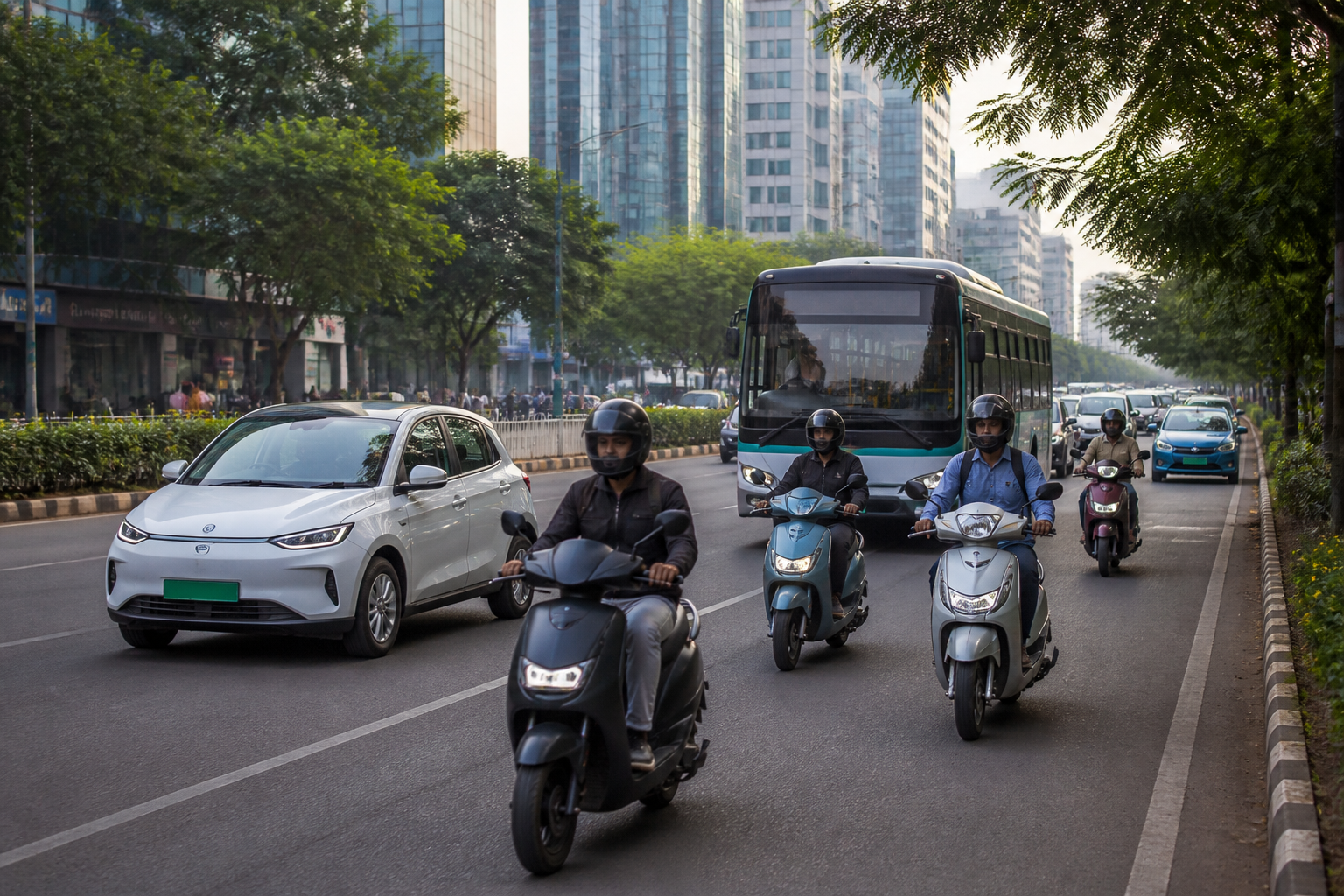
Bengaluru is becoming the centre of Karnataka’s electric vehicle transition, but the latest registration data reveals a more complicated picture than a simple clean-mobility success story. In August 2026, electric vehicles accounted for 17.5% of all new vehicles registered in the city, yet EVs still made up only about 3.8% of Bengaluru’s total registered vehicle fleet as of August 30.
The figures reported by the transport department and published by the Times of India show the difference between the rate at which a technology is entering the market and the much slower process of changing the entire vehicle stock on the road. Bengaluru registered 76,508 new vehicles in August, including 13,389 EVs. Nearly 2,500 new vehicles were added to the city’s roads each day, of which about 430 were electric.
That makes Bengaluru the dominant engine of Karnataka’s electric mobility market. The city accounted for 50.3% of the 26,636 EVs registered across the state during August. Its accumulated lead was even larger: as of August 30, Bengaluru had more than 4.9 lakh registered EVs, compared with nearly 8.9 lakh across Karnataka. The city therefore held about 56% of the state’s total EV fleet.
The numbers matter because Bengaluru’s transport transition is not taking place on an empty road network. The city had 1.3 crore registered vehicles as of August 30, including more than 88.5 lakh two-wheelers and nearly 25.5 lakh cars. Even after years of rising EV adoption, the existing fleet remains overwhelmingly powered by conventional fuels or includes vehicles outside the electric category. New sales can change quickly; the accumulated fleet changes only as older vehicles leave the road or are replaced.
## Bengaluru EV registrations are being driven by two-wheelers
The composition of new EV registrations explains much of the city’s growth. Electric two-wheelers accounted for 9,453 of Bengaluru’s 13,389 EV registrations in August, or about 71% of the monthly electric total. Electric cars contributed 1,258 registrations, equivalent to about 9% of the city’s EV registrations. The remaining vehicles belonged to other categories.
On a daily average, this translated into roughly 300 electric two-wheelers and 40 electric cars joining Bengaluru’s roads each day in August, alongside about 90 EVs from other categories. The pattern confirms that electrification is entering the city primarily through smaller private vehicles rather than through a broad-based replacement of every mode at the same speed.
This distinction is important for understanding the urban effects of the transition. A large increase in electric two-wheelers can reduce tailpipe emissions from new vehicles, but it does not by itself reduce congestion, road-space pressure or the total number of vehicles. Bengaluru’s registration data shows the scale of the vehicle market continuing to expand even as its powertrain mix begins to change.
The data also points to the importance of affordability and use patterns, although the supplied figures do not establish the reasons behind the purchasing choices. Two-wheelers already form the largest part of Bengaluru’s registered vehicle fleet, with more than 88.5 lakh in the city. Their dominance in new EV registrations means that the electric shift is occurring most rapidly in the same vehicle category that already shapes daily mobility for a large share of urban residents.
## A rapid rise from a low base
Karnataka’s annual registration trend shows how quickly EV adoption has accelerated. The state recorded 7,155 EV registrations in 2019-20. That number rose to 46,140 in 2021-22, crossed 1 lakh in 2022-23 and reached 2.3 lakh in 2025-26. Annual registrations in 2025-26 were more than 32 times the 2019-20 level.
The growth is substantial, but the comparison also illustrates why percentage increases need to be read alongside the size of the total fleet. A technology can expand many times over from a small starting point while remaining a minority of the vehicles in operation. Karnataka’s nearly 8.9 lakh registered EVs and Bengaluru’s more than 4.9 lakh EVs represent a significant installed base, but they remain a limited share of all registered vehicles in the city.
The August figures show that the transition is gaining momentum in the flow of new registrations. Nearly one in every six new vehicles registered in Bengaluru during the month was electric. But the city’s total fleet reflects years of accumulated registrations, and that stock changes more slowly. This gap between new sales and the existing fleet is central to evaluating the pace of urban decarbonisation.
It also means that registration data provides two different measures of progress. The monthly figure indicates how consumer and commercial vehicle purchases are changing now. The total fleet figure indicates how much of the city’s mobility system has actually changed. Bengaluru’s data is strong on the first measure and still limited on the second.
## The commercial fleet is part of the transition
Bengaluru’s electric fleet is not confined to private two-wheelers and cars. As of August 30, the city had 9,922 electric motor cabs, 6,855 passenger three-wheelers and 9,876 goods three-wheelers. It also had 2,009 electric buses registered with its regional transport offices.
These categories connect electrification to the functioning of the city rather than only to private vehicle ownership. Motor cabs, passenger three-wheelers, goods three-wheelers and buses support passenger movement, deliveries and public or shared transport. Their presence in the registration data shows that the transition includes commercial and service vehicles that operate frequently and contribute to the daily movement of people and goods.
However, the supplied data does not establish how these vehicles are used, how many are actively operating, their average daily distances, or the availability and location of charging infrastructure. It therefore confirms the size of the registered electric fleet but cannot by itself measure the reduction in fuel consumption, emissions or operating costs.
The same limitation applies to the city’s electric buses. The registration of 2,009 buses indicates a substantial electric-bus presence in the RTO records, but registration numbers alone do not show how many are in active service, which operators run them, or what share of the city’s bus journeys they carry. Those details would be necessary to assess the operational reach of electric public transport.
## The infrastructure question follows the registration surge
Bengaluru’s data raises an institutional question beyond vehicle sales: whether the city’s transport systems can keep pace with the changing composition of the fleet. The source material establishes the number and categories of registered EVs, but does not provide figures for charging stations, electricity demand, grid upgrades, parking-based charging or the distribution of charging facilities across neighbourhoods.
That missing layer matters because vehicle adoption and infrastructure provision do not automatically move at the same speed. A city may record strong electric two-wheeler growth while facing different charging requirements from electric cars, motor cabs, goods three-wheelers and buses. Commercial vehicles may need more predictable access to charging because their use is tied to daily trips and operating schedules.
The data also places Bengaluru’s municipal and transport institutions in a central position. The state’s registration totals are heavily concentrated in the capital, while the city’s fleet includes private, commercial and bus categories. This makes the electric transition a city-management issue involving road use, parking, public transport operations and energy systems, even though the figures supplied here are primarily vehicle-registration statistics.
For policymakers, the distinction between registrations and active mobility outcomes should remain clear. Rising registrations show that EVs are entering the market. They do not alone demonstrate that the city has reduced congestion, improved air quality, lowered transport costs or made mobility more equitable. Those outcomes require additional evidence that is not included in the August registration data.
## What Bengaluru’s numbers confirm—and what they do not
The evidence confirms three broad features of Karnataka’s electric shift. First, Bengaluru is the state’s principal centre of EV adoption, accounting for half of August registrations and about 56% of the accumulated EV fleet. Second, electric two-wheelers are the main driver of current growth, representing about 71% of the city’s EV registrations in August. Third, adoption has risen sharply from the 2019-20 baseline, with Karnataka’s annual registrations reaching 2.3 lakh in 2025-26.
At the same time, the evidence confirms that electrification remains incomplete when measured against the total vehicle stock. Bengaluru’s 4.9 lakh EVs form only about 3.8% of its 1.3 crore registered vehicles. The city is therefore experiencing a fast-moving change at the point of new purchase, alongside a much larger legacy fleet that will continue to shape road use for years.
The next stage of understanding Bengaluru’s transition will depend on information beyond registration counts: the operational performance of electric commercial fleets and buses, the geography and capacity of charging infrastructure, and the relationship between EV growth and the city’s broader mobility conditions. For now, the transport department’s figures show a city leading Karnataka’s electric shift, but not yet one whose entire vehicle system has been transformed.
