


Four alleged offences involving minor girls across Delhi in 14 days have brought attention back to a question that cannot be answered through arrests alone: how safe are the city’s ordinary spaces before a crime takes place? The reported locations range from a neighbourhood shop and a public road to an open area and a park. Their differences are important because they point away from a single “unsafe hotspot” and towards a broader problem involving surveillance, lighting, access, public awareness and the speed with which known vulnerabilities are addressed.
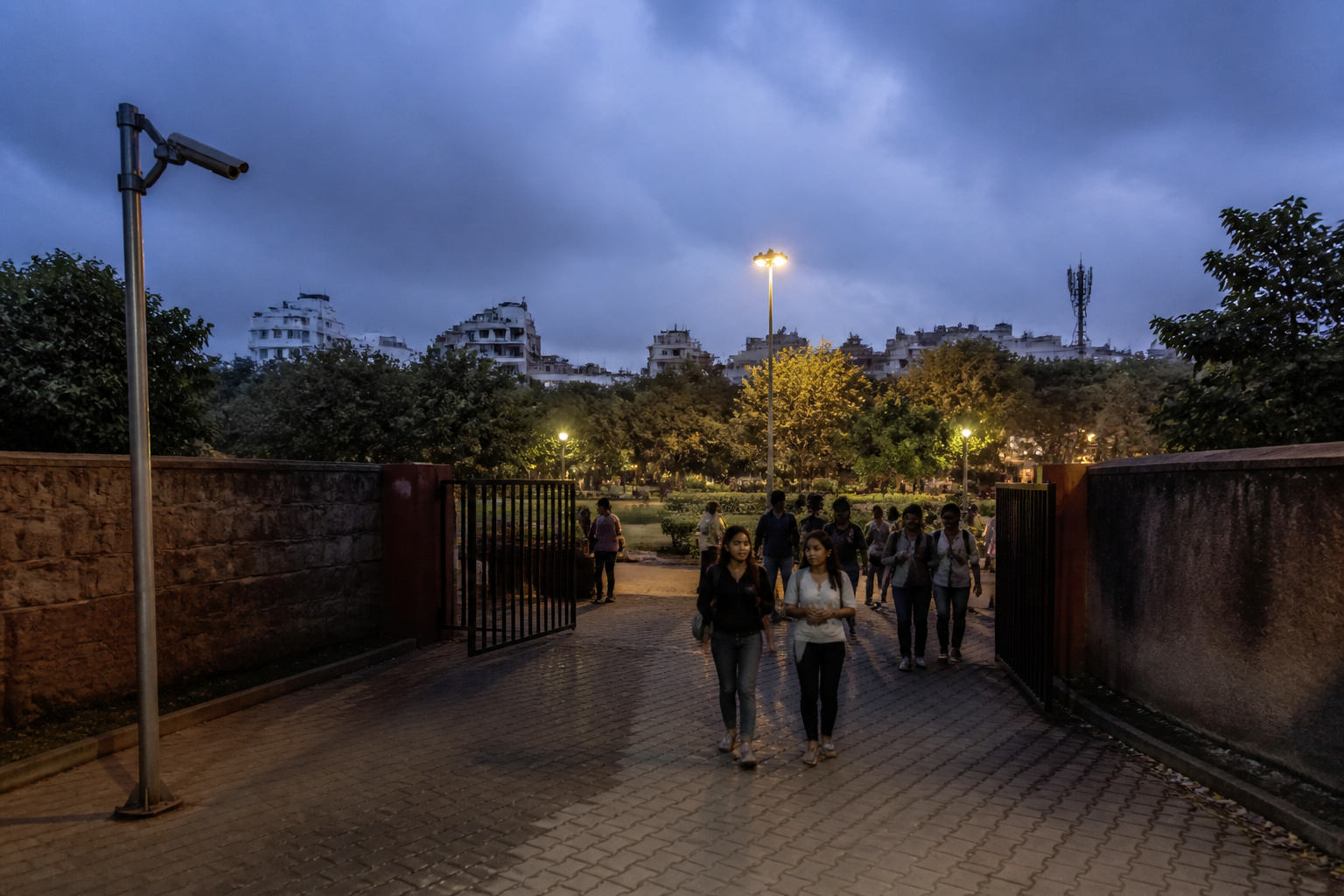
The latest case, reported from Aastha Kunj Park in Kalkaji, involved a 17-year-old girl who was allegedly gang-raped by men posing as police personnel. The case drew attention to the security conditions around the South Delhi park, including questions about CCTV coverage, lighting and the ability of authorities to monitor access and movement in a large public space. The police said the three accused were arrested within around 12 hours after investigators examined CCTV footage and technical inputs. One of the suspects was injured in an encounter.
That response illustrates one part of Delhi’s public-safety system: the capacity to investigate a reported offence, trace suspects and make arrests. It does not, by itself, establish whether a park was adequately lit, whether surveillance was functional, whether patrols were present or whether warning signs had been acted upon before the incident. Those are different administrative questions, involving not only the police but also agencies responsible for public-space management, lighting, maintenance and access control.
## Delhi safety is not confined to one type of place
The four cases reported since September 10 involved girls aged between six and 17. In Swaroop Nagar, a 17-year-old girl was allegedly gang-raped and killed after going to meet a teenage acquaintance. Four people, including three juveniles, were arrested, according to the report. In Sadar Bazaar, an 11-year-old girl was allegedly raped inside a shop after she went to buy stationery. A six-year-old girl was allegedly sexually assaulted on Deshbandhu Gupta Road. The fourth case was the alleged attack on the 17-year-old in Aastha Kunj Park.
The significance of these cases lies in the variety of settings rather than in any proven common method or common offender. A shop is a commercial premise; a road is a public route; a park is an open recreational space; and the Swaroop Nagar case followed a meeting with an acquaintance. Each setting has a different ownership, management and policing context. Treating all four simply as cases requiring more police deployment would overlook the institutional arrangements that shape safety in each location.
A commercial area may require responsible business practices, visibility and mechanisms for reporting suspicious conduct. A road may depend on lighting, pedestrian movement and the presence of nearby establishments. A park may require controlled entry points, functioning lights, patrols and working cameras. A meeting arranged through a personal connection raises a different set of risks and cannot be addressed only through physical infrastructure. The common urban question is whether the city’s safety systems recognise these differences and respond before an offence occurs.
The report’s evidence also points to a distinction between response and prevention. In the Swaroop Nagar investigation, police examined footage from more than 50 CCTV cameras and traced a suspicious tempo to identify the suspects. In the Kalkaji case, CCTV and technical inputs helped investigators make arrests quickly. These capabilities matter because they can improve the chances of identifying offenders after an incident.
But post-incident investigative performance is not the same as preventive safety. A camera that helps reconstruct an offence may not have deterred it. A high rate of arrests may demonstrate investigative capacity without showing that children and women can move safely through parks, roads, shops and neighbourhoods. The two functions require different measures, different responsibilities and different forms of public accountability.
## What the numbers establish—and what they do not
The latest NCRB data cited in the report places Delhi at the top among the 19 metropolitan cities covered for absolute numbers of crimes against women in 2024. Delhi recorded 13,396 such cases, including 1,058 rape cases. It also recorded 7,662 crimes against children, the highest number among the metros in the cited data.
The absolute numbers establish the scale of the problem in the capital, but they do not by themselves explain the risk attached to a particular park, street, shop or neighbourhood. They also cannot be read as a direct measure of the probability of victimisation without population, reporting and case-definition context. The report does not present those additional measures. What the figures do show is that the recent incidents are part of a larger and continuing public-safety challenge rather than an isolated administrative episode.
Delhi Police figures cited in the report show 1,901 rape cases in 2025, compared with 2,076 in 2024 and 2,141 in 2023. Police also said that 95% of murder cases and 97% of rape cases were solved in 2025. These figures indicate a reported decline in rape cases over the three years and a high stated case-solving rate. They do not resolve the prevention question, because solving a case happens after harm has occurred.
Nor can the four cases reported over 14 days be treated as proof of a new trend in Delhi’s crime rate. The source itself makes that distinction. Each case must be assessed on its own facts, while the circumstances collectively expose the range of places in which minors may be vulnerable. The evidence supports a concern about the breadth of the safety challenge; it does not support a claim that the city has entered a new crime pattern based on this short period alone.
## The institutional problem behind public-space safety
Safety in the built environment is distributed across institutions. Police are responsible for investigation, emergency response and policing, but lighting may rest with a civic agency or another public authority. Parks may be managed by municipal bodies, development agencies or local institutions. Shops and commercial premises operate under private ownership but within a regulatory environment. CCTV systems may be installed by different agencies, with separate questions about maintenance, monitoring, storage and access to footage.
This division can produce a familiar administrative gap: every agency may perform a defined task while no single authority is held responsible for the safety of the entire journey or place. A park can technically have lights but remain poorly illuminated at its edges. Cameras can exist but fail to cover entry routes. A road can be public and busy during the day but difficult to monitor at night. A commercial premise can be open to customers without clear safeguards for children. The supplied evidence does not establish which of these specific failures occurred in each case, but it identifies the areas that require examination.
The response of Lady Shri Ram College to the Kalkaji incident, by shifting classes online, shows how an offence in a public space can alter the functioning of an institution beyond the immediate site. Such a decision may be a short-term safety measure, but it also demonstrates how insecurity changes access to education, mobility and public life. When institutions restrict movement because nearby public space is perceived as unsafe, the costs are carried by students, families and workers even when they were not directly involved in the case.
A prevention-focused system would therefore need to look beyond whether suspects are arrested. It would have to examine whether vulnerable locations are mapped, whether complaints about lighting and surveillance are acted upon, whether park and street management responsibilities are clear, and whether information moves quickly between institutions. The source material does not provide an audit of these systems, so it cannot establish how many gaps exist or which agency is responsible in each location. It does, however, show why those questions are now unavoidable.
## The larger urban question
Delhi’s safety challenge is not limited to policing isolated hotspots because the reported incidents occurred across different kinds of urban space. That makes the design and management of everyday environments part of the public-safety conversation. Visibility, lighting, access, staffing, surveillance and community vigilance may influence how easily an offence can occur or be detected, but their effectiveness depends on maintenance and coordination rather than installation alone.
The cases also underline the importance of separating evidence from reassurance. Arrests, FIRs and investigations are necessary parts of the justice process. They should not be presented as evidence that the underlying safety problem has been solved. Likewise, a short-term decline in reported cases or a high solving rate cannot substitute for information about whether public spaces are safer before an offence is reported.
What the available evidence confirms is that Delhi has significant reported crime against women and children, that the recent cases involved varied settings, and that police investigations used CCTV and technical inputs to trace suspects. What remains uncertain is how many of the relevant locations had functioning preventive safeguards, whether earlier warnings were available, and how responsibilities were divided among agencies. Those are the next facts that any serious assessment of Delhi’s urban safety must establish.
