


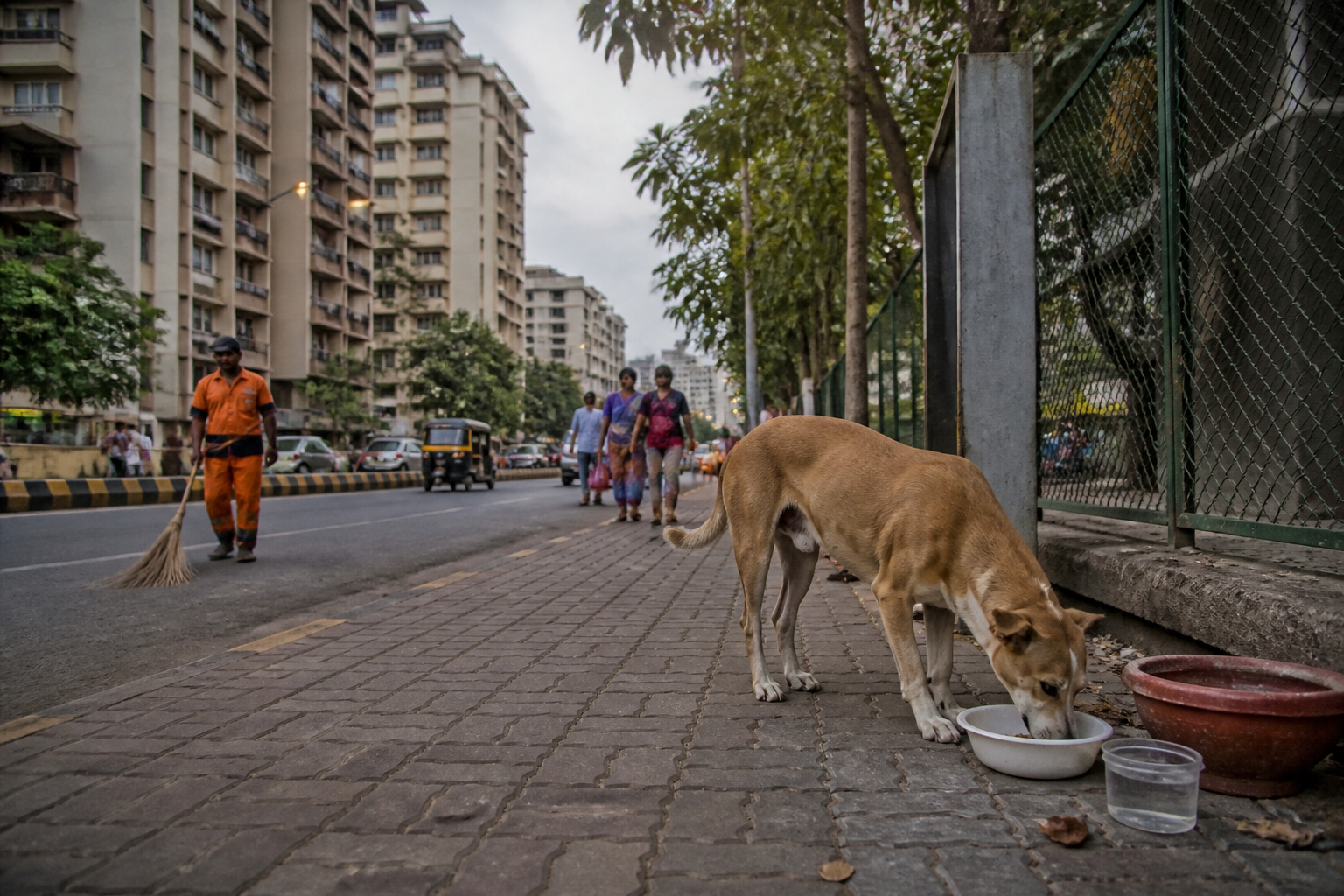
Mira Bhayandar’s decision to impose a fine of up to Rs 5,000 on people who feed stray dogs outside designated locations is now under legal scrutiny, exposing the administrative tension between neighbourhood sanitation concerns, animal-care practices and the limits of municipal enforcement.
The Mira Bhayandar Municipal Corporation had identified specific locations where stray dogs could be fed. Its provision applies a fine of up to Rs 5,000 when feeding takes place in open areas outside those locations. The municipal decision followed complaints that feeding in public spaces was creating unclean conditions and foul odours, according to a report by Loksatta.
The dispute moved beyond a local municipal order after animal lover Roshan Pathak complained to the district animal husbandry department. In a letter sent on 4 September, the department directed that the legal validity of the municipal provision be examined. It also asked the civic body to obtain an opinion from its law and justice department.
That sequence is significant because the issue is no longer limited to where residents may feed community dogs. It has become a question of how a municipal corporation can regulate an activity that intersects with sanitation, public-space management and animal welfare. The available report does not state that the fine has been cancelled or suspended. It records that its legality is being examined and that further action has been sought in accordance with applicable rules and guidelines.
The municipal corporation’s stated concern is the effect of open feeding on the immediate urban environment. Complaints cited in the report refer to unclean conditions and foul odours. In a dense city, such complaints can become a neighbourhood-level governance issue because feeding may take place near residential buildings, roads or other shared spaces. However, the report does not identify the number of complaints, the locations involved, the enforcement mechanism or the number of fines issued.
The other side of the dispute is represented by animal caregivers and the complaint submitted by Pathak. Their opposition indicates that the designated-location rule is being challenged as potentially inconsistent with the legal and administrative framework governing the treatment of stray dogs. The report does not provide the full text of the complaint, the municipal order or the legal arguments made by the complainant. Those documents would be necessary to establish the precise grounds on which the fine is being contested.
The district animal husbandry department has asked the municipality to consider the matter under the Animal Birth Control Rules, 2023, and guidelines issued by the Animal Welfare Board of India. The report names these instruments but does not reproduce their relevant provisions. It therefore establishes that the department has directed the civic body to examine the policy against that framework, but it does not establish the final legal position of the fine.
This distinction matters in municipal administration. A civic body may create rules to address local complaints, but the validity and implementation of those rules can depend on the wider legal and regulatory framework. In this case, the district department has not been reported as issuing a final ruling against the municipality. Instead, it has asked the corporation to undertake a legal review, consult its own law and justice department and take necessary action after considering the 2023 rules and animal-welfare guidelines.
The episode also shows how an apparently narrow public-space rule can produce overlapping institutional responsibilities. The municipal corporation is responsible for managing conditions in its jurisdiction and has acted in response to sanitation complaints. The district animal husbandry department has intervened after receiving a complaint and has directed a review based on animal-control and welfare provisions. The Animal Welfare Board of India’s guidelines have also been brought into the administrative consideration described in the report.
The available information does not clarify whether the feeding locations were selected through a notified policy, whether residents were consulted, what sanitation arrangements exist at those locations or how the corporation proposes to prevent waste and odour there. It also does not say whether the municipal corporation has published a standard operating procedure for feeding, cleaning, handling complaints or imposing penalties. These details would determine whether the rule functions as a workable management system or only as a restriction backed by a fine.
The same information gap applies to enforcement. The reported penalty is up to Rs 5,000, but the report does not state whether the amount is fixed or discretionary, which officer can impose it, what evidence is required, whether a notice or hearing is provided, or what appeal process is available. Without those details, the practical effect of the order on residents and animal caregivers cannot be fully assessed.
The dispute therefore sits at the intersection of three urban concerns. The first is public hygiene: residents have complained about unclean conditions and foul odours associated with feeding in open areas. The second is the management of stray dogs through the framework cited by the animal husbandry department. The third is the design of municipal enforcement, including how a city identifies permitted locations and ensures that regulation is clear, consistent and legally defensible.
None of these concerns can be resolved by the existence of a fine alone. A penalty may define what the municipality does not want to see in public spaces, but the reported action by the district department shows that the legal basis and administrative method still require examination. The source material does not establish whether the designated sites are adequate, whether they are accessible to caregivers or whether they have been linked to cleaning and waste-control arrangements.
The immediate next step is the legal review directed by the district animal husbandry department. Mira Bhayandar Municipal Corporation has been asked to seek an opinion from its law and justice department and consider the Animal Birth Control Rules, 2023, along with the Animal Welfare Board of India’s guidelines before taking necessary action.
Until that process produces a further order or clarification, the available facts support a limited conclusion: the Rs 5,000 stray dog feeding fine remains the subject of an official legality review. The outcome will determine whether the municipal corporation changes, retains or otherwise revises the provision, but that decision has not been reported in the supplied material.
