


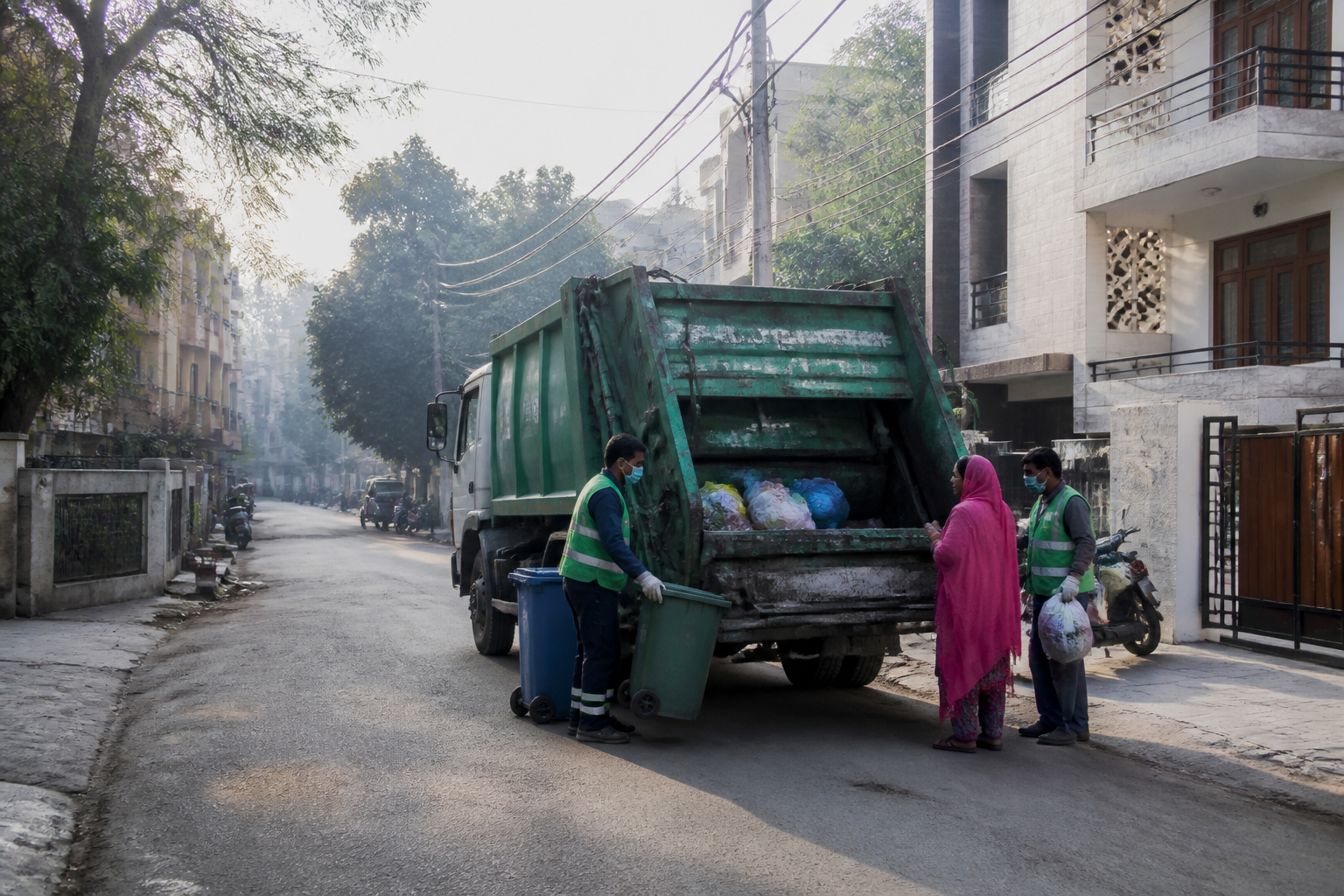
The Municipal Corporation of Delhi’s proposed increase in waste user charges and penalties is not simply a question of higher monthly bills. It is a test of whether the city can build a workable system for financing solid waste management while persuading residents that payment is linked to reliable sanitation services. Under the draft Solid Waste Management Bylaws 2026, charges could rise by nearly 50%, but the proposed rates would vary sharply according to colony categories.
The draft places residential properties in categories A to D on a higher tariff than those in categories E to H. A residential property measuring up to 50 square metres in an A to D colony would pay Rs 75 a month, compared with Rs 40 in an E to H colony. For a 100-square-metre residential plot, the proposed charge is Rs 150 in A to D colonies and Rs 75 in E to H colonies.
MCD officials have linked the proposed increase to the annual escalation provided for under the Solid Waste Management rules. One official told The Times of India that the rules provide for a 5% increase in user fees and penalties every year from 2018, resulting in an expected increase of around 50% at this stage. The lower rates for E to H colonies, the official said, are intended to increase participation in areas where compliance remains a challenge.
That distinction is central to the proposal. A uniform charge would be simpler to administer, but it would not reflect the differentiated rate structure that MCD already uses for property-tax categories. The draft instead attempts to combine an existing administrative classification with a sanitation-financing mechanism. The result is a system in which the location and size of a property determine the proposed charge, while the corporation’s stated objective is not only revenue collection but wider participation.
The proposal also exposes the difficulty of converting a bylaw into a functioning municipal service. MCD notified solid waste management bylaws in 2018, but the user fee was not actively implemented or collected because of what an official described as political and logistical issues. Charges were later linked to property-tax payments in April 2025. That step triggered opposition from residents, who questioned both the imposition of the fee and the quality of sanitation services.
This history matters because the practical challenge is not limited to deciding the tariff. MCD must identify liable properties, connect the charge to an existing payment system, communicate the category-based rates and enforce collection without creating confusion over exemptions or service obligations. The supplied report does not establish how the proposed bylaws would address each of these operational questions. It does, however, show that the corporation’s earlier attempt to establish the charge did not secure consistent acceptance.
The proposed structure also places service quality at the centre of the payment question. Residents’ opposition in 2025 was linked to concerns about sanitation standards. That means the fee cannot be assessed only as a municipal revenue measure. For households, it is likely to be understood as a direct exchange: a recurring payment in return for collection and related waste services. Where collection is irregular or streets remain unclean, the legitimacy of the charge becomes harder for the civic body to establish, regardless of the legal basis for imposing it.
MCD’s approach reflects a wider problem faced by large cities. The official cited Mumbai, Noida and Gurgaon as cities that have also struggled to levy waste charges fully. The comparison, as reported, does not provide figures for collection rates or explain whether the institutional arrangements in those cities are identical. It nevertheless indicates that the difficulty is not confined to Delhi. User charges may be approved on paper but remain weak in practice when billing, enforcement, public acceptance and visible service delivery do not operate together.
The category-based rates raise a second institutional question: whether a lower charge will produce greater participation in E to H colonies. MCD’s stated intention is to encourage compliance by keeping the rates substantially below those for A to D colonies. The proposal therefore treats affordability and participation as connected. But the supplied material does not provide evidence yet showing whether the lower tariff will improve payment levels, increase household cooperation or reduce enforcement costs.
The categories themselves are based on property-tax rates and cover markedly different urban environments. A colonies include Vasant Vihar, Shanti Niketan, Maharani Bagh, New Friends Colony and Anand Niketan. B colonies include Defence Colony, Nizamuddin East, Greater Kailash, Hauz Khas, Green Park and Safdarjung Enclave. E category areas include older parts of the city and specific extensions such as Chandni Chowk, Kashmere Gate, Khirki Extension, Pandav Nagar and Moti Nagar.
These examples show that the proposed tariff is being attached to an established classification rather than to a direct measurement of the amount of waste generated by each property. The report does not state that the draft calculates charges according to household waste volume, occupancy or the number of residents. The proposed basis is instead property size combined with the colony category. That makes the system easier to relate to property records, but it also means the charge is not presented as a precise account of individual waste generation.
The draft bylaws must still pass through the corporation’s formal approval process. Officials said the draft would first be placed before the MCD House and then sent to the Delhi government’s urban development department. MCD is targeting March 2027 for finalisation and implementation of the revised bylaws. Until those steps are completed, the proposed rates remain part of a draft framework and are not an implemented citywide charge under the information supplied.
The approval route also clarifies where responsibility will sit. MCD is preparing and placing the draft before its elected house, while the Delhi government’s urban development department has a subsequent approval role. The process creates more than one institutional checkpoint before implementation. It also means that the final provisions, including the tariff structure, penalties and collection mechanism, could not be treated as settled solely because officials have announced the draft proposal.
For residents, the immediate issue is the potential increase in monthly costs. For MCD, the larger issue is whether the charge can become a dependable part of solid waste management finance. The numbers in the proposal are clear: Rs 75 rather than Rs 40 for properties up to 50 square metres in the two broad category groups, and Rs 150 rather than Rs 75 for 100-square-metre residential plots. The administrative consequences are less settled, because the earlier record shows that notification did not automatically produce collection.
The proposal therefore places Delhi’s waste-management system at the intersection of three obligations: raising funds, maintaining public legitimacy and delivering a service that residents can recognise. A higher fee may strengthen the financial basis of the system only if the corporation can collect it consistently. A lower fee may encourage participation only if residents understand the classification and see a credible connection between payment and sanitation. The supplied evidence does not yet show whether either outcome will follow.
What is established is that MCD is seeking to revise a charge structure first notified in 2018, after an earlier attempt at implementation faltered and a 2025 link with property-tax payments generated opposition. What remains to be tested is whether the 2026 draft can resolve those operational and legitimacy problems. The next concrete milestones are its placement before the MCD House, consideration by the Delhi government’s urban development department and the proposed finalisation and implementation target of March 2027.
