


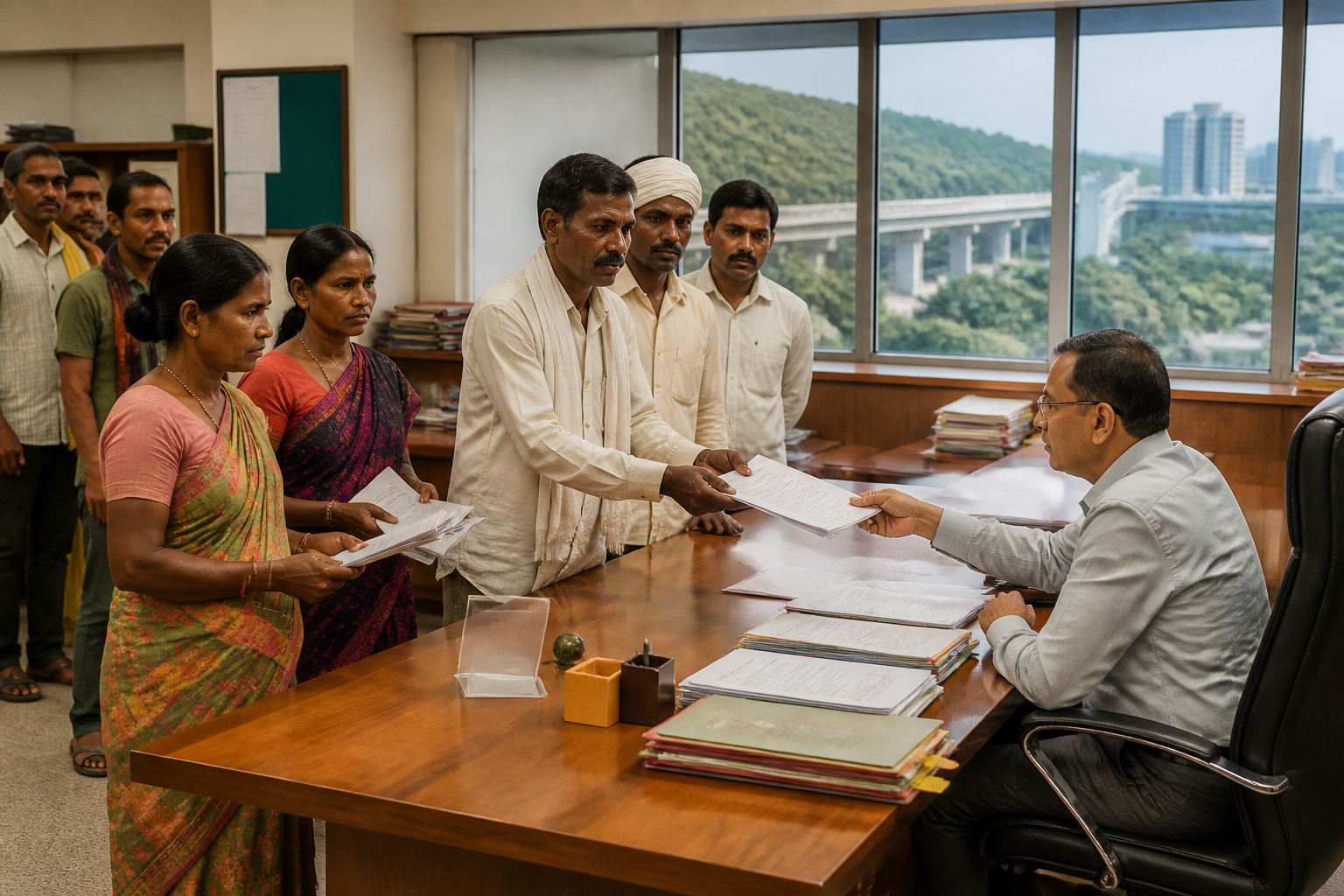
A new demand to clear pending forest-rights claims in Thane district has exposed a persistent gap between the legal recognition of forest-dwelling communities and the administrative delivery of those rights. Shramik Mukti Sanghatana has asked the Thane district collector, who also chairs the district-level Forest Rights Committee, to use a recently announced state campaign to resolve claims and appeals pending across Kalyan, Ambernath, Murbad and Shahapur talukas.
The organisation says 64% of forest-rights claims filed in the district have either remained pending or been rejected. Only 36% of claims have been accepted, according to figures it attributed to the Tribal Research and Training Institute. The numbers place the current demand within a wider governance problem: a law intended to secure livelihood and residence rights has not translated into timely or complete recognition for a large share of claimants.
The Forest Rights Act was passed in 2006 to provide rights over livelihood and residence to tribal communities and traditional forest dwellers. According to the report, many claims in Thane were filed from 2008 onwards. The organisation says several claimants died during the intervening years without receiving a final decision, and has asked the administration to process the claims of their legal heirs as a priority.
This waiting period is not simply an administrative delay. For households dependent on forest land and resources, the outcome of a claim can affect whether their residence and livelihood are formally recognised. Yet the material supplied in the report does not provide a district-wise breakdown of pending claims, the number of individual and community claims, or the reasons recorded for rejection. Those gaps matter because a single aggregate percentage can conceal different administrative problems: unresolved applications, rejected claims awaiting appeal, incomplete documentation, or decisions that have not been communicated effectively.
The reported acceptance rate also needs to be read alongside the area recognised. Shramik Mukti Sanghatana says the average area covered by accepted claims is only about half a hectare. The figure does not by itself establish whether the recognised area corresponds to the claims submitted or to the limits applied during adjudication. It does, however, raise a question about the relationship between formal recognition and practical livelihood security. A title or recognition covering a small area may provide legal clarity while still leaving households with limited productive land, particularly where access to common resources is also constrained.
The organisation has highlighted an even sharper disparity involving traditional forest dwellers who are not members of tribal communities. It says 91% of their claims have been rejected. The supplied report does not state the total number of such claims, the reasons for rejection or the number of appeals pending. Without that information, the percentage cannot be used to measure the absolute scale of the problem. It does indicate, however, that the administrative experience of different claimant groups may not be uniform and that the rejection process warrants closer examination.
Community forest rights form another part of the dispute. Shramik Mukti Sanghatana says such rights have been approved for most villages, but that the corresponding legal powers are not being respected. The report does not identify the specific rights involved or name the authorities allegedly failing to recognise them. That omission prevents a detailed assessment of implementation. The broader institutional issue remains clear: approval on paper does not necessarily mean that a village can exercise the authority, access or resource-related benefits associated with that approval.
The district collector’s role is central to the process described in the report. The memorandum was addressed to the collector both as the district’s senior administrative authority and as chair of the district-level Forest Rights Committee. The organisation has submitted updated lists of pending claims and appeals from four talukas. This gives the administration a concrete starting point for review, but the report does not specify a disposal timetable, a public hearing schedule or a mechanism for informing claimants about the status of their cases.
The state government’s newly announced campaign is therefore being presented as an opportunity to address an old backlog rather than as a routine administrative exercise. Shramik Mukti Sanghatana has asked that the campaign cover pending claims as well as appeals and that the heirs of deceased claimants be considered without further delay. The supplied report does not provide the campaign’s formal name, operating guidelines, targets, staffing arrangements or deadline. Those details will determine whether it becomes a time-bound clearance process or another announcement without measurable closure.
The Thane case also brings land-use decisions into the same frame as rights recognition. The organisation has alleged that forest land is being transferred on a large scale for highways, dams, power projects and mines, while forest-dependent communities must repeatedly organise demonstrations and approach the state administration to secure rights. It has further criticised proposed large projects in the Sahyadri ranges, including pumped-storage power projects, dams and river-linking schemes, alleging that they would damage nature and communities dependent on it.
These allegations are attributed to the organisation and are not independently established in the supplied material. The report does not identify particular projects, land parcels, acquisition notifications or environmental clearances. It would therefore be inaccurate to treat the allegations as proof of unlawful transfers or displacement. Their importance lies in the structural tension they identify: the state may process forest land for infrastructure through project-specific institutions while claimants experience rights recognition as a slow, fragmented administrative process.
That tension is especially significant in a district linked to the wider Mumbai Metropolitan Region while also containing rural and forest-dependent settlements. The report does not provide population, land-use or project data that would allow the scale of this regional relationship to be quantified. It does show how metropolitan expansion and infrastructure planning can intersect with communities whose claims are processed through district-level committees. A delay in one administrative system can become a barrier to residence, livelihood security and participation in decisions affecting land.
The evidence supplied points to four measurable administrative questions. First, how many claims are pending, and how many have been rejected but remain appealable? Second, how many cases concern individual rights compared with community forest rights? Third, why have 91% of claims by traditional forest dwellers been rejected, according to the organisation’s figures? Fourth, what procedure will apply to claims whose original applicants have died? Unless these questions are answered publicly, the 64% figure will remain a signal of failure without a transparent diagnosis.
There is also a data-quality question. The figures have been presented by Shramik Mukti Sanghatana using data attributed to the Tribal Research and Training Institute, but the report does not reproduce the underlying table or state the reference date. It does not say whether the 64% combines pending and rejected claims because the two categories require different administrative responses. A pending application may need scrutiny and a decision; a rejected application may require reasons, appeal information or reconsideration. Combining them makes the backlog appear in one number while obscuring the work required to resolve it.
For the district administration, the immediate test is not only disposal but transparency. Updated lists have reportedly been submitted for Kalyan, Ambernath, Murbad and Shahapur. Publishing the number of cases received, accepted, rejected, pending and under appeal for each taluka would allow claimants and civil society groups to track progress. Separately identifying cases involving deceased applicants would make it possible to monitor whether heirs are being recognised. The source report does not say that such a public dashboard exists, so its creation cannot be treated as an announced government measure.
The larger urban question is how regional infrastructure expansion is governed when land rights remain unresolved. Highways, dams, power projects and other large interventions are usually discussed through capacity, investment and connectivity. The Thane claims show another side of the same development geography: the administrative capacity to recognise the people already living from and on the land. When decisions about projects move faster than decisions on rights, communities can experience development as a process that identifies land more efficiently than it identifies legal claimants.
The available evidence confirms a serious reported backlog and a demand for a time-bound administrative response. It does not establish the reasons behind every rejection, the legal status of particular projects or the government’s formal implementation plan for the new campaign. The next developments to monitor are the district administration’s response to the memorandum, publication of updated claim and appeal figures, the treatment of deceased claimants’ heirs, and whether community forest rights are translated into recognised and usable authority at village level.
