


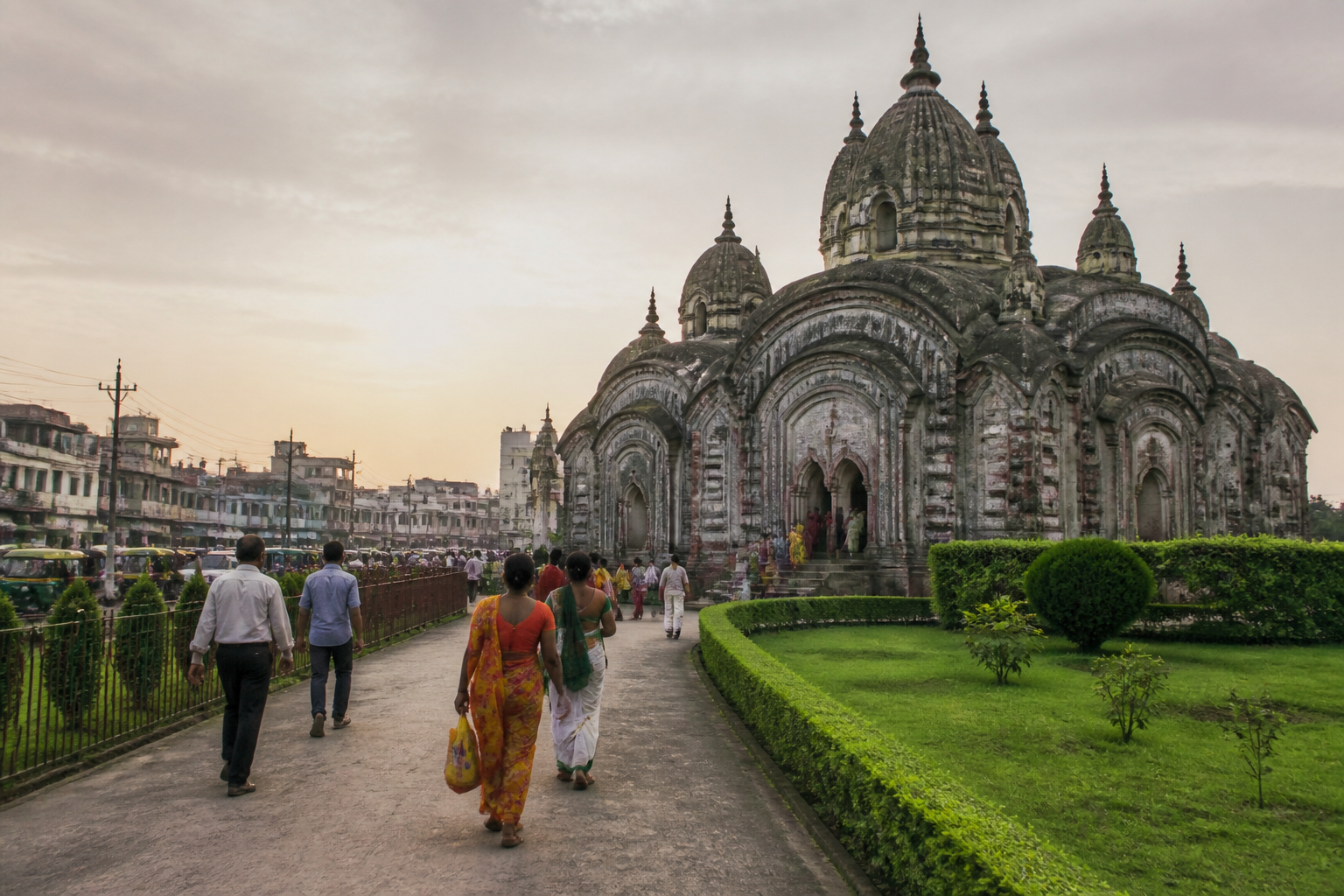
The proposed development of Cooch Behar as a major religious tourism destination places connectivity, public investment and institutional coordination at the centre of the city’s growth strategy. Chief Minister Suvendu Adhikari has said the historic city should attract both religious and nature-focused visitors, while identifying railways, roads, air services and temple infrastructure as essential to that ambition.
The announcement followed Adhikari’s visit to Cooch Behar during a three-district tour of North Bengal. He offered prayers at the Madan Mohan Temple and later told reporters that Cooch Behar should be developed as a tourism destination comparable to Tiger Hill in Darjeeling. The comparison is significant not simply because it invokes an established attraction, but because it frames Cooch Behar as part of a wider regional tourism circuit rather than as a single-site religious destination.
The proposed circuit would combine the city’s religious attractions with the forests, hills and wildlife of North Bengal. The chief minister referred to the Terai, Dooars and hills, as well as the region’s one-horned rhinoceros, as assets that could draw visitors. In this formulation, Cooch Behar becomes an entry point into a larger geography of tourism, with religious travel and nature-based travel expected to reinforce each other.
That approach also reveals the infrastructure challenge built into the plan. Religious tourism can generate demand around specific temples and festivals, but a regional tourism strategy requires visitors to move between districts and attractions. Adhikari therefore stressed the need to improve railway, road and air connectivity. The report does not specify new routes, capacity targets or completion timelines, but it makes clear that transport access is being treated as a prerequisite rather than a secondary benefit of tourism development.
The airport is one of the clearest institutional tests. Adhikari said he and Union Civil Aviation Minister Kinjarapu Rammohan Naidu would be in Cooch Behar on September 28 to discuss and pursue the development of the Cooch Behar airport. The proposed meeting brings a state-level tourism and development agenda into contact with the Union government’s civil aviation responsibilities. Its outcome will indicate whether the airport is being considered as an operational connectivity project, a broader regional access point, or both.
The temple itself is the first visible site of planned investment. According to the report, the Cooch Behar District Magistrate informed the chief minister that a detailed project report involving around Rs 2 crore had been prepared for the development of the Madan Mohan Temple. Adhikari said he had asked the district administration to increase the allocation and that money would not be a constraint.
This detail is important because it shows how the tourism proposal is moving from a broad political announcement towards a project-based administrative process. A detailed project report provides a basis for defining works, estimating costs and assigning responsibility, although the supplied report does not identify the proposed components of the temple project. The difference between a stated allocation and completed public infrastructure will depend on approvals, tendering, execution and maintenance, none of which has yet been detailed.
The North Bengal Development Department has also floated its first tender, with the chief minister saying that the maximum number of works had been earmarked for Cooch Behar. He said the process of preparing fund allocations for the district had begun and that flagship programmes of the Central and state governments had already been initiated and were being implemented there. These statements suggest that the tourism plan is being positioned within a wider development programme rather than as a stand-alone cultural initiative.
However, the report does not establish the scale, value or nature of the tendered works. Nor does it specify how the proposed projects will be integrated with the temple development plan, airport discussions or improvements to roads and railways. That missing information matters because tourism infrastructure is rarely limited to a landmark. Visitor growth places demands on access roads, parking, pedestrian movement, sanitation, waste management, water supply, public information and emergency services. The supplied announcement confirms some intended areas of intervention, but not the full civic infrastructure framework.
Cooch Behar’s proposed tourism role also depends on how the city is connected to the wider regional landscape. Adhikari referred to Madhupur Satra, which Assam Chief Minister Himanta Biswa Sarma had recently visited, alongside the Madan Mohan Temple as part of Cooch Behar’s religious attractions. This reference places the city within a cultural geography that extends beyond one district and crosses state boundaries. It also raises a coordination question: a multi-destination circuit requires reliable links and compatible visitor infrastructure across administrative jurisdictions.
The state government’s stated focus on both religious and nature tourism creates a second layer of coordination. Religious sites and wildlife destinations do not have identical infrastructure requirements. A temple precinct may need visitor circulation, crowd management and heritage-sensitive improvements, while forest and wildlife tourism require access controls and location-specific management. The report does not set out a common planning framework for these destinations, but the proposed combination makes such coordination central to the strategy.
The bridge over the Murti river, which Adhikari said he would later inaugurate, illustrates how individual infrastructure projects can acquire tourism significance. The chief minister said the bridge could become a tourist attraction. Its primary function, design, location and expected transport benefits are not described in the supplied material. What is clear is that the government is presenting infrastructure not only as a means of movement but also as part of the visitor experience and regional tourism identity.
That dual role needs to be distinguished carefully. A bridge may improve access, but its designation as a tourist attraction does not by itself establish visitor demand or economic impact. Similarly, a temple development project may improve the visitor environment without resolving the wider transport and service constraints that shape access to the city. The Cooch Behar announcement therefore combines several types of intervention—heritage development, airport planning, departmental works, regional connectivity and tourism promotion—whose outcomes will depend on how they are sequenced.
The institutional structure outlined in the report is spread across multiple levels. The district administration is preparing the temple project report. The North Bengal Development Department is handling tenders and fund-allocation processes. The state government is promoting the broader tourism plan. The Union civil aviation ministry is expected to participate in discussions on the airport. Central and state flagship programmes are also cited as active in the district. This distribution of responsibility creates opportunities for pooled investment, but it also makes implementation dependent on administrative coordination.
The immediate public milestones are therefore procedural. The airport discussions scheduled for September 28, the tender process, the preparation of district fund allocations and the implementation of the temple project will reveal whether the announcement develops into an integrated programme. The chief minister also asked Cooch Behar residents to give the government about a year to fulfil their expectations, providing a broad political timeline but not a detailed project schedule.
The evidence currently supports a conclusion about direction, not delivery. The government has identified religious tourism as a development priority, named the Madan Mohan Temple as an initial investment site, linked Cooch Behar to North Bengal’s natural attractions and acknowledged the need for better rail, road and air connectivity. It has also indicated that departmental and district-level funding processes have begun.
What remains unestablished is the size of the proposed tourism economy, the number of visitors targeted, the specific transport improvements planned, the final cost of the temple works and the institutional arrangements for managing a larger visitor base. Those details will determine whether Cooch Behar’s religious tourism proposal becomes a connected urban and regional development programme or remains a collection of separate works around prominent attractions. The airport discussions, tender outcomes and project implementation will be the next evidence of how the strategy is taking shape.
