


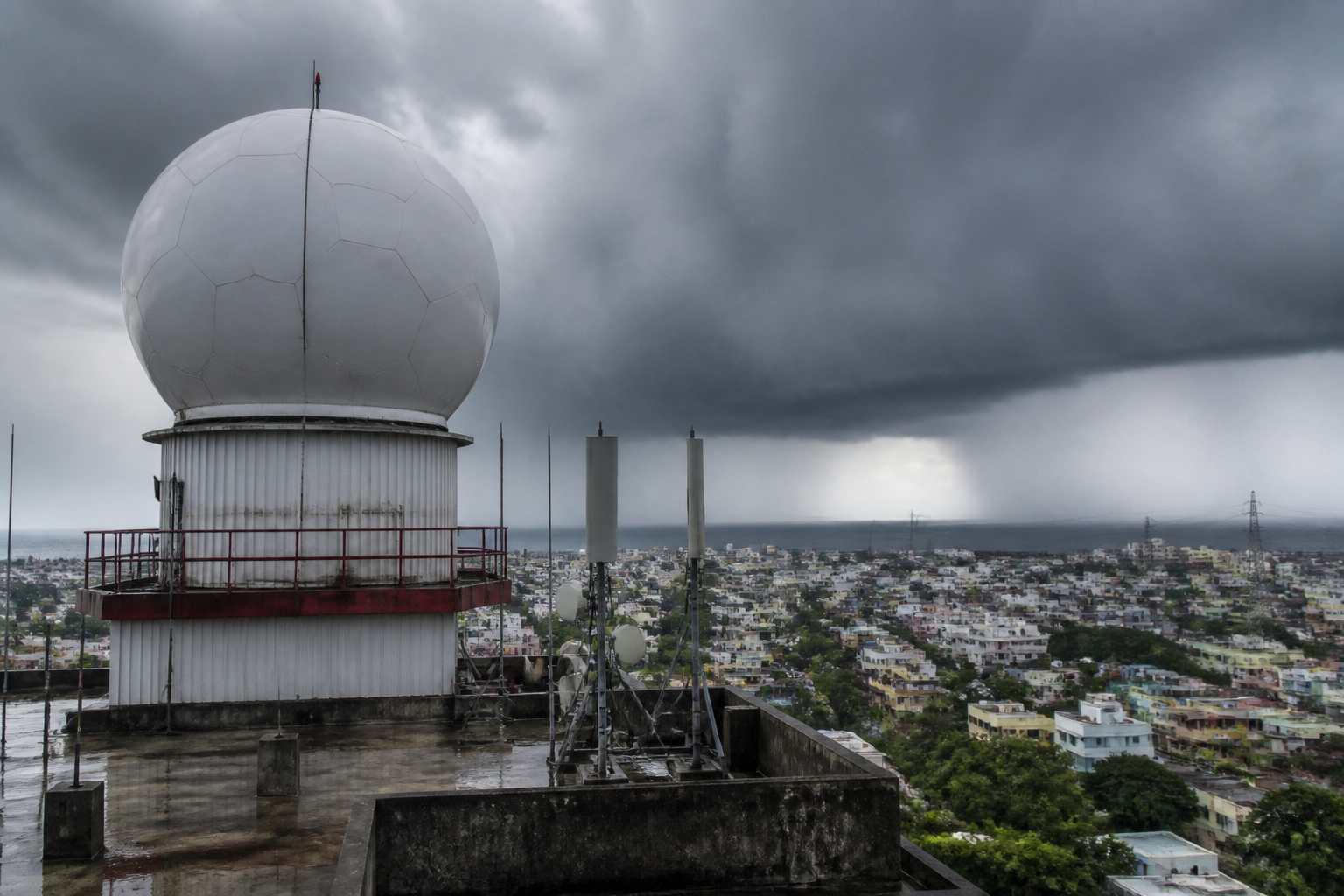
A reported technical problem at Chennai Port’s Doppler Weather Radar, combined with the pending installation of a replacement system, has drawn attention to a vulnerable part of the city’s monsoon-readiness infrastructure. The issue matters because radar is not merely a forecasting tool: it helps meteorologists track rain-bearing systems and changes in rainfall intensity over short periods, information that can shape warnings and emergency decisions during rapidly developing weather events.
According to a Thanthi TV report cited by DT Next, the radar at Chennai Port is facing a technical issue as Tamil Nadu enters a period of increased rainfall activity. The report also said that work to install a new radar has not yet been completed. The account does not establish that Chennai has lost all weather-monitoring capability, but it does raise questions about the reliability and resilience of the city’s localised warning network at a time when the northeast monsoon is approaching.
That distinction is important. Weather monitoring operates through several linked systems rather than one instrument. The India Meteorological Department continues to provide Chennai radar observations through its official platform, including rainfall intensity and other radar products, according to the report. Other facilities, including the National Institute of Ocean Technology radar at Pallikaranai, as well as radars at Sriharikota and Karaikal, also contribute data. Satellite observations and numerical weather models provide additional inputs, while the IMD’s Regional Meteorological Centre in Chennai issues district-wise warnings and nowcast information for Tamil Nadu and Puducherry.
The presence of alternative data sources provides some operational redundancy. However, redundancy is not the same as full substitution. A Doppler radar positioned to observe weather systems around a particular urban region can offer near-real-time information about the movement, direction and intensity of rain-bearing clouds. This is especially relevant to nowcasting, which focuses on conditions over the next few hours. Forecasting for longer periods depends more heavily on satellite observations and numerical weather models. The two functions overlap, but they are not interchangeable.
For a city such as Chennai, the difference between a general forecast and a localised nowcast can have practical consequences. Intense rainfall can vary sharply across parts of the metropolitan region, while drainage capacity, traffic conditions and exposure to flooding also differ from one neighbourhood to another. Information about where a rain cell is moving and whether its intensity is increasing can support decisions by agencies responsible for roads, stormwater drains, power supply, transport and emergency response. The supplied report does not quantify any current reduction in warning accuracy or response performance, but it identifies the monitoring gap that could affect these decisions.
The issue also has an institutional history. Chennai’s radar infrastructure has faced problems before. The Times of India reported in 2018 that the Doppler Weather Radar at the Chennai Port Trust building was not functioning at its optimal level and could measure only some parameters. A DT Next report later said that the radar underwent repairs and was restored for round-the-clock operations in August 2022. The recurrence of technical concerns shifts the story beyond a single equipment failure and towards the question of how ageing, specialised public infrastructure is maintained and replaced.
The November 2021 rainfall episode provides another point of reference. The News Minute reported that the Chennai and Karaikal radars were under maintenance when the city subsequently recorded more than 20 cm of rain during an intense spell. That episode demonstrated the operational importance of continuous radar coverage, even though the present report does not claim that the current glitch has produced a comparable monitoring failure. It instead places today’s concern within a pattern in which maintenance periods and extreme rainfall can overlap.
The pending replacement radar is therefore more than a procurement detail. Installation involves decisions about site selection, technical specifications, construction or equipment support, calibration, communications and integration with the IMD’s operating systems. The supplied material does not state the project’s cost, contractor, approved timeline or reason for the delay, so those aspects remain unestablished. What is clear is that the new installation has not been completed, leaving existing and supplementary systems to carry the monitoring burden while the city moves towards a season of heightened rainfall activity.
This also reveals the fragmented structure of urban climate preparedness. Rainfall monitoring is largely an IMD function, but the consequences of a warning are managed across multiple agencies. Municipal bodies must translate information into drain maintenance, road closures and flood response. Transport agencies need to manage disruption. Electricity and water utilities must protect networks. District administrations and emergency services must communicate with residents. A radar problem may therefore originate within a specialised meteorological system but become an urban governance concern when it affects the timing and precision of action elsewhere.
The available evidence suggests that Chennai retains several layers of weather observation. The IMD’s official radar products, radars at Pallikaranai, Sriharikota and Karaikal, satellite data and weather models continue to support analysis, while regional authorities issue warnings and nowcasts. At the same time, the Chennai Port radar’s reported technical issue and the unfinished replacement indicate that the city’s monitoring architecture is not fully insulated from the failure of individual assets. The 2018 and 2022 references further show that reliability depends not only on installing equipment but also on sustained maintenance and timely renewal.
The central urban question is whether critical warning infrastructure is being treated as a continuously operated public service or as a project that is considered complete once equipment is installed. Radar coverage has value only when instruments function, data is transmitted, observations are interpreted and warnings reach agencies and citizens in time. The supplied reports do not provide enough information to assess the current system’s performance, but they identify the points that require scrutiny: the condition of the Chennai Port radar, the schedule for the new installation, the effective capacity of alternative radars and the arrangements for continuity during maintenance.
The next milestone is the completion of the proposed new radar installation and the restoration or clarification of the Chennai Port system’s operational status. Until those details are publicly established, Chennai’s weather monitoring remains supported by a network of alternative sources, but with renewed attention on the reliability of the infrastructure intended to strengthen localised monsoon warnings.

