


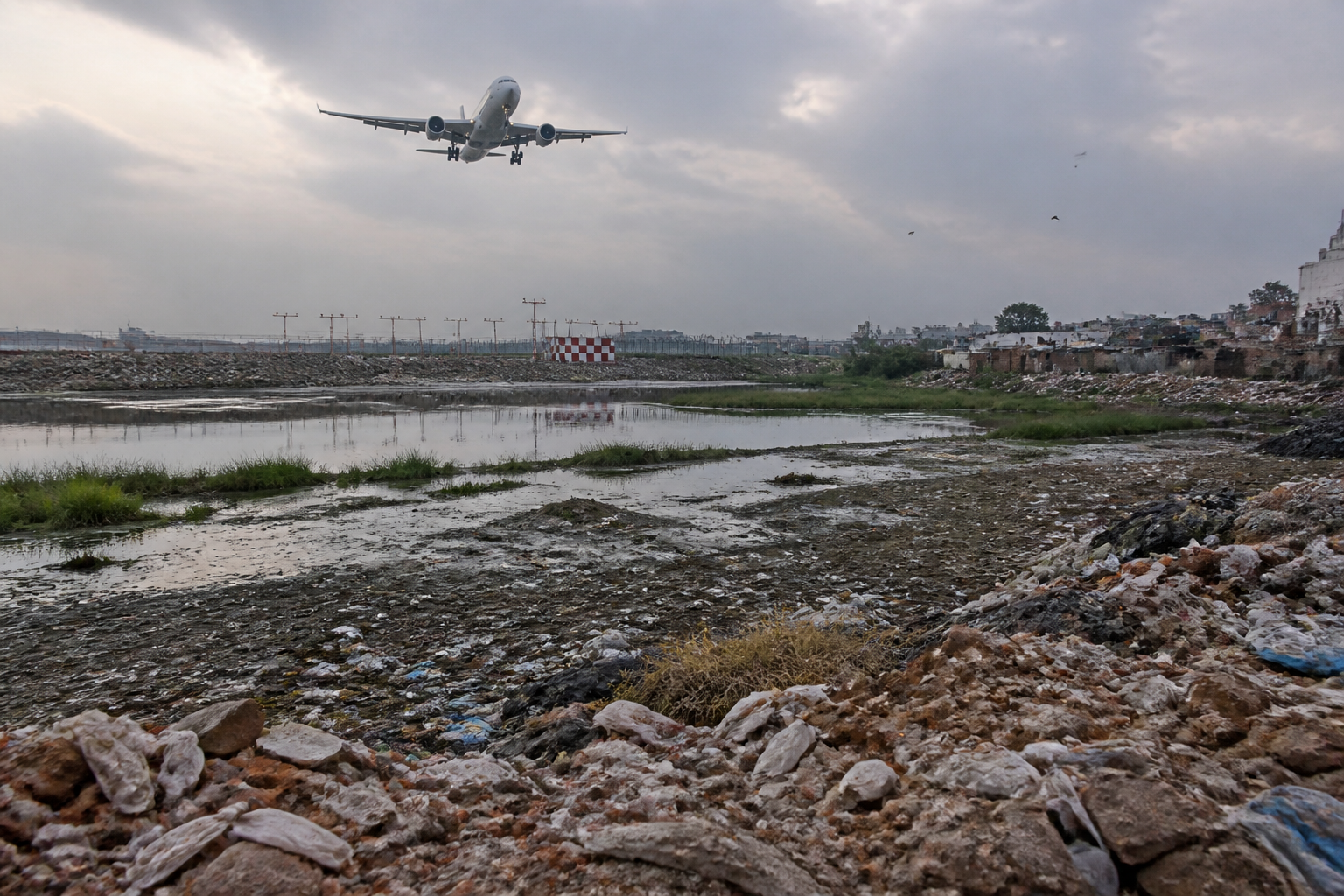
Bird strikes at Delhi’s Indira Gandhi International Airport have increased approximately 3.5 times in 2025 and 2026 compared with previous years, according to information presented by Delhi International Airport Ltd (DIAL) to the Airfield Environment Management Committee. The increase is not being described simply as an aviation problem. The committee identified a chain of urban management failures around the airport, including waste dumping, stagnant sewage, unauthorised meat markets, construction debris, animal movement and bird feeding.
That makes the issue larger than the airport boundary. Aircraft approach paths pass over a city whose waste, drainage, land-use and enforcement systems are divided among several agencies. When those systems fail at the edge of a major airport, the consequences appear as a safety risk to aircraft, passengers and people on the ground. The committee’s response shows that the immediate hazard is visible, but responsibility for addressing it is dispersed.
The committee meeting, chaired by Special Secretary (Urban Development) Manoj Kumar Dwivedi, reviewed airfield-environment conditions affecting aircraft operations around IGI Airport. DIAL told the committee that bird-strike incidents had risen approximately 3.5 times in 2025 and 2026. The operator also raised concerns about waste disposal and unauthorised meat vending along aircraft approach paths, activities that can attract birds and other animals.
The reported presence of peafowl, monkeys and dogs around the airport added another layer to the risk. An officer quoted in the report said the animals posed a threat to VIPs, foreign delegates, passengers and aircraft operations. The committee directed the government agencies and civic bodies concerned to catch and relocate the animals in a time-bound manner.
The evidence presented at the meeting points to a recurring urban pattern: a safety-sensitive location is surrounded by ordinary city services that are either incomplete, poorly enforced or divided across institutional boundaries. Waste sites, drains, markets and informal settlements are not separate from airport operations when they lie below aircraft approach paths. They become part of the airport’s operating environment even when they are outside the airport’s direct control.
## The airport’s safety perimeter is larger than its fence
The most revealing location discussed by the committee was Rangpuri Pahadi. Stagnant sewage water and waste dumping into a water body by unauthorised colonies, particularly K-Block in Mahipalpur, were flagged as sources of bird activity. The land belongs to the Delhi Development Authority, while a portion was reportedly handed over to the Delhi Jal Board in December 2024 for construction of a sewage treatment plant. The work had not begun, according to the report.
This site illustrates why the problem cannot be resolved only through airport patrols or animal relocation. The water body, sewage flows and dumped waste are linked to land ownership, sanitation infrastructure and the pace of public works. DDA controls the land, DJB is associated with the proposed sewage treatment plant, and DIAL is responsible for reporting the operational consequences. The committee therefore directed DIAL to meet senior officers of the Municipal Corporation of Delhi, DDA and DJB and present the ground situation through photographs and videos.
The instruction is significant because it converts an aviation complaint into an inter-agency coordination exercise. It also underlines a persistent governance difficulty: the institution experiencing the risk is not necessarily the institution that controls the source of the risk. DIAL can identify bird activity near approach paths, but it cannot by itself remove municipal waste, build a sewage treatment plant or regulate every adjoining land parcel.
The committee also asked DDA to clear dumped waste and preserve the ecological integrity of the water body. The two directions are connected. Clearing waste may reduce immediate bird attraction, but the condition of the water body, the movement of sewage and the continuing disposal of waste will determine whether the hazard returns. The report does not establish that the proposed sewage treatment plant has received a revised timeline or that construction has started.
## Meat waste, construction debris and rodents form the same urban chain
At Indra Market in RK Puram, the committee discussed an illegal chicken market where meat waste was allegedly being dumped into a drain behind the market. Such waste provides a direct food source for birds and can also contribute to wider sanitation problems. The chairman advised DIAL to hold in-person meetings with senior civic officials and explore a model in which DIAL could collect and transport meat waste from the locations concerned.
The proposed model reflects the practical difficulty of assigning responsibility after waste has already become an operational hazard. MCD was asked to increase challans and lodge First Information Reports under public nuisance provisions against individuals or shop owners dumping meat waste in the drain. The reported response combines service delivery with enforcement: waste must be collected reliably, but violations must also attract consequences.
A similar pattern was identified in Dwarka, where construction and demolition waste had reportedly been dumped along railway tracks adjacent to the approach areas of Runways 9, 10 and 11. The area behind the cremation ground near the railway line was specifically mentioned. An official said the dumping was contributing to increased bird activity and creating rodent hideouts within the aircraft approach area.
This is an example of how construction waste can become an aviation-safety issue. The material may be deposited away from the airport’s operational surfaces, but its effects can travel through the urban ecology. Waste can provide shelter for rodents, rodents can attract animals and birds, and bird movement can intersect with aircraft paths. The report does not provide a quantified breakdown of bird strikes by location or identify the proportion linked to each waste site. It does, however, show that the committee is treating several types of waste as part of one connected risk environment.
## Enforcement gaps are visible across multiple neighbourhoods
The committee’s concerns were not confined to a single hotspot. Pigeon feeding in Dwarka Sector 8 was discussed, while installation of “no bird feeding” signage was still pending. DIAL was asked to provide DDA with cautionary slogans or advisory messages for posters warning residents not to feed birds near airport localities.
Other locations flagged for garbage accumulation, illegal waste segregation or poor waste management included Jai Hind Colony opposite Vasant Square Mall in Vasant Kunj, Dhalao No 6 in Rangpuri, Dabri Mor, Kusumpur Pahadi and Gokul Chowk in Palam Colony. The spread of locations matters. It indicates that the airport’s environmental management challenge is not limited to one illegal dump or one badly managed market. It extends across a network of neighbourhoods connected to approach paths and airport surroundings.
The pending signage in Dwarka also demonstrates the difference between identifying a risk and implementing a response. A sign is a relatively simple intervention, but its absence can persist even after the underlying concern has been raised. The report records directions to agencies, but it does not establish whether the signs were subsequently installed, whether feeding reduced or whether penalties were imposed.
That implementation gap is central to the story. The committee can convene DIAL, MCD, DDA and DJB, identify sites and issue directions. The next stage depends on field action: removal of waste, treatment of sewage, regulation of meat markets, control of construction debris, enforcement against dumping and management of animals. Without documented completion of those tasks, the meeting remains an administrative response to a continuing hazard.
## A coordination problem disguised as a bird problem
The institutional map around IGI Airport is complex. DIAL operates the airport and monitors conditions affecting aircraft operations. MCD has responsibilities related to municipal waste, public nuisance enforcement and local markets. DDA owns land at the Rangpuri Pahadi site and was asked to clear waste and protect the water body. DJB was linked to the proposed sewage treatment plant. Railway land and adjoining areas also appear in the discussion of dumping near Dwarka.
The reported directions show that the airport safety issue cuts across these mandates. No single agency controls the entire chain from waste generation to disposal, drainage, animal movement and aircraft risk. That is why the committee asked DIAL to meet senior officers and use photographs and videos to communicate the ground situation. The instruction is an attempt to make a dispersed problem concrete for agencies whose daily responsibilities may be organised by civic function rather than by airport approach zone.
The proposed collection and transport of meat waste by DIAL is particularly notable because it suggests that conventional jurisdiction may not be sufficient in a high-risk environment. The report does not say that this model has been approved, funded or implemented. It records it as an option to be explored. Any such arrangement would require clarity on cost, legal authority, service boundaries and coordination with MCD.
The same question applies to the treatment of sewage and water bodies. DDA and DJB are associated with different parts of the Rangpuri Pahadi problem, while local colonies are reported to be dumping waste into the water body. A plant alone cannot resolve the issue if waste continues to enter the site, just as waste removal may not be durable if sewage remains stagnant.
## What the available evidence confirms
The available report establishes five important facts. First, DIAL reported an approximately 3.5-fold increase in bird-strike incidents in 2025 and 2026 compared with previous years. Second, the Airfield Environment Management Committee linked airport-environment concerns to waste dumping, unauthorised meat vending, bird feeding and animal presence. Third, multiple sites across Rangpuri, Mahipalpur, RK Puram, Dwarka, Vasant Kunj, Dabri, Kusumpur Pahadi and Palam Colony were discussed.
Fourth, the committee issued directions to several agencies, including animal relocation, waste clearance, stronger enforcement, inter-agency meetings and the use of warning signage. Fifth, the reported sewage treatment plant at Rangpuri Pahadi, for which a portion of land was handed over to DJB in December 2024, had not begun construction at the time covered by the report.
The report does not provide the absolute number of bird strikes, a month-by-month trend, the aircraft types affected, the severity of incidents, or a completed action-taken report from the agencies. It also does not establish that every bird strike was caused by waste sites or meat disposal. Those limits matter. The 3.5-fold increase is a serious signal, but the available evidence does not support assigning a precise share of responsibility to each location or activity.
The larger urban lesson is nevertheless clear. Airport safety depends partly on the quality of city management beyond airport land. Where waste, sewage, construction debris and informal commercial activity are not controlled, their effects can enter high-consequence infrastructure systems. In Delhi, the committee’s response has identified the institutional links. The next test is whether those links produce verified work on the ground.
For now, the key developments to monitor are the status of the sewage treatment plant at Rangpuri Pahadi, clearance of the identified dumping sites, action against meat-waste disposal, installation of bird-feeding warnings, animal relocation and the completion of the agency meetings directed by the committee. These steps will determine whether the reported increase in bird strikes leads to sustained environmental management or remains another warning recorded in an inter-agency review.
