


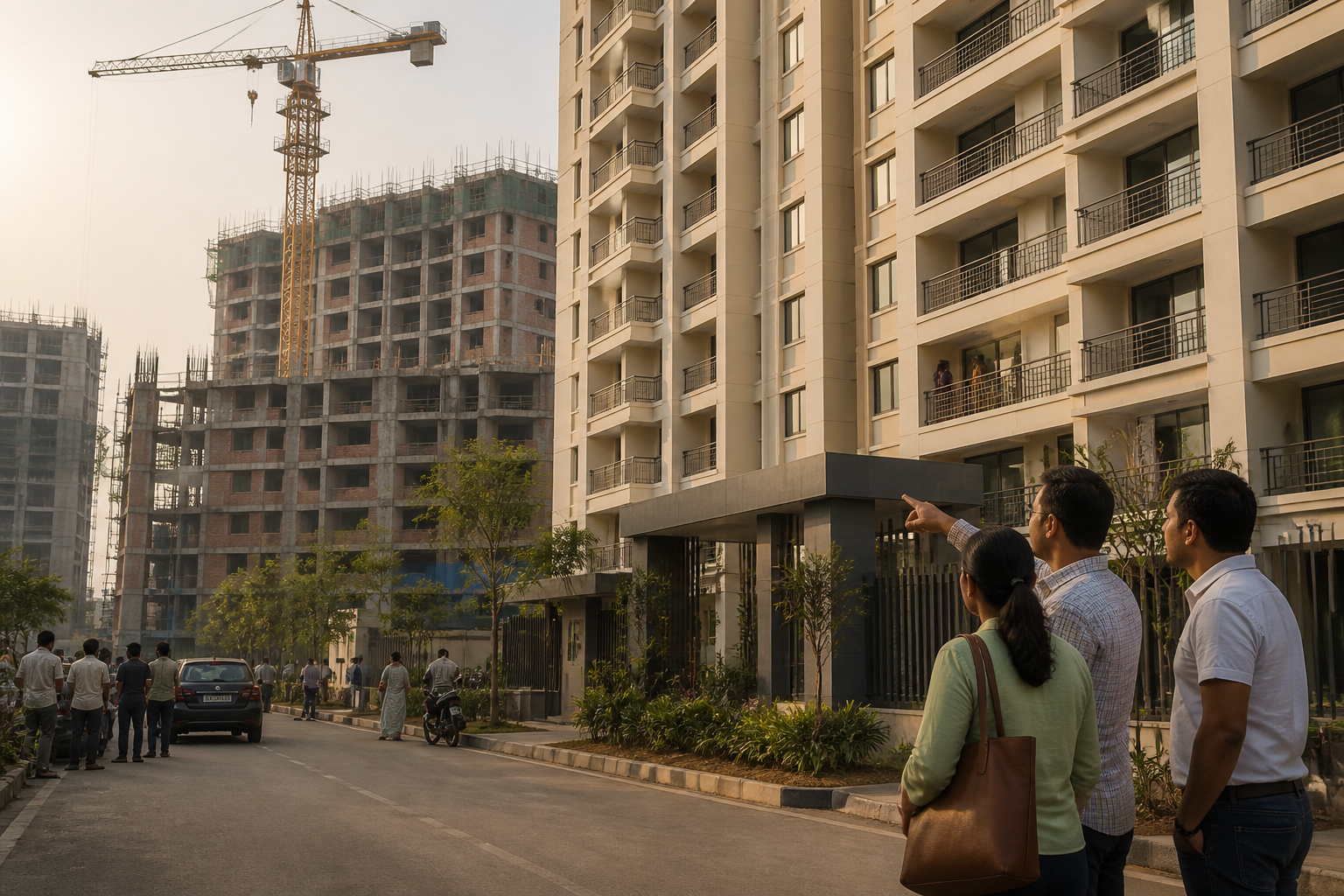
A new survey of homebuyers across India’s major cities shows that Mumbai and Pune continue to stand apart from several other metropolitan markets: the 2BHK remains the preferred format for more than 40% of respondents in both cities, even as rising prices push a growing share of buyers to postpone or abandon their purchase plans. The findings point to a housing market where demand is not disappearing, but is being reshaped by affordability.
The survey, conducted by Anarock Group, recorded responses during the first half of this year from 8,320 people aged between 23 and 77 across 14 cities. The report, as cited by Loksatta – Pune, examines housing preferences across eight metropolitan markets. Its findings provide a snapshot of what prospective buyers say they want, rather than a direct measure of completed property transactions.
That distinction is important. A stated preference for a 2BHK does not necessarily mean that a buyer has purchased one, or that suitable homes are available at a price the household can afford. But the responses do show the size and configuration of homes that remain relevant to buyers, and the extent to which increasing prices are influencing the timing of a purchase.
Mumbai-Pune real estate trends reveal a distinct demand pattern
Across the metropolitan markets covered, larger homes received the strongest overall preference. Forty-eight percent of respondents selected 3BHK homes, while 38% preferred 2BHK units. One-bedroom homes were preferred by 9% of respondents, and 4BHK or larger homes by 5%.
Mumbai and Pune show a different balance. In both cities, more than 40% of respondents preferred 2BHK homes. Mumbai recorded an 18% preference for 1BHK homes, while the corresponding figure for Pune was 10%. The preference for 3BHK homes stood at 38% in Mumbai and 47% in Pune. In both cities, only 3% of respondents preferred 4BHK or larger homes.
The numbers suggest that the middle of the housing market remains central to demand in the two urban regions. In Mumbai, the relatively high preference for 1BHK homes indicates the continuing importance of smaller units. Pune, by contrast, shows stronger demand for 3BHK homes while retaining a substantial 2BHK market. The survey does not provide the income, household-size or employment profile of respondents, so it cannot establish precisely why these preferences differ between the two cities.
The wider national comparison reinforces the contrast. More than half of respondents in Ahmedabad, Hyderabad, Chennai and Delhi preferred 3BHK homes. Bengaluru recorded the highest preference for 4BHK and larger homes, at 10%. Mumbai and Pune were therefore among the markets where 2BHK housing had a particularly strong position.
The price barrier is changing the timing of demand
The most consequential finding is not only the type of home respondents want, but what they intend to do when prices rise. According to the survey, 38% of respondents across the country had temporarily postponed their purchase decision because of increasing home prices. Another 18% had either postponed the decision indefinitely or cancelled it.
Together, these figures indicate that a sizeable portion of prospective demand is being held outside the immediate transaction market. The survey does not say that all these households have left the market permanently. Some have delayed a purchase, while others have deferred it indefinitely or abandoned the plan. These are different forms of demand pressure, with different consequences for developers, lenders and city-level housing planning.
For buyers, the result is a widening gap between the home they prefer and the home they can commit to purchasing. A 2BHK may be the preferred format in Mumbai and Pune, but the survey does not establish whether respondents are finding units in that category at acceptable prices. The fact that many buyers are delaying decisions suggests that preference alone is not translating smoothly into effective demand.
This is particularly relevant in markets where a household may be considering a home purchase for several years before making a final decision. Rising prices can change the calculation from choosing between a 2BHK and a 3BHK to deciding whether to buy at all. The survey captures this pressure at the point where aspiration meets affordability, although it does not quantify household budgets or the price thresholds at which decisions change.
What the survey shows about housing supply
The preference data also raises a question about the alignment between what cities produce and what households seek. In Mumbai and Pune, 2BHK and 3BHK homes together account for the overwhelming majority of stated preferences. Smaller and larger homes occupy narrower segments of the demand profile, although the 18% preference for 1BHK homes in Mumbai is significant.
The survey alone cannot show whether developers are supplying enough homes in each category, whether available units are located near employment and transport networks, or whether their prices match the purchasing capacity of respondents. It also does not provide city-level inventory, sales, rental or completion figures. Those gaps prevent a direct conclusion that a shortage of a particular unit size is responsible for the purchase delays.
What can be established is that demand is concentrated around a limited set of housing formats while the affordability constraint affects the decision to proceed. For the real estate industry, this creates a need to read demand not simply as a preference for larger homes, but as a combination of preferred size, location and price. The survey supplies evidence for the first element, and a clear warning about the third, but not enough information to assess the second.
The distinction between Mumbai and Pune is also significant for urban planning. Both cities are commonly discussed as major housing markets in the same regional economic corridor, yet their survey responses are not identical. Mumbai has a higher stated preference for 1BHK homes, while Pune has a higher preference for 3BHK units. Their housing strategies cannot therefore rely on a single metropolitan template based only on broad regional demand.
Housing affordability is now a demand-side issue
The survey’s postponement figures place affordability at the centre of the housing story. Price increases do not only affect people who are actively searching for homes. They also affect whether households enter the market, how long they remain in it and whether a planned purchase is reduced, delayed or cancelled.
For policymakers, this means that housing demand should not be assessed solely through registrations, sales or project launches. Those indicators record decisions that have already been completed. The 38% who temporarily postponed a purchase and the 18% who postponed indefinitely or cancelled represent decisions that may not appear in transaction data, even though they influence the underlying housing requirement.
The available material does not identify the causes of the reported price increases. It does not separate land costs, construction costs, financing costs, taxes, household income or local supply conditions. Nor does it establish whether the postponements are concentrated in Mumbai, Pune or other cities. These limits matter because the same national percentage can reflect different urban problems in different markets.
The findings do, however, show why housing demand cannot be understood only through the number of units that buyers say they prefer. In Mumbai and Pune, the 2BHK remains a strong demand category, but the market is also experiencing a substantial delay in purchase decisions. That combination points to a gap between desired housing and financially accessible housing.
The bigger urban question
The central issue raised by the Anarock survey is whether metropolitan housing markets are delivering homes in the formats that households want at prices that allow them to act. Mumbai and Pune offer a clear example of this tension. More than 40% of respondents in each city prefer 2BHK homes, while a large proportion of respondents nationally are holding back because of rising prices.
The evidence does not establish that one unit size will dominate future sales, nor does it predict how the market will behave. It confirms that preferences vary substantially between cities, that 2BHK homes are particularly important in Mumbai and Pune, and that price escalation is delaying or weakening purchase decisions across the surveyed markets.
The next stage of understanding will require city-level evidence on actual sales, available inventory, household incomes, project locations and financing conditions. Until those measures are connected to stated preferences, the survey is best read as an indication of housing intent under pressure: buyers continue to want homes, but an increasing number are choosing to wait or step away because the price of entry has become more difficult to manage.
