


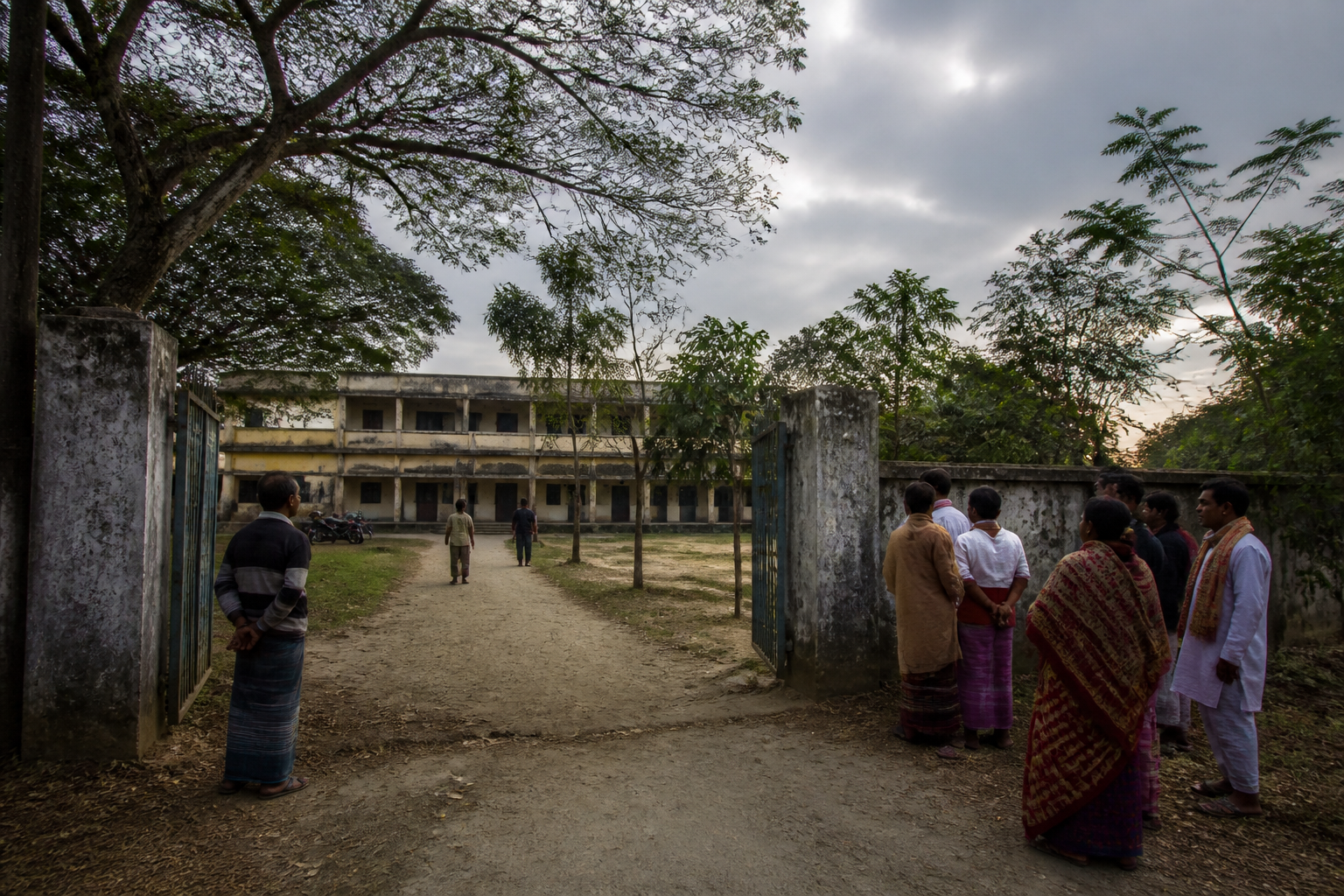
The Daribhit High School killings have returned to public attention not because the investigation has reached a conclusion, but because the families of Rajesh Sarkar and Tapas Barman say eight years have passed without justice. Their renewed criticism of the political parties that once supported them exposes a larger problem in public administration: a change of government does not automatically produce continuity, transparency or accountability in a contested criminal investigation.
The two former students, aged 19 and 22, were killed during a protest at Daribhit High School in North Dinajpur on September 20, 2018. The protest began over the appointment of teachers. Students wanted a Bengali teacher to be posted instead of the approved Urdu and Sanskrit teachers. During the unrest, Rajesh and Tapas were killed in firing, while another youth, Biplab Sarkar, was injured.
The incident connected education administration, language politics, policing and electoral mobilisation in one school-level dispute. What began as a disagreement over teacher appointments became a prolonged conflict involving protests, clashes, strikes, competing demands for an investigation and a legal battle over who should examine the deaths. The case therefore cannot be understood only as a law-and-order episode. It also reflects how decisions about public institutions can become politically charged when communities believe that representation, language and administrative responsiveness are at stake.
The families’ latest allegations are directed at the gap between political support in opposition and action in government. Manju Barman, Tapas’s mother, said the BJP had stood by the families during their agitation but that this support had weakened after the party came to power. She also said she had expected the judicial process to accelerate after the change of government and alleged that the case had not received significant attention.
These are allegations by a bereaved family, not findings established by a court. But their persistence is itself an important indicator of the case’s institutional failure as experienced by those seeking justice. The families have continued to ask for punishment for the police officers allegedly involved in the firing. They initially rejected cremation and buried the bodies near their homes before approaching the Calcutta High Court. Those actions demonstrate the depth of their distrust in the official process, even though responsibility for the deaths remains a matter for investigation and adjudication.
The investigation has already passed through several institutional stages. The then Trinamool Congress government ordered a CID investigation after the incident. The families instead demanded a CBI probe. On May 10, 2023, the Calcutta High Court transferred the investigation to the National Investigation Agency. An NIA team subsequently visited Daribhit, inspected the school premises and spoke to the families of Rajesh and Tapas and to Biplab, who was injured. Murarimohan Mandal, then the district inspector of secondary schools, was also questioned for several hours at the NIA office in Rajarhat, according to the report.
The transfer to the NIA is significant because it shows that the earlier investigative arrangement did not settle the families’ concerns. It also illustrates how contested cases can accumulate investigative layers without necessarily producing visible closure. A state CID inquiry, a demand for a central agency and a later High Court-directed NIA investigation represent different stages of institutional involvement. For families, however, the measure of progress is ultimately narrower: whether the circumstances of the firing are established, whether responsibility is fixed and whether the accused are prosecuted through due process.
The renewed mobilisation in Daribhit also shows how unresolved cases remain embedded in local political life. The Akhil Bharatiya Vidyarthi Parishad organised a rally demanding justice for the two youths. ABVP state secretary Deep Datta said the organisation remained optimistic that justice would be delivered and appealed to the chief minister to declare September 20 as Bangla Bhasha Dibas. The demand links the deaths to the language dimension of the original dispute, while also converting the date into a proposed public memorial marker.
The demand for official recognition of September 20 is not the same as a judicial remedy. It belongs to the sphere of memory, recognition and political symbolism. The families, however, are seeking both recognition and accountability. The case demonstrates why governments face pressure when they respond to contentious incidents with public homage or commemorative language while the underlying investigation remains incomplete. Recognition can acknowledge grief, but it cannot substitute for an evidence-based determination of what happened.
The state government’s response, as reported, has been to affirm that the probe is continuing. Koushik Choudhury, the state minister for fire and emergency services and education, visited Daribhit and paid homage to the deceased. He said the investigation was in progress and that the families would receive justice. BJP district vice-president Surajit Sen blamed the earlier Trinamool-led government for allegedly stalling the investigation, while also promising that the BJP would continue to support the families.
These competing statements reveal the political structure surrounding the case. Each side presents the other as responsible for delay, while the families measure both governments against the same unresolved outcome. The families’ criticism of the BJP is particularly notable because it challenges the assumption that a party’s opposition-era position will automatically determine its conduct in office. In long-running investigations, changes in political power may alter public rhetoric without changing the pace or visibility of the legal process.
The Daribhit episode also raises questions about the administration of schools in areas where language and identity carry political significance. The original protest concerned the appointment of Urdu and Sanskrit teachers instead of a Bengali teacher. The supplied account does not establish the policy basis for those appointments, the process by which they were approved or whether the appointments were later altered. Those unanswered administrative details matter because they would help distinguish a routine staffing dispute from a breakdown in consultation, communication or decision-making.
That missing institutional record is one reason the case continues to generate competing narratives. Political organisations describe the youths as victims of state action. The families demand accountability. The government points to an ongoing probe. The investigation must determine the factual sequence, including the circumstances of the firing and the role of those allegedly involved. Until that process produces findings, public claims should remain clearly separated from established facts.
For citizens, the case reflects a broader problem in the governance of public institutions: accountability often becomes visible only when a dispute escalates into protest, violence or litigation. By that point, the original administrative decision has been overtaken by questions of policing, criminal liability and political responsibility. The school is no longer only a place where teachers are appointed. It becomes the site of a dispute over who is heard, who is protected and which institution has the authority to establish the truth.
The case also demonstrates the limits of administrative assurances. Statements that justice will be delivered are meaningful only when accompanied by a transparent process, identifiable milestones and legally sustainable findings. The report does not establish when the NIA investigation will be completed, whether charges have been filed or what conclusions investigators have reached. Those gaps prevent a final assessment of the case and leave the families dependent on a process whose progress remains largely invisible to them.
The next stage is therefore not another political promise but the completion of the investigation and the communication of its findings through the appropriate legal process. The High Court-ordered NIA probe remains in progress, while the families continue to seek accountability and recognition. Until the investigation establishes what happened at Daribhit High School and the courts determine responsibility, the eight-year-old case will remain an unresolved test of whether institutional change can deliver justice beyond political statements.
