


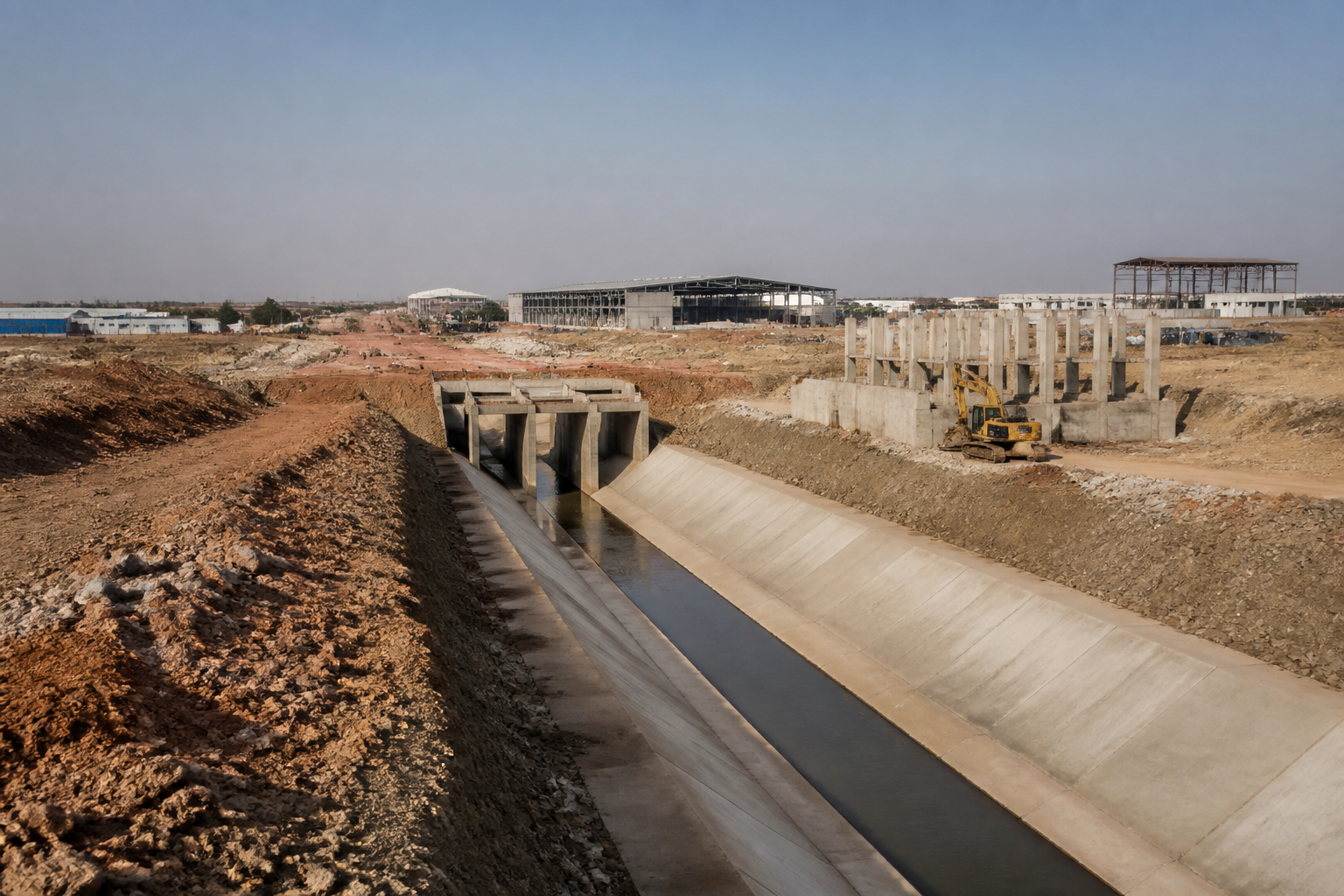
Telangana’s revenue slowdown is being linked to a problem that extends beyond tax collection: the State has spent heavily on irrigation and industrial infrastructure without converting enough of that investment into operating assets. An opinion published by Telangana Today argues that incomplete projects, delayed utilisation and rising debt have weakened the connection between public expenditure and economic returns.
The argument matters because infrastructure spending produces fiscal benefits only when projects are completed and used. Irrigation canals must deliver water, industrial parks must attract operating factories and transport or utility networks must support economic activity. Until that happens, expenditure remains tied up in construction, debt servicing and maintenance rather than generating wider production, employment and tax revenue.
According to the article, Telangana experienced a period of rapid fiscal expansion after its formation in 2014. Revenue growth reached 27.6 per cent in 2021-22, while the State recorded a revenue surplus of Rs 5,994 crore in 2022-23. The period was marked by large investments in irrigation, industrial infrastructure and welfare programmes.
Projects such as Kaleshwaram Lift Irrigation, Palamuru-Rangareddy and Sitarama were presented as instruments for expanding irrigation, stabilising agriculture and supporting rural prosperity. On the industrial side, Hyderabad Pharma City, NIMZ Zaheerabad and other industrial parks were intended to strengthen Telangana’s manufacturing base. The expectation behind these projects was not limited to physical construction. Their value depended on the economic activity that would follow completion.
The article identifies 2023-24 as a turning point. It states that revenue growth fell to 6.1 per cent in that financial year and became negative at minus 0.76 per cent in 2024-25. It attributes the deterioration to several factors, including weaker GST and property registration collections, increased borrowing and a widening revenue deficit. These claims are made by the author and are not accompanied in the supplied material by links to budget documents or audit reports.
The fiscal numbers nevertheless illustrate the pressure created when current obligations rise faster than productive returns. The article says Telangana’s debt increased by Rs 2.5 lakh crore in two years, exceeding Budget estimates by 129 per cent. It also places the revenue deficit at Rs 8,782 crore in 2024-25 and says it worsened beyond Rs 10,000 crore in 2025-26. If accurate, the figures point to a shift from a position in which revenue could support expenditure towards one in which borrowing and debt servicing absorb a larger share of fiscal capacity.
The irrigation sector is central to the article’s argument. It states that 20 major irrigation projects were incomplete as of March 2023. Their cumulative cost had risen from Rs 1.02 lakh crore to Rs 2.06 lakh crore, while Rs 1.73 lakh crore had already been spent. The implication is that much of the financial commitment has already been made, but the assets have not yet delivered their intended benefits at full scale.
This is the fiscal risk associated with incomplete capital formation. Cost escalation increases the amount required to finish a project, while delayed operation postpones the benefits that were meant to support agriculture and rural demand. The State may therefore face both higher debt-related obligations and a longer wait for the income, production and tax effects that justified the original investment.
The author argues that quicker execution after 2023 could have allowed several major irrigation projects to be completed by 2027-28 with an additional outlay of about Rs 40,000 crore. This is a projection within the opinion article, not an independently verified estimate in the supplied material. It is nevertheless useful in showing the policy choice at the centre of the debate: whether limited fiscal resources should be spread across new announcements or concentrated on completing projects already carrying substantial sunk costs.
The industrial infrastructure case presents a similar problem. The article says land was allotted to 1,642 units across Hyderabad Pharma City, NIMZ Zaheerabad and other Telangana State Industrial Infrastructure Corporation parks, but only a fraction had begun production. It also refers to investigations into alleged diversion of funds and concessional land allotments below market value. These allegations require separate documentary verification and should not be treated as established findings on the basis of the opinion article alone.
The economic mechanism described is straightforward. Non-operational industrial land cannot generate manufacturing output, employment or related consumption. It also cannot produce the property, registration or GST-linked revenues that would be expected from active industrial clusters. The physical presence of an industrial park therefore says little about its fiscal value unless factories are built, production begins and supporting supply chains emerge.
The same distinction applies to irrigation. A project can absorb capital during construction without immediately expanding irrigated area or increasing agricultural output. The intended multiplier appears only when water reaches farms, cropping patterns change, rural incomes rise and related activities such as agro-processing and transport expand. Incomplete works interrupt that chain.
The article describes this outcome as a negative multiplier. Contractors and suppliers may face delayed payments, while demand for materials such as cement and steel, along with transport services, can weaken when construction slows. At the same time, the government may borrow to maintain expenditure, increasing interest obligations. This interpretation connects project execution to the wider urban and regional economy rather than treating fiscal performance as a narrow accounting issue.
For Hyderabad and Telangana’s other urban centres, the consequences extend beyond the project sites. Industrial parks and manufacturing zones are planned as employment and production systems, not simply as land parcels. When they remain underused, the State loses potential jobs and the cities lose the additional demand that would support housing, mobility, logistics, retail and municipal services. Similarly, irrigation delays affect rural purchasing power and the economic relationships between towns, agricultural regions and urban markets.
The institutional question is how governments track the transition from expenditure to outcomes. The article argues that Telangana’s earlier focus on capital formation was followed by a stronger emphasis on short-term welfare expenditure and debt-financed commitments. Welfare spending is not inherently incompatible with development, but its sustainability depends on a revenue base capable of supporting recurring obligations. The article’s central contention is that this base weakens when capital projects remain unfinished.
The proposed response is to prioritise a small number of high-impact projects, including the completion of Kaleshwaram, the activation of Pharma City and the operationalisation of NIMZ Zaheerabad. It also calls for a pause on new announcements until existing commitments begin producing returns, along with debt restructuring, stronger GST and property registration administration, transparent monetisation of idle industrial land and greater use of public-private partnerships.
Several of these proposals concern administrative capacity rather than construction alone. The article recommends quarterly monitoring by the Finance Department, budget links to measurable revenue performance and annual project completion reports showing expenditure, progress and expected returns. Independent audits and citizen oversight are also proposed. The underlying principle is that a project should be assessed not only by how much has been spent or how much physical work is visible, but by whether it has become an operating asset.
The available figures show a sharp contrast between Telangana’s earlier revenue expansion and the slowdown described after 2023-24. They do not, on their own, prove that incomplete projects caused the entire deterioration. Revenue can be affected by tax administration, economic cycles, expenditure choices, borrowing conditions and changes in the property market. The opinion article presents incomplete infrastructure as a major explanation, but the causal relationship would need to be tested against official budget data, project completion records, audit findings and sector-level performance.
The article also estimates that, had earlier growth and project completion continued, Telangana’s revenues could have been around Rs 40,000 crore higher by 2025-26, with annual project-linked inflows of Rs 20,000 crore to Rs 25,000 crore. These are counterfactual estimates attributed to the author and should be read as an argument about lost opportunity, not as established revenue data.
What the evidence supplied does establish is the importance of completion and utilisation in public infrastructure. Telangana’s debate is not simply about whether the State spent enough. It is about whether spending created functioning irrigation systems, operating industrial clusters and durable revenue capacity. The next stage of scrutiny should therefore focus on project-wise completion dates, revised costs, expenditure already incurred, assets currently in use and measurable economic returns. Without that information, fiscal policy remains separated from the physical systems it is intended to create.
