


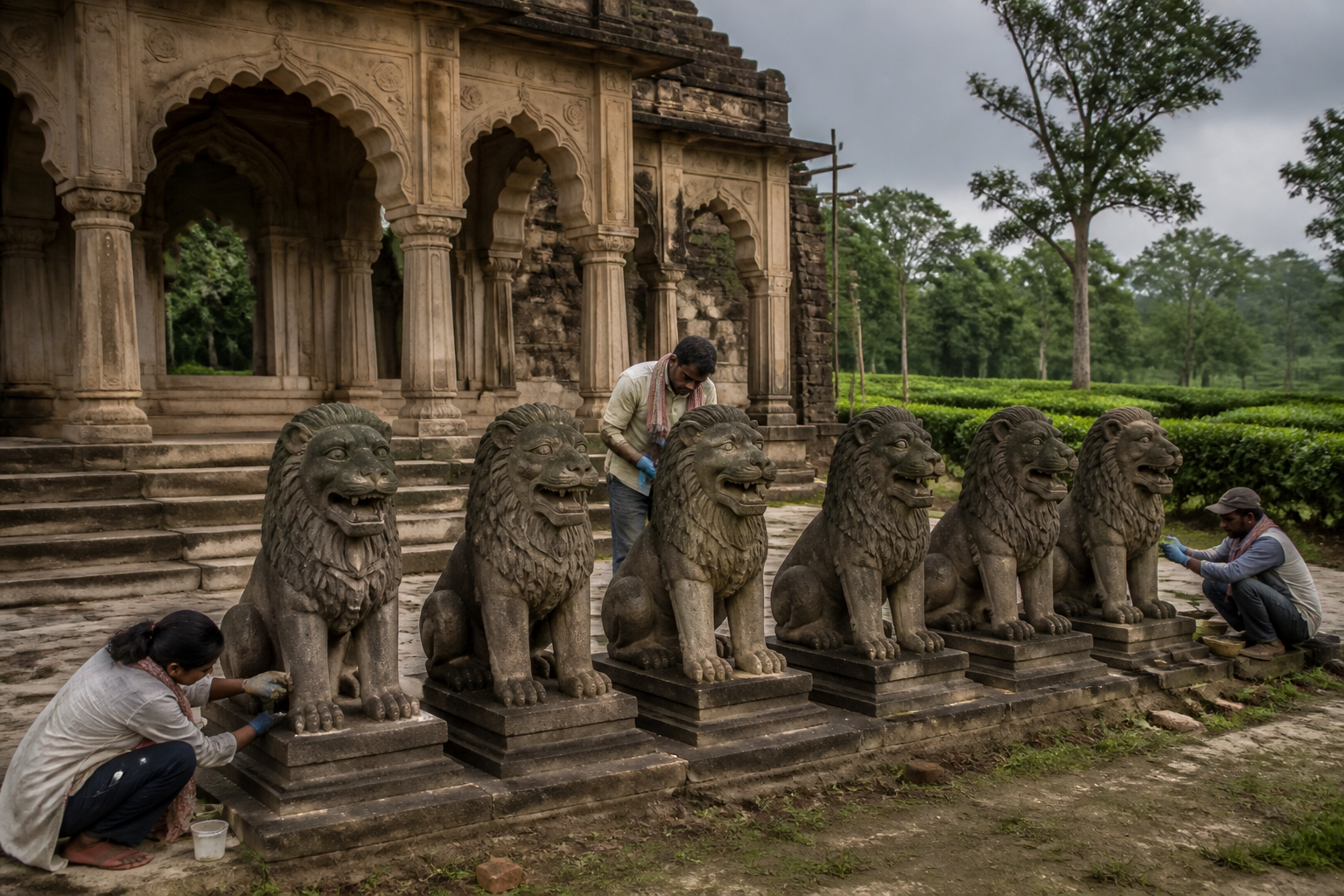
The reported damage to six antique stone lions at the entrance of the Devi Choudhurani-Bhawani Pathak Temple in Shikarpur, Jalpaiguri district, is more than an isolated mishap during a religious restoration. It shows how historic objects can remain physically protected yet institutionally vulnerable when a reconstructed site is treated as a construction project rather than a conservation exercise.
The lions survived the fire that destroyed the centuries-old wooden temple and its wooden idols on February 16, 2018. They were among the few material remnants of the earlier structure. According to a Telegraph India report, some lions suffered broken legs and tails while workers installed them at the reconstructed temple on Sunday. The damaged portions were repaired with white cement and other materials before the statues were placed at the entrance.
The reported sequence matters because the objects were not ordinary decorative elements. They were surviving relics of a historic religious site whose earlier structure had already been lost. Their value lay not only in their stone, form or function at the temple entrance, but also in their continuity with the older temple and the cultural landscape around it.
The rebuilding of the temple followed a fire that destroyed its wooden structure. Sculptor Biswajit Ghosh created a new temple and idols with government aid, and the reconstructed site was consecrated in 2022. The six stone lions, however, were not reinstalled at that time. Their delayed return created a separate conservation decision: how to move, assess, repair and position objects that had survived the destruction of the original site.
That decision appears to have been handled primarily through local institutional arrangements rather than a documented conservation process. A district administration official told the newspaper that the lions had been kept in the custody of the Jalpaiguri district magistrate after the fire and moved to the government treasury in 2019 under the supervision of then district magistrate Abhishek Tiwari. Last year, they were handed over to the temple committee led by former MLA Khageswar Roy and taken to the Shikarpur tea estate.
The transfer of custody is central to understanding the episode. Protection in a treasury and placement at a living temple involve different risks and responsibilities. A treasury can provide controlled storage, while reinstallation requires structural assessment, lifting and handling plans, foundations, orientation, documentation and a decision on whether any repair is compatible with the object’s historic character. The available report does not establish that such a conservation plan existed before the statues were moved.
The temple committee said the statues had remained in the care of the Shikarpur Tea Estate management for the past year. Gopal Roy, the committee’s secretary, said the committee decided to reinstall them after devotees requested their return and with Durga Puja approaching. He described the damage as minor and said the statues were repaired before installation. The report also states that neither government officials nor archaeological experts were present during the exercise.
This creates a familiar institutional tension at historic religious sites. The temple is a functioning place of worship, and devotees may reasonably expect its surviving elements to be visible and accessible. At the same time, the objects are heritage assets whose handling cannot be governed only by immediate religious requirements or seasonal deadlines. The pressure to restore a familiar visual arrangement before a major festival can conflict with the slower procedures required for conservation.
The criticism from people involved in the reconstruction points to that gap. Sculptor Biswajit Ghosh said that using ordinary contractors to install the antique lion statues in a haphazard manner was inappropriate and failed to respect the temple’s history. Anandagopal Ghosh, a former member of the state heritage commission, stressed the need for professional conservation of the stone lions. These comments do not by themselves establish the full extent of the damage, but they identify the technical issue at the centre of the incident: historic objects require specialist assessment even when the work appears to be routine installation.
The site’s history further complicates the question of treatment. Anandagopal Ghosh said the area had historically been influenced by Bhutanese and later British presence, and that references to the “Sannyasi temple” extended back a long time. He also suggested that the stone lions could be linked to folk traditions in a region close to Tibet and Bhutan. The supplied report does not establish a formal archaeological attribution for the statues. That uncertainty is precisely why documentation and expert assessment become important before restoration decisions are made.
Heritage conservation is often associated with grand monuments, protected buildings and officially notified sites. But the Jalpaiguri temple illustrates a wider category of built heritage: living religious places where objects, structures, rituals and local memory overlap. Such sites may not always have the same institutional visibility as centrally protected monuments. Their care may involve district administrations, temple committees, local communities, contractors, estate managers and state heritage bodies, with no single actor necessarily controlling the entire conservation chain.
The history of the lions shows how responsibility can become fragmented. The district administration reportedly held custody after the fire. The objects were later stored in a government treasury, then handed to the temple committee and kept with a tea estate management. Their eventual installation was decided by the committee. Each transfer may have been practical, but the report does not mention a publicly available condition survey, chain-of-custody record, conservation specification or expert clearance accompanying the movement.
Those records are not bureaucratic decoration. A condition report made before transport can establish whether cracks, weakness or earlier repairs exist. Photographs and measurements can preserve evidence of the object’s condition and placement. A handling plan can determine the equipment and lifting method required. A repair record can identify what material was used and distinguish an old feature from later intervention. Without such documentation, later assessment becomes more difficult and disagreements over responsibility become harder to resolve.
The use of white cement and other materials to fix broken portions also raises a conservation question, although the supplied report does not identify the material composition, extent of repair or long-term effect. Modern repair materials can alter the appearance of historic stone and may complicate future treatment if they are incompatible with the original material. Establishing whether the repairs are reversible, structurally sound and visually appropriate would require a qualified conservation assessment, which the report says was absent during installation.
The episode also exposes the limited distinction often made between reconstruction and conservation. The temple rebuilt after the 2018 fire is a new structure created to continue the site’s religious and cultural life. The six lions, by contrast, are surviving elements from the earlier temple. Rebuilding can involve design, fabrication and construction decisions. Conservation involves retaining material evidence, recording change and minimising avoidable intervention. Treating both tasks as ordinary works execution risks erasing the very history that surviving objects are meant to carry.
For local administrations and temple committees, the practical challenge is to reconcile public access with professional care. The available report does not say whether the district administration, a state heritage authority or any archaeological body has ordered a fresh assessment after the reported damage. It also does not establish whether the statues will be moved again or whether the repairs will be reviewed. Those are the next institutional questions, particularly because repeated handling could create additional risk.
The story’s wider significance lies in what happened after the fire. The destruction of the wooden temple was an obvious heritage emergency. The later handling of the surviving stone elements was quieter, but it may determine how much of the site’s material history remains legible. A disaster can destroy a monument in a single event; inadequate post-disaster management can diminish its surviving evidence incrementally.
The reported damage therefore points to a conservation system that needs to account for living heritage, not only formally protected monuments. The facts establish that the lions survived the 2018 fire, changed custody several times, were reinstalled ahead of Durga Puja and were reportedly damaged during that process. What remains to be established is the full condition of the statues, the quality and reversibility of the repairs, and which authority was responsible for approving and supervising their reinstallation. Those questions should be answered through a documented professional assessment before further intervention takes place.
