


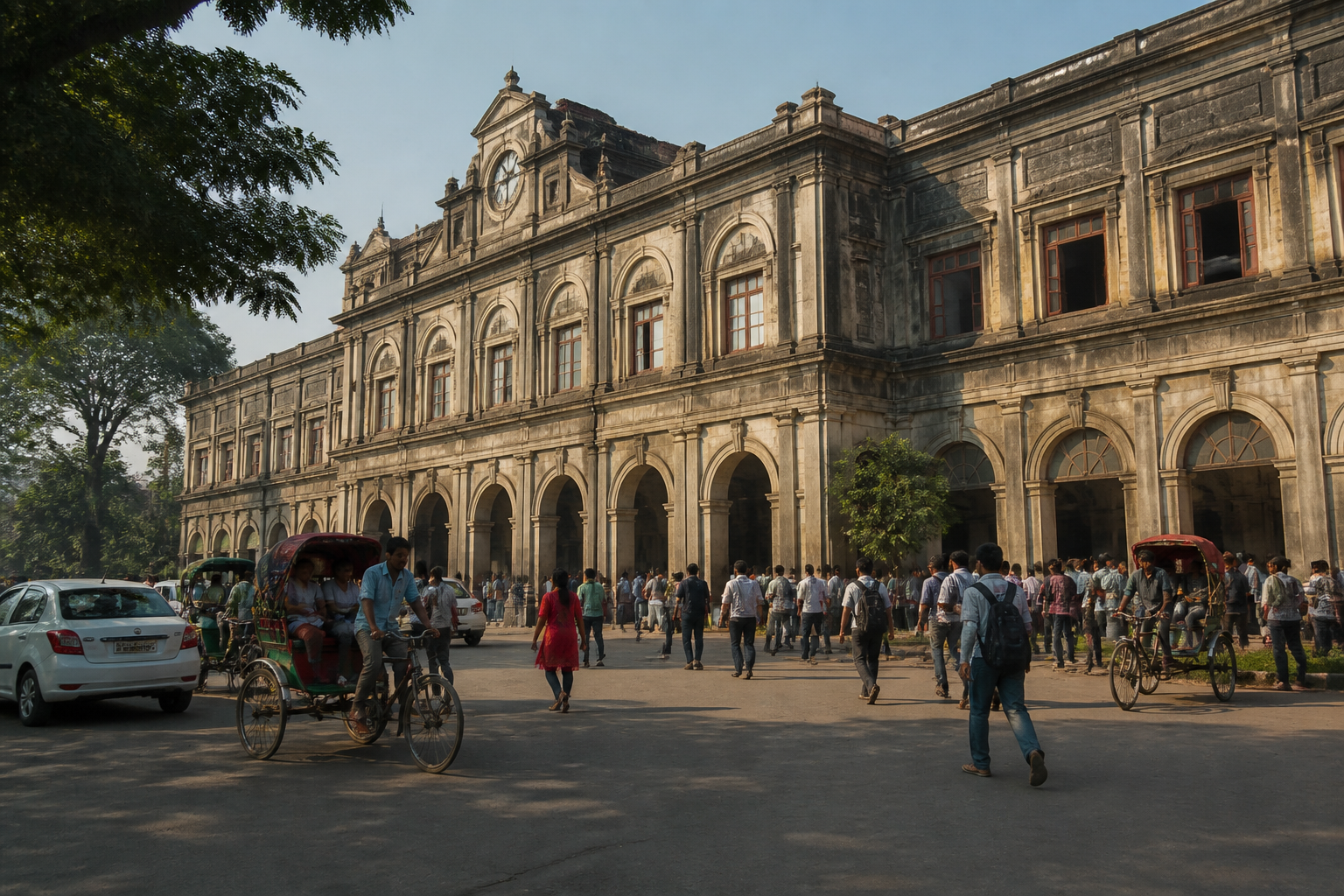
The Municipal Corporation of Delhi’s effort to trace the history of the city’s railway stations, schools, colleges, hospitals and police stations that are more than 100 years old is not simply an exercise in remembering the past. It is also a test of whether a rapidly changing capital can recognise, document and manage buildings that continue to perform everyday public functions.
The MCD heritage cell has identified 16 such buildings, while work to locate more is continuing. According to an MCD official quoted in the report, the list records each building’s historical significance, associated anecdotes and institutional links. That approach places the buildings within the lived history of the city rather than treating them only as architectural objects.
This distinction matters because many of the structures being examined have not become museums or abandoned monuments. They remain railway stations, educational institutions and medical facilities. Some have been renovated or modified over the decades, but their original structures are described as largely intact. The central administrative question is therefore not whether a building should be preserved in isolation, but how its historical character can be understood while the institution inside it continues to operate.
### Delhi’s railway history remains embedded in active infrastructure
The railway stations in the MCD’s list show how transport infrastructure can carry layers of urban and national history. Old Delhi Railway Station, earlier known as Delhi Junction, opened in 1864, while its present building dates to 1903. The building was notified as a heritage structure in the Delhi government’s 2010 gazette notification issued by the urban development department.
The station is also associated with Mahatma Gandhi’s return to India after several years in South Africa. The MCD official said Gandhi first disembarked in the capital at Delhi Junction in April 1915. That association gives the station significance beyond its physical form: its platforms and building are connected to a major moment in the city’s political history.
Shahdara Railway Station illustrates a different kind of historical connection. The station was established as part of the Shahdara-Saharanpur Light Railway in 1907 and continues to operate as an active junction. It is associated with Gandhi’s final rail journey. On September 9, 1947, amid communal violence and disruptions at Old Delhi Railway Station, his train terminated at Shahdara, where he safely disembarked.
The report also records an important limitation. Details about Shahdara station’s history require verification from Northern Railway archival records. That caveat is significant for any heritage inventory. A building’s age, institutional associations and architectural history need to be supported by archival documentation before they are converted into an official public record.
Sarai Rohilla station, opened to the public in 1873, and Subzi Mandi railway station, built in 1880, further demonstrate the depth of Delhi’s railway network. Both remain linked to the city’s functioning transport system. Their inclusion suggests that heritage mapping can extend beyond landmark buildings to infrastructure that residents continue to use, often without recognising its historical layers.
### Education institutions show how public buildings change without disappearing
The history of Zakir Husain Delhi College illustrates how educational institutions can move, reorganise and change administrative form while retaining older physical and institutional connections. The college traces its history to 1792, when it was known as Delhi College. Its earlier campus at Ajmeri Gate stood alongside a school on a site that housed a madrassa founded in 1696.
The institution shut in 1790, reopened in 1792 and was later reorganised by the East India Company in 1828. It was reconstituted as Anglo-Arabic Intermediate College in 1924 and affiliated with the University of Delhi in 1925. The college shifted to its present campus on Jawaharlal Nehru Marg in 1986, but the historic Ajmeri Gate building continues to house the Anglo-Arabic Senior Secondary School, a co-educational government-aided institution.
This history complicates the idea that heritage is tied only to an institution’s current name or location. The building at Ajmeri Gate has retained an educational function even as the college associated with it moved elsewhere and its institutional structure changed. The same site therefore connects different phases of Delhi’s education system and its changing administrative arrangements.
The MCD’s proposed documentation can help make such continuities visible. However, the supplied report does not specify how the list will be published, what legal protection will follow identification, or whether conservation plans and funding arrangements have been prepared. Those details will determine whether the exercise remains an inventory or becomes part of a wider heritage-management system.
### Medical heritage is also part of the city’s working infrastructure
Ayurvedic and Unani Tibbia College in Karol Bagh represents another strand of Delhi’s institutional history. The institution began as Madrassa-e-Tibia in 1883 and was later re-established on its present campus. Its main building was inaugurated in 1921.
According to the MCD official, the college is the only known institution in India that offers education and clinical training in both Ayurvedic and Unani medical systems under one roof. It is affiliated with the University of Delhi. Its significance therefore lies in the combination of architecture, medical education, clinical training and the continuing use of the campus.
The example is important because public heritage often becomes narrowly associated with political monuments, palaces or religious structures. The MCD’s list, as described in the report, expands that frame to include institutions that have shaped everyday access to education, healthcare and transport. These buildings represent the civic systems through which a city is administered and experienced.
At the same time, the report does not establish whether the buildings face specific structural risks, accessibility challenges, service constraints or redevelopment pressures. It records that some have undergone modifications while retaining much of their original character, but it does not provide condition assessments or details of the interventions. Those gaps will matter if identification leads to future conservation decisions.
### The policy challenge is to document buildings without freezing them
The MCD’s work sits at the intersection of heritage administration and municipal service delivery. A heritage inventory can establish historical significance, create a common reference for departments and bring scattered institutional histories into one record. But listing alone does not resolve the practical tension between conservation and continued use.
Railway stations must handle passengers and railway operations. Schools and colleges require classrooms, circulation spaces and modern facilities. Hospitals and medical colleges need clinical infrastructure. Police stations have operational requirements. A building can retain its original structure while also requiring upgrades that alter parts of its fabric. The report confirms that modifications have already occurred in some cases, but it does not explain how such changes are assessed or regulated.
The documentation of historical anecdotes also raises a question about evidence standards. Oral associations and institutional memory can add depth to a heritage record, but the Shahdara example shows why archival verification remains necessary. A credible municipal inventory must distinguish between established records, attributed accounts and details that are still being checked.
The available information does not indicate whether the MCD is working with the Delhi government’s urban development department, Northern Railway, the University of Delhi or the institutions occupying the buildings. Nor does it identify a dedicated financial mechanism or implementation timeline. These institutional arrangements will be central to the next stage of the initiative because ownership, operation and heritage authority may not rest with the same organisation.
### What Delhi’s old buildings reveal about urban continuity
The 16 identified buildings offer a view of Delhi as a city where infrastructure and public institutions have accumulated across centuries without becoming entirely detached from their original functions. Old Delhi Railway Station, Shahdara, Sarai Rohilla and Subzi Mandi remain connected to rail operations. The Ajmeri Gate building continues to support school education. Tibbia College continues to combine institutional and clinical functions.
That continuity is the strongest urban insight in the MCD exercise. Heritage is not only a record of what a city once was; in these cases, it is embedded in services that residents still use. The buildings’ value therefore depends on both their historical associations and their ability to remain usable.
The evidence currently confirms an identification and documentation exercise, not a completed conservation programme. The number of buildings may rise as the MCD continues its survey. Further verification, especially from archival records, will be needed for some historical details. The next significant developments will be the completion of the wider list, the public availability of the documentation and clarity on how identified buildings will be protected while continuing to serve their present purposes.
