


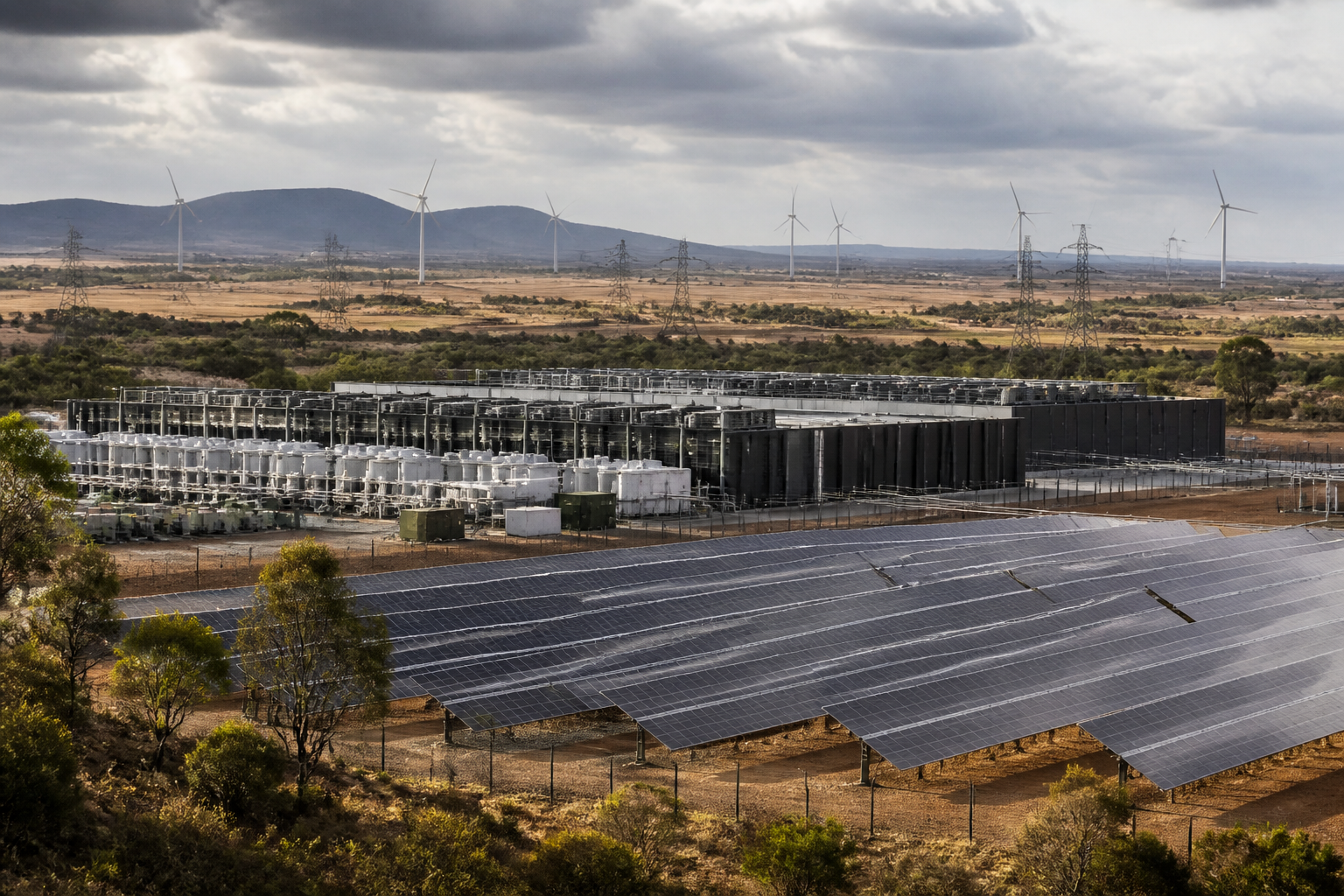
Australia is positioning itself as a major home for the infrastructure behind artificial intelligence, with investors reportedly planning to commit about $156 billion to data-centre clusters across the country. The scale of the proposed investment places Australia behind only the United States and China, according to the report, but the opportunity is also exposing the difficult trade-offs that come with building very large computing facilities: electricity demand, water consumption, grid expansion, land use, data security and the distribution of economic gains.
The attraction is partly geographic and partly institutional. Australia has abundant land, strong solar and wind potential and relatively low-cost renewable energy production, according to the country’s science agency. These advantages matter because data centres consume large quantities of electricity to train and operate artificial-intelligence models. Facilities that can generate or procure renewable power may reduce pressure on conventional electricity supplies, while remote locations can keep large buildings, cooling systems and associated noise away from dense residential areas.
That combination gives Australia a different proposition from locations where data-centre investment is colliding directly with neighbourhood concerns over power demand, water use and land availability. The report says Australian officials are seeking to convert the country’s physical advantages into a durable industrial position rather than allow the current investment cycle to remain a temporary windfall.
The opportunity is being strengthened by Australia’s position in the digital geography of the Indo-Pacific. American technology companies are wary of depending on subsea cables that pass through the South China Sea, where infrastructure could be exposed to disruption or sabotage during a potential conflict involving China. Many new cables connecting the United States to Asia therefore stop first in Australia. That makes the country a natural location for computing capacity serving users and businesses across the region.
The logic is particularly relevant because India is identified in the report as Anthropic’s second-largest market by usage, while Singapore and South Korea are also described as having high rates of artificial-intelligence adoption. Australia’s value is therefore not limited to its domestic market. Its data centres can serve a wider regional demand while remaining connected to American technology companies through established digital routes.
Security and political alignment add another layer to the investment case. Australia is a member of the Five Eyes intelligence alliance and its cyber agencies are accustomed to protecting sensitive American data, the report says. The country also enforces American export controls, reducing the risk that high-demand Nvidia chips installed in Australian facilities could be diverted to competitor countries, particularly China. For AI companies, the protection of model weights, advanced chips and proprietary systems is part of the infrastructure decision alongside electricity and fibre connectivity.
But the same characteristics that make data centres attractive to investors create pressure on public systems. Artificial-intelligence computing facilities require reliable power at a scale that can affect electricity networks, and their connection to the grid can require new infrastructure. Cooling systems can also create water demand, making the location and design of facilities important in a country where climate and water availability vary considerably between regions.
Australia’s government is responding by preparing basic standards for new data centres. Andrew Charlton, the minister responsible for AI, said the proposed rules would require facilities to generate more electricity than they take from the grid, pay the costs of connecting to the network, remain away from homes and schools, and minimise water use. These conditions would place part of the infrastructure burden on the companies seeking to build the facilities rather than leaving governments and electricity consumers to absorb it.
The proposed rules also show why data-centre development is becoming an urban and regional planning issue rather than simply a technology-sector decision. A facility may be physically distant from a major city, but its electricity connection, transmission requirements, water demand, construction traffic and land-use effects are matters for public authorities. Decisions about siting therefore involve the relationship between industrial land, housing, schools, utilities and environmental constraints.
The public-value question extends beyond physical impacts. Data centres create substantial construction activity, but the report notes that they create relatively few continuing jobs once construction is complete. Their tax contribution may also be limited compared with resource industries such as iron ore. This creates a risk that the headline investment value will be much larger than the long-term local employment or revenue gains.
Charlton wants AI laboratories to reserve some computing capacity for Australian companies and researchers. At present, this is described as an expectation rather than a binding requirement. That distinction is important. Without enforceable conditions, local firms and universities may benefit from the arrival of infrastructure only indirectly, while the largest commercial gains continue to flow to American technology companies and their investors.
The debate resembles the familiar question asked of resource projects: what does the host country retain after global capital, technology and expertise have been brought in? Data centres are not mines, but the comparison is relevant because both depend on large physical assets, extensive utility networks and access to export-oriented markets. In the case of data centres, the exported product is computing capacity rather than minerals, and the ongoing workforce is smaller than the investment figures might suggest.
Copyright regulation could become another condition shaping the sector. Australian officials want local businesses and creatives to be paid when their data is used to train artificial-intelligence systems. The report says the government is considering how copyright law may limit AI training on proprietary information. If companies are required to pay for Australian data, they could face legal complications in the United States, where AI firms have been permitted to scrape books and large portions of the internet more freely.
This issue connects the physical expansion of AI infrastructure with the less visible systems that make the technology valuable. Electricity, land and fibre cables determine where computing can operate, but data rights determine what models can be trained and under what terms. A country seeking local economic value from AI therefore has to address both infrastructure access and the ownership of information.
Australia is not competing without alternatives. Canada and the United Arab Emirates are also seeking to attract American computing capacity. This gives AI companies choices over energy supply, regulation, security, connectivity and operating costs. Australia’s advantage is strongest when its renewable-energy potential and regional cable position are combined with predictable regulation and trusted security arrangements.
The policy challenge is to avoid treating speed and safeguards as opposing goals. The government wants investment to arrive quickly, but it also wants new facilities to pay for their grid connections, limit water use, avoid sensitive community locations and contribute to domestic research and business capacity. If the rules are too weak, the public may carry the infrastructure and environmental costs. If they are too prescriptive, investors may choose other locations, as the report cautions.
Australia’s data-centre boom therefore provides a wider lesson about the next phase of digital infrastructure. Artificial intelligence may be presented as a software revolution, but its growth depends on land, electricity, cooling, cables, security agencies and planning approvals. The investment figures are significant, yet they do not by themselves establish how much value will remain in Australia or how communities will experience the facilities.
What is established in the supplied report is that Australia has attracted major proposed investment and is using energy resources, geographic position and institutional trust to compete for AI infrastructure. What remains unsettled is whether the country can turn that advantage into durable domestic capability while controlling public costs. The next defining steps will be the final data-centre standards, the treatment of copyright and the terms under which Australian firms and researchers gain access to the computing capacity being built on their territory.
