


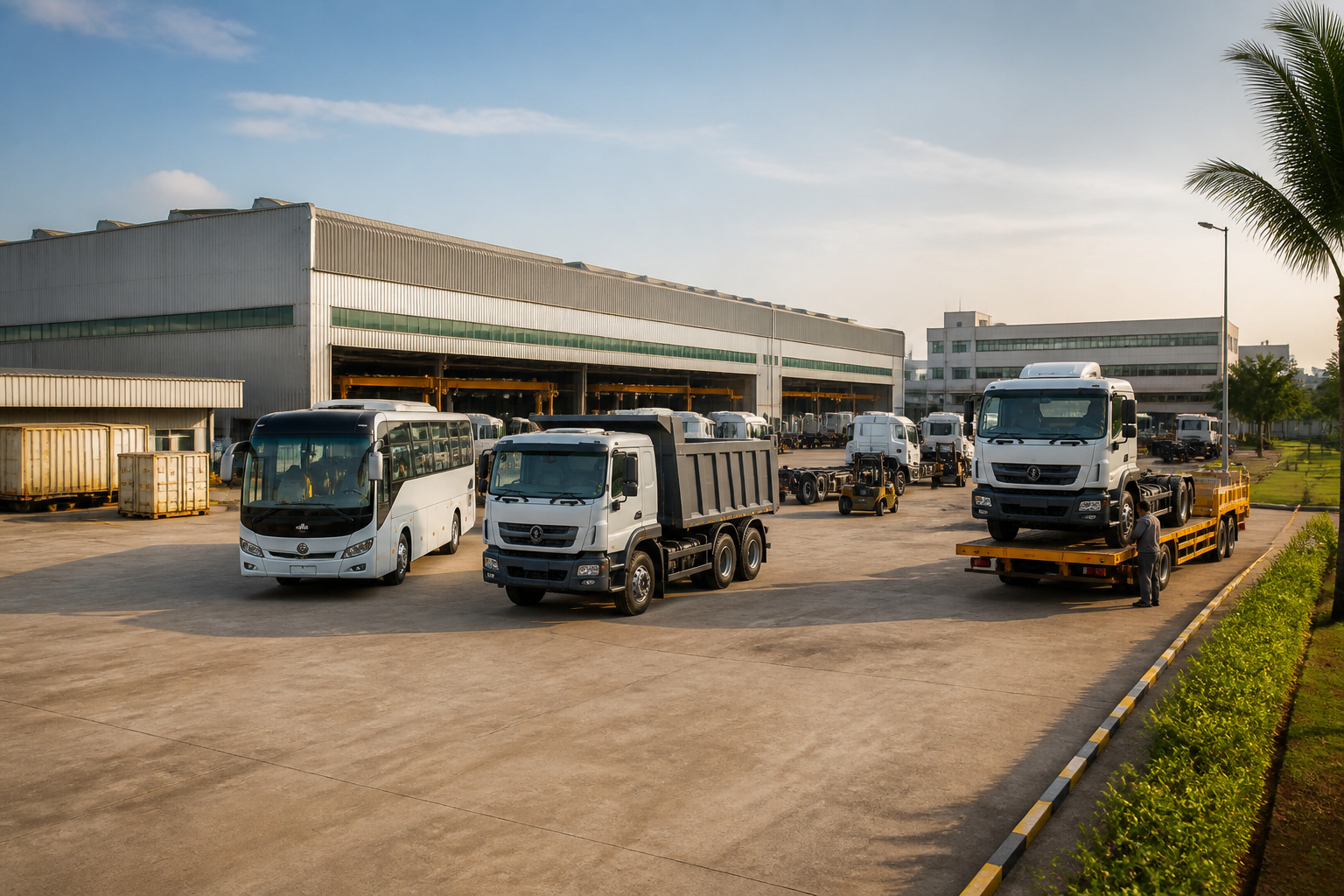
Daimler India Commercial Vehicles’ additional ₹4,000 crore investment in Tamil Nadu is more than a capacity announcement. It signals an attempt to make the Chennai-Oragadam facility a deeper part of Daimler Truck’s global engineering, manufacturing and supplier network, with implications for how the region participates in the commercial-vehicle economy.
The investment, committed to the Tamil Nadu government last month, will take Daimler’s cumulative investment in India to more than ₹14,500 crore, according to Torsten Schmidt, CEO and managing director of DICV. Schmidt, who will also serve as president of the newly established Mercedes-Benz Trucks customer region covering India, South-East Asia and Australia-Pacific, described the Chennai facility as an integrated operation spanning engineering, sourcing, manufacturing, sales, after-sales and exports.
That integration is central to understanding the investment. The company is not presenting Oragadam only as a plant where trucks are assembled. It is positioning the facility as a location where customer requirements are collected, converted into product development, tested through engineering capabilities and taken into manufacturing for domestic and international markets.
This shift matters because manufacturing competitiveness is increasingly determined by the depth of activity around a factory. A plant that only performs final assembly captures less value than one that also carries out engineering, product adaptation, supplier qualification, component production and export coordination. DICV’s account of Chennai indicates that the company wants the Oragadam hub to perform more of these functions within the same industrial ecosystem.
The facility has produced 2,30,000 trucks for the Indian market since 2012 and exported 75,000 trucks to more than 70 countries, Schmidt said. It currently has annual capacity for 58,000 trucks and 2,000 buses. Those figures establish Chennai’s existing scale, but the investment is not being described simply as an expansion of annual output.
Schmidt said the spending would support future product creation, engineering and manufacturing capabilities. The stated objective is to develop products that are more advanced and manufacturing-ready, while maintaining the quality and efficiency required for both domestic and global markets. In that formulation, the investment is as much about the capability of the production system as it is about the number of vehicles that can leave the factory.
The Chennai facility’s role has also expanded beyond finished vehicles. DICV produces four global brands under one roof, including Mercedes-Benz, BharatBenz and Freightliner. BharatBenz products are made for the Indian market, while the other brands are produced for global markets, according to the company’s chief executive. The facility also exports parts into Daimler Truck’s worldwide network.
DICV said it has exported more than 330 million parts into the global Daimler Truck network and more than 60,000 transmissions manufactured in India for European plants. These figures show how the Oragadam operation is connected to production systems outside India. The industrial value of the Chennai hub therefore extends beyond the vehicles assembled within the plant boundary to the components and systems supplied to other facilities.
That network role depends on supplier capability. Schmidt said DICV and its suppliers are qualifying vendors to deliver into the wider Daimler Truck system. Supplier qualification is a significant institutional and operational process because it connects local manufacturing to the quality, consistency and delivery requirements of global production. The interview does not provide a figure for the number of suppliers involved, but it establishes that supplier integration is part of the company’s expansion strategy.
For the Chennai region, this creates a more complex industrial footprint than a standalone automobile factory. Engineering teams, component suppliers, logistics operators, maintenance services and export infrastructure all become part of the production system. The supplied material does not quantify employment or local economic output, so the direct regional employment impact of the new investment cannot be established from the announcement. Its stated scope, however, indicates activity across several layers of the value chain.
The investment also comes as Daimler Truck reorganises the way it manages its global customer markets. The establishment of the Mercedes-Benz Trucks India, South-East Asia and Australia-Pacific customer region places the Chennai facility within a wider regional framework. Schmidt is set to lead that customer region in addition to his responsibilities at DICV.
The significance of this arrangement is that product development at Chennai is linked to requirements gathered from customers across multiple markets. Schmidt said the company is collecting global customer requirements and bringing them into development. Future products created through this process are expected to be available for exports, although the company has not disclosed a product-wise launch schedule or specific export targets.
The plant’s product strategy is already moving towards greater use of automated technology. DICV introduced the HX series for construction and the Torqshift series, an automated manual transmission version, for mining last year, according to Schmidt. The company has received what he described as encouraging feedback from drivers and fleet operators, who reported reduced fatigue, greater comfort and higher productivity.
DICV plans to expand automated manual transmission technology across the BharatBenz portfolio. At present, the technology is used in construction and mining applications, while the company is also examining its use in additional models and variants, including on-road transportation. The statement establishes an intended product direction, but it does not specify launch dates, model names or the expected share of vehicles that could use the technology.
This product shift connects the Chennai hub to a wider change in the requirements placed on commercial vehicles. Construction, mining and long-distance transport impose different demands on vehicles, drivers and operators. A technology that affects driving effort and operating productivity is therefore not only a technical feature; it can influence how fleets are deployed and how drivers experience their work. The available material, however, does not provide independent performance measurements or comparative operating data.
The Oragadam facility’s stated capacity of 58,000 trucks and 2,000 buses a year provides the physical base for this strategy. The company says it will leverage the integrated setup to grow both in India and in the ISEAA region. Whether that ambition results in higher utilisation, new models or a changed domestic-export mix remains dependent on future product decisions and market demand. DICV has not disclosed those projections in the supplied interview.
The Chennai hub also sits within Tamil Nadu’s broader effort to attract and retain large industrial investments. The investment commitment was made with the Tamil Nadu government, but the supplied material does not provide details of incentives, land arrangements, public expenditure, job commitments or implementation milestones. Those omissions matter because the public value of a major industrial investment depends not only on its headline amount, but also on how it is delivered and how benefits are distributed through the regional economy.
For government, the important issue is therefore not merely whether the announced capital enters the facility. It is whether the investment strengthens local engineering capabilities, creates durable supplier relationships and supports higher-value exports. The company’s references to R&D, supplier qualification, parts exports and global product development suggest the relevant indicators, but no formal monitoring framework or targets have been announced in the supplied material.
For Chennai’s industrial geography, the development reinforces Oragadam’s position as a production location with an international role. DICV’s description of an end-to-end facility shows how industrial clusters become embedded in global networks: finished trucks move to domestic and foreign markets, parts move to other plants, and engineering requirements circulate across regions. The result is a production hub whose importance cannot be measured only by the vehicles manufactured locally.
The central urban question is whether Chennai can continue moving from assembly-led manufacturing towards integrated industrial capability. The available evidence points in that direction. DICV is adding investment to engineering, R&D and manufacturing, supplying parts and transmissions to global operations, and developing products for both Indian and international requirements. At the same time, the evidence does not yet establish the investment’s final scale of output, employment impact, implementation schedule or effect on the domestic-export balance.
What is clear is that Oragadam is being positioned as a central anchor in Daimler Truck’s global operations rather than only an Indian production site. The next evidence to watch will be the specific projects supported by the ₹4,000 crore commitment, the product and technology milestones that follow, and whether the supplier and export network expands alongside the facility’s engineering role.
