


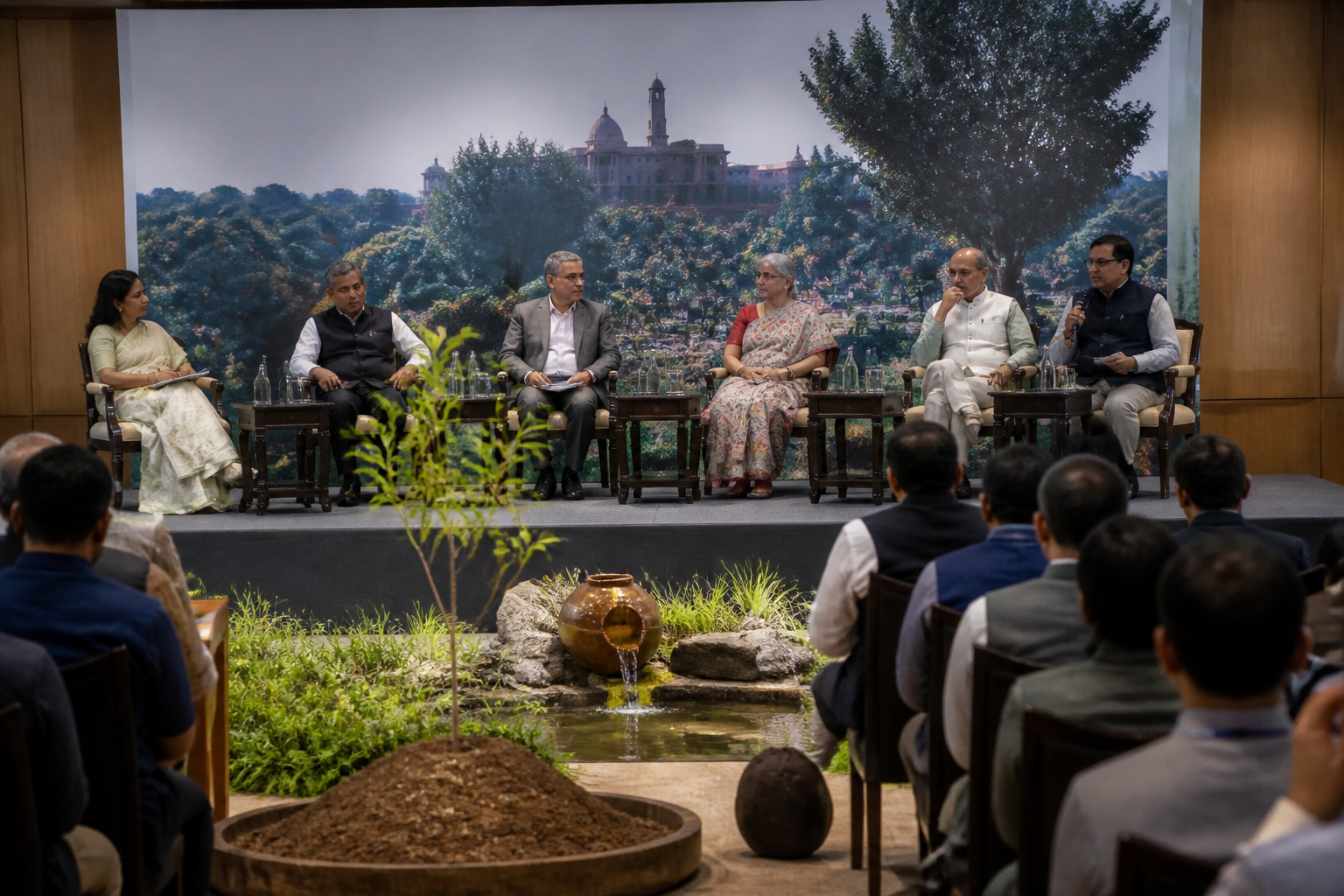
President Droupadi Murmu has called for a robust climate policy framework that places affected communities at the centre of adaptation planning, warning that climate change is worsening risks to food security, health and livelihoods. Speaking at the National Green Tribunal’s two-day international conference on ‘The Future of Environment and Climate Dynamics’, she also urged biodiversity-focused afforestation aligned with local conditions.
Murmu said climate change was creating imbalances across multiple aspects of human life, with biodiversity loss, water stress and land degradation closely linked to the wider crisis. She said an effective policy framework would require the participation of governments, legal experts and communities experiencing the impacts of climate change.
“Special sensitivity towards the needs of rural and forest-dwelling societies, small farmers, women and other vulnerable communities is crucial, as they bear the brunt of natural disasters,” the President said, according to the report. Her remarks placed community participation and local experience alongside formal government and legal mechanisms in the design of climate action.
The President also highlighted traditional knowledge systems and the lived experiences of local communities as important to strengthening climate adaptation. She said people-centric and community-based approaches could improve resilience, particularly when they were rooted in local practices and conditions.
On afforestation, Murmu said the objective should extend beyond the planting of trees. Sustainable afforestation, she said, should focus on restoring healthy and self-sustaining ecosystems while nurturing biodiversity. The emphasis is significant for environmental administration because it links tree-planting programmes with ecological restoration rather than treating plantation numbers as the sole measure of success.
Murmu further said developing countries needed to improve resilience while maintaining the pace of development. Climate commitments, she said, should be aligned with national development needs and economic aspirations, while remaining technically feasible.
At the conference, Union minister Manohar Lal cited India’s progress in expanding non-fossil energy capacity. He said non-fossil sources accounted for nearly 55% of the country’s installed generation capacity and that India had achieved its 50% non-fossil capacity target five years ahead of schedule.
The remarks came as environmental governance increasingly requires coordination across energy, land, water, biodiversity and disaster management. The President’s emphasis on affected communities also brings questions of implementation into focus, particularly for rural and forest-dwelling populations, small farmers and other groups identified as especially vulnerable to climate impacts.
National Green Tribunal chairperson Justice Prakash Shrivastava said climate action must be inclusive and equitable, with attention to vulnerable communities and future generations. He said environmental law needed to remain responsive and forward-looking by embracing technology, innovation, sustainable finance and a just transition.
The conference’s stated policy focus therefore combined climate adaptation, ecosystem restoration, energy transition and environmental law. The next challenge for institutions will be to translate these principles into policies and actions that reflect local conditions while meeting India’s development and climate objectives.
