


President Droupadi Murmu’s call for a robust climate change policy framework places a question of implementation at the centre of India’s environmental debate: whether climate action can protect vulnerable communities while supporting development and restoring damaged ecosystems. Speaking at the valedictory session of the National Green Tribunal’s two-day international conference on “The Future of Environment and Climate Dynamics”, she linked climate change with food security, health, livelihoods, biodiversity loss, water stress and land degradation.
The significance of the intervention lies less in the need to acknowledge climate change, which is already embedded in public policy discussions, and more in the way the President described the required response. Her remarks connected national policy and legal oversight with the participation of communities directly exposed to environmental risks. That framing places adaptation, rather than only emissions reduction or installed energy capacity, at the centre of the climate question.
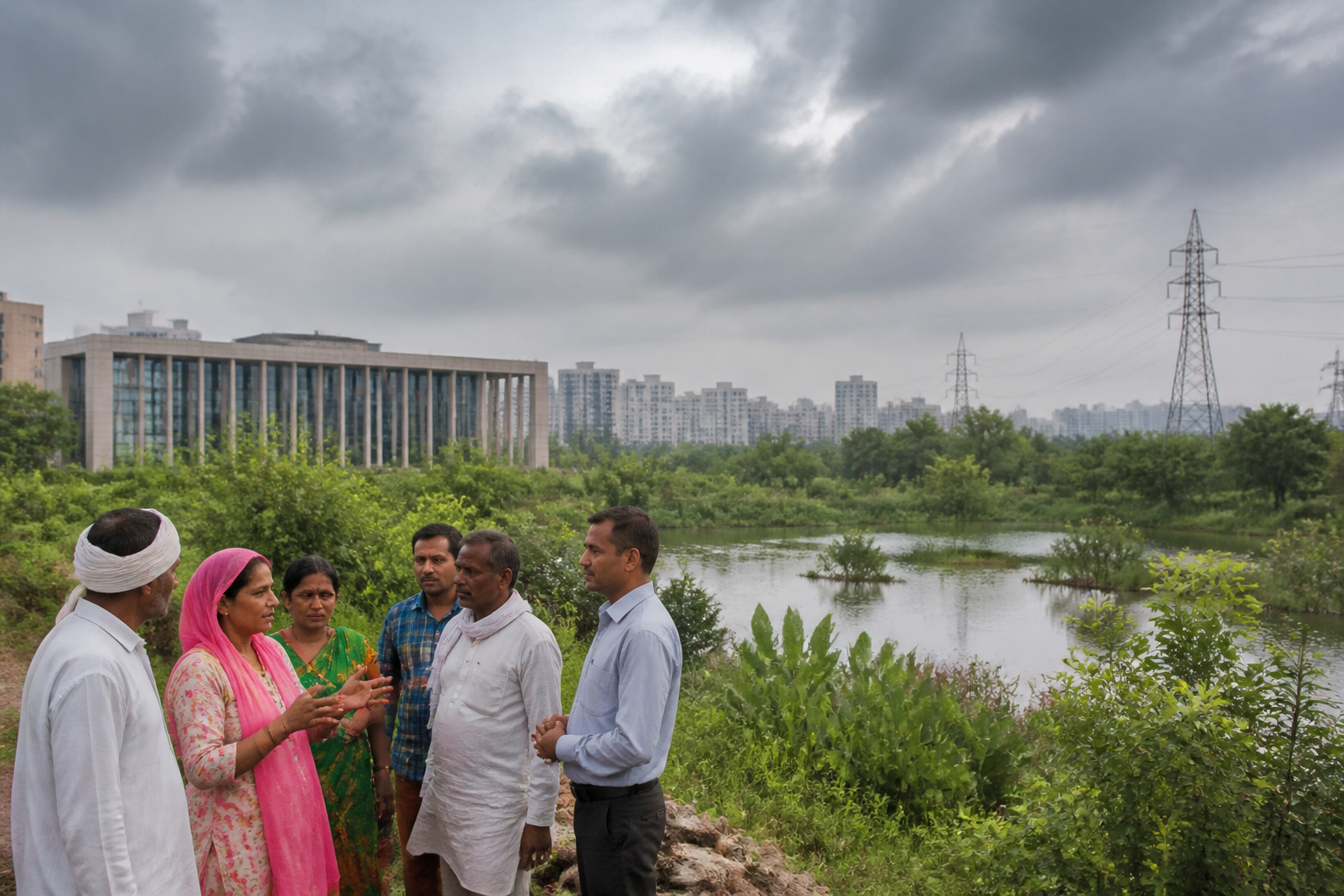
The President said a well-structured framework of policies and actions was necessary to address the complexity of climate change. Such a framework, she said, should involve governments, legal experts and communities most affected by climate impacts. She specifically identified rural and forest-dwelling societies, small farmers, women and other vulnerable groups as requiring special sensitivity because they bear the brunt of natural disasters.
This is an important institutional signal. Climate policy is often discussed through national targets, energy transitions and large infrastructure investments. The remarks at the NGT conference broaden that frame to include the people and places where environmental stress is experienced: agricultural landscapes facing livelihood risks, forest areas where communities depend on local ecosystems, and settlements exposed to disasters. The source report does not provide a new programme or implementation schedule, but it does identify participation and local knowledge as necessary components of future action.
### Adaptation is a governance challenge
The President emphasised that traditional knowledge systems, along with the lived experiences and practices of local communities, can strengthen climate adaptation capacity. The argument is not simply cultural. It assigns practical value to local knowledge in designing responses to changing environmental conditions. For public institutions, this raises a question of how such knowledge is incorporated into policy, planning and environmental decision-making.
The remarks also underline that climate adaptation cannot be treated as a specialised environmental department’s responsibility alone. The issues cited—water stress, land degradation, biodiversity loss, food security, health and livelihoods—cross administrative boundaries. They involve environmental regulation, rural development, agriculture, water management, disaster response and local governance. The conference’s institutional setting, involving the National Green Tribunal, also highlights the role of environmental law in responding to these overlapping risks.
NGT chairperson Justice Prakash Shrivastava said climate action must be inclusive and equitable, with particular attention to vulnerable communities and future generations. He also said environmental law must remain responsive and forward-looking, embracing technology, innovation, sustainable finance and a just transition. Taken together, the remarks from the President and the NGT chairperson present climate governance as a combination of law, finance, technology, participation and social protection rather than a single environmental intervention.
That combination matters because the consequences of environmental decisions are unevenly distributed. The President’s reference to small farmers, women and rural and forest-dwelling communities identifies groups whose dependence on land, water and natural systems can make them especially exposed to ecological disruption. However, the supplied account does not establish how existing schemes or institutions currently measure this exposure, or how communities are represented in formal decisions. That gap between principle and administrative mechanism remains central to the policy challenge.
### Afforestation is more than a planting target
The President also drew a distinction between tree planting and ecological restoration. She said the true objective of sustainable afforestation was not merely to plant trees, but to restore healthy and self-sustaining ecosystems. This distinction is important for urban and rural planning alike because it shifts attention from the number of saplings planted to the condition and functioning of the landscape being restored.
A planting exercise can be counted relatively quickly. Restoring an ecosystem requires a longer view of biodiversity, local conditions and the relationship between land, water and communities. The President said afforestation efforts should nurture biodiversity and be aligned with local conditions. Her formulation therefore challenges uniform approaches that treat tree cover as an isolated numerical objective.
The source material does not provide figures on survival rates, species selection, land ownership, funding or monitoring. It would therefore be premature to assess the performance of any particular afforestation programme from the conference remarks alone. What the intervention does establish is a policy principle: ecological restoration should be judged by whether it creates healthy, self-sustaining ecosystems, not only by the scale of planting activity.
This principle has a direct built-environment dimension. As cities and infrastructure expand, decisions on land, drainage, water systems and green areas influence how communities experience environmental stress. The President’s emphasis on local conditions suggests that climate resilience measures cannot be designed solely through standardised targets. They must account for the ecological and social characteristics of each location. The supplied report does not detail an urban programme, but its focus on water stress, land degradation and community-led adaptation is relevant to how settlements plan for environmental risk.
### Development and climate responsibility
The President said developing countries must pursue a path that enhances resilience while maintaining the pace of development. She added that responsible climate action should align with development needs and economic aspirations and remain technically feasible. This places feasibility alongside ambition in the design of climate policy.
Union minister Manohar Lal, speaking at the event, highlighted India’s effort to balance rapid development with environmental sustainability. He said non-fossil sources accounted for nearly 55% of installed generation capacity and that India had achieved its 50% non-fossil capacity target five years ahead of schedule. These figures, as reported from the conference, provide the main national energy indicator in the supplied material.
That achievement is significant within the discussion because it demonstrates the importance of measurable national targets. At the same time, the President’s remarks show that energy capacity is only one part of climate policy. A country may report progress on an energy indicator while still needing to address water stress, biodiversity loss, land degradation and the livelihood effects of disasters. The conference therefore brought two strands of climate action into the same policy frame: mitigation and energy transition on one side, and adaptation and ecological resilience on the other.
The source does not provide a breakdown of the 55% figure, its geographical distribution or its effect on local communities. Nor does it identify the financing or institutional arrangements required to implement community-based adaptation. Those details will be essential if the broad principles expressed at the conference are to become operational policy rather than remain statements of intent.
### The institutional test
The conference brought together the executive and legal dimensions of environmental governance. The President called for a framework involving governments, legal experts and affected communities. The NGT chairperson stressed responsive environmental law, while the Union minister pointed to progress in the energy sector. This combination reflects the multiple institutions that shape climate action: governments formulate and implement policy, tribunals interpret environmental obligations, and communities experience the results.
The central institutional question is how these roles are coordinated. Climate impacts do not follow departmental boundaries, and the communities most exposed to them may not have equal access to formal decision-making. A policy framework that recognises participation must therefore be assessed not only by the language of consultation, but by whether local experience affects project design, ecological restoration and adaptation priorities. The supplied report does not describe such mechanisms, so their effectiveness cannot be determined here.
Justice Shrivastava’s reference to sustainable finance, technology, innovation and just transition adds further dimensions to the challenge. Climate action requires resources and technical capacity, but the transition must also account for equity. The conference remarks offer these as areas that environmental law and policy should accommodate, without announcing a specific legal reform, financial instrument or implementation timetable.
The evidence presented at the event confirms a broad policy direction rather than a new scheme. India’s reported non-fossil capacity milestone demonstrates progress on a national energy target. The President’s intervention insists that this progress must be accompanied by community-led adaptation, biodiversity-focused afforestation and protection for vulnerable groups. The unresolved issue is how these goals will be translated into accountable programmes with measurable outcomes.
For cities and other settlements, the larger lesson is that climate resilience cannot be reduced to a single infrastructure project or a single energy statistic. It involves the interaction of land, water, ecosystems, livelihoods, law and public institutions. The conference placed that integrated challenge on record. The next developments to monitor are the policy mechanisms, financing arrangements and local participation processes through which the principles described by the President and NGT chairperson may be implemented.
