


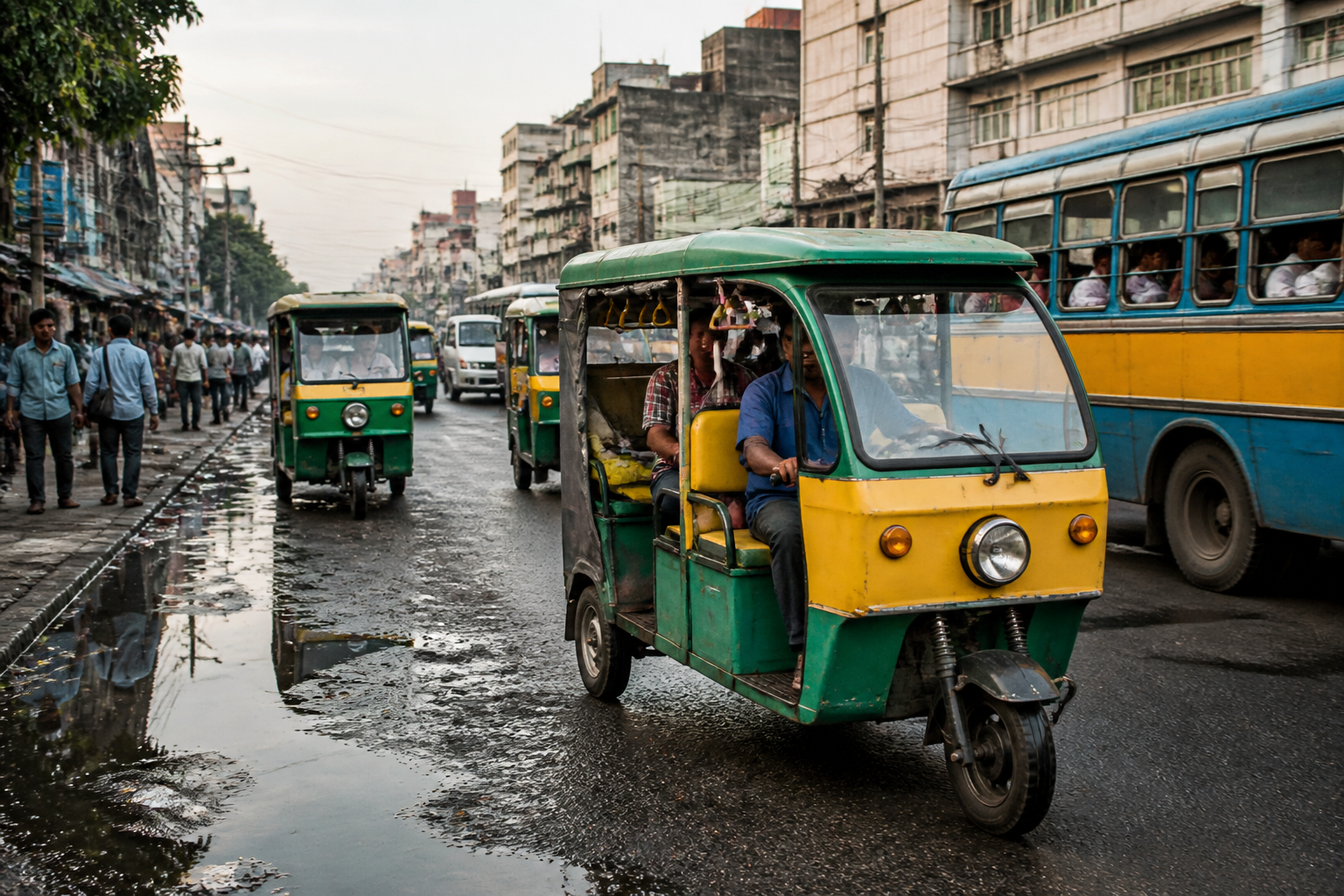
Kolkata’s electric-auto transition is advancing through the economics of daily operations rather than a major policy push. A field study by Sustainable Mobility Network found that electric autos made up 118 of 598 vehicles surveyed across routes where both total and electric-auto numbers were available, or about 19.7%. The figure is significant not because it represents a citywide fleet estimate—it does not—but because it shows how differently electrification is progressing from one para-transit corridor to another.
The report, Accelerating the Electric Transition of Kolkata’s Para-transit System, found the highest electric-auto presence on the Taratala-Ramnagar route, where such vehicles accounted for 41.7% of the surveyed autos. The share was 38.1% on Ballykhal-Uttarpara and 25% on Howrah Station-Salkia. Adoption was considerably lower on Taratala-Hazra, at 11.8%; RG Kar-Dum Dum, at 5.2%; and Dum Dum Station-30A Stand, at 1.6%. No electric autos were recorded on the RG Kar-Beleghata ID and Bagbazar-Bata routes covered by the study.
This uneven pattern is the central fact in Kolkata’s transition. The city is not moving from conventional para-transit to electric vehicles at one uniform pace. Instead, adoption appears to be shaped by the relationship between route economics, vehicle utilisation, charging arrangements and drivers’ confidence in the technology. The available findings do not establish that one factor explains every route-level difference, but they show that the transition is already being filtered through operating conditions on the ground.
For drivers interviewed in the study, the clearest incentive was the cost of running an electric auto. A full electric charge typically costs Rs 50-70, compared with Rs 300-400 for an LPG refill. Electric vehicles also eliminate engine oil, clutch and conventional gearbox-related servicing, reducing some recurring maintenance requirements. These savings matter particularly in para-transit, where the vehicle is both a livelihood asset and the basis of a daily service.
The purchase price remains higher. The study placed the cost of an electric auto at around Rs 4.65 lakh and said its payback calculations showed that the additional upfront expense could be recovered through operating savings in about one year and five months under the modelled assumptions. Where a driver paid Rs 50,000 upfront and financed the balance, the estimated payback period increased to around one year and eight months.
Those figures are not a guaranteed return for every driver. They are modelled estimates whose outcome depends on factors such as daily distance, charging cost, vehicle utilisation, financing terms, maintenance experience and the difference between expected and actual battery performance. Their importance lies in showing why some drivers may find electric autos commercially attractive even without a large new policy incentive: the decision can be evaluated through the recurring cost of keeping a vehicle on the road.
The operating-cost advantage is also linked to how Kolkata’s para-transit system functions. An auto driver does not assess an electric vehicle only as a cleaner alternative. The practical questions are whether it can complete the route, where it can be charged, how long it remains in service and what happens when its most expensive component begins to fail. The Sustainable Mobility Network study found that overnight charging is sufficient on many routes, but high-mileage operations may require daytime charging. That distinction could become increasingly important if adoption expands beyond routes where vehicles can reliably return to a charging point between shifts.
Battery performance is the most substantial uncertainty identified in the report. Drivers said that real-world range was 20-40% lower than advertised figures. This gap affects more than convenience. It can alter the number of trips a vehicle can complete, increase the need for mid-day charging and create uncertainty around whether a driver can finish a working day without losing operating time. In a para-transit system, where earnings depend on availability and repeated short journeys, a vehicle’s usable range is more relevant than its advertised range.
Battery replacement creates a second financial risk. The study identified a possible replacement cost of Rs 1.5 lakh-Rs 1.8 lakh as a major concern. That expense changes the calculation of ownership. A vehicle that appears to recover its additional purchase cost quickly through lower energy and maintenance costs may present a different financial proposition once a large future component replacement is included. The supplied findings do not specify when replacement would be required, so the total ownership cost over the vehicle’s full working life remains uncertain.
Service access and resale value add to that uncertainty. Drivers cited the distance from service centres and the lack of clarity over resale value as hurdles to wider adoption. These concerns point to an institutional dimension of electrification. Purchase economics may encourage the first wave of drivers to switch, but sustained adoption depends on the support system around the vehicle: service availability, battery-related information, financing, charging access and a functioning second-hand market.
The route-level numbers suggest that this support system cannot be assessed only at city scale. The difference between 41.7% electric presence on Taratala-Ramnagar and no recorded electric autos on RG Kar-Beleghata ID and Bagbazar-Bata indicates that local operating conditions matter. The study does not provide enough information to establish whether the differences are caused by route length, traffic conditions, driver ownership patterns, charging access, passenger demand, vehicle supply or other factors. That limitation is important. The findings identify a pattern, but they do not by themselves explain every route’s performance.
The study also records operational benefits beyond fuel and maintenance costs. Drivers reported quieter operation, less engine heat and reduced dependence on LPG. Some said electric autos could negotiate waterlogged stretches more easily. These observations are reported driver experiences rather than a systematic performance comparison in the supplied material. Even so, they show that technology adoption is being judged through the street-level realities of Kolkata: heat around the driver, noise during operation, monsoon-related road conditions and the availability of fuel or charging.
The governance response described in the report is supportive but open-ended. Bengal urban development and municipal affairs junior minister Umesh Rai said electric vehicles are the future and asked stakeholders to share practical issues, adding that the government was available to help. The statement signals acceptance of the transition, but the study’s findings show that broad support will need to be connected to specific implementation problems. Drivers are not only asking whether electric vehicles are desirable. They are dealing with range shortfalls, battery replacement costs, service-centre access, charging requirements and uncertain resale values.
That distinction matters for urban mobility policy. A transition can appear successful when measured by vehicle registrations or the presence of electric autos on selected routes, while remaining fragile at the level of daily operations. The Kolkata study’s 19.7% figure is therefore best understood as evidence of early and uneven adoption across the surveyed routes, not as proof that the para-transit system has completed its shift. The higher shares on some corridors demonstrate that adoption is possible; the low or zero presence on others shows that the conditions enabling it are not yet consistent.
The financial calculations offer a useful way to interpret this stage. Lower electricity and maintenance expenditure can make an electric auto attractive despite a higher initial price. But the calculation is sensitive to costs that are not fully settled in the evidence supplied with the report. If actual range is lower than advertised, charging during the day becomes necessary, or battery replacement is expensive and difficult to plan, the practical payback period may differ from the modelled estimate. The study identifies these pressures but does not present a revised payback period incorporating every possible risk.
For Kolkata’s para-transit network, the larger question is whether early cost-led adoption can become a reliable system-wide transition. The evidence currently supports three conclusions. First, drivers have a strong operating-cost reason to consider electric autos. Second, adoption is already substantial on some surveyed routes but minimal or absent on others. Third, the next phase will depend on the reliability and affordability of the ecosystem around the vehicle, not just on the vehicle’s purchase price.
What remains unclear is equally important. The supplied study findings do not establish the total number of electric autos in Kolkata, the age and ownership profile of the surveyed vehicles, the availability of public or private charging points, or the precise reasons for route-level variation. They also do not establish the long-term battery replacement cycle or resale performance. These gaps do not weaken the evidence of a live transition; they define what must be measured before the city can assess whether the shift is durable.
Kolkata’s electric-auto story is therefore positive in one narrow but important sense: the economics of lower running and maintenance costs are already persuading drivers to switch. But the same evidence warns that adoption cannot be sustained by purchase incentives or optimism alone. The next test will be whether charging, servicing, battery finance and route-level operational support can match the pace set by drivers’ search for lower daily costs.
