


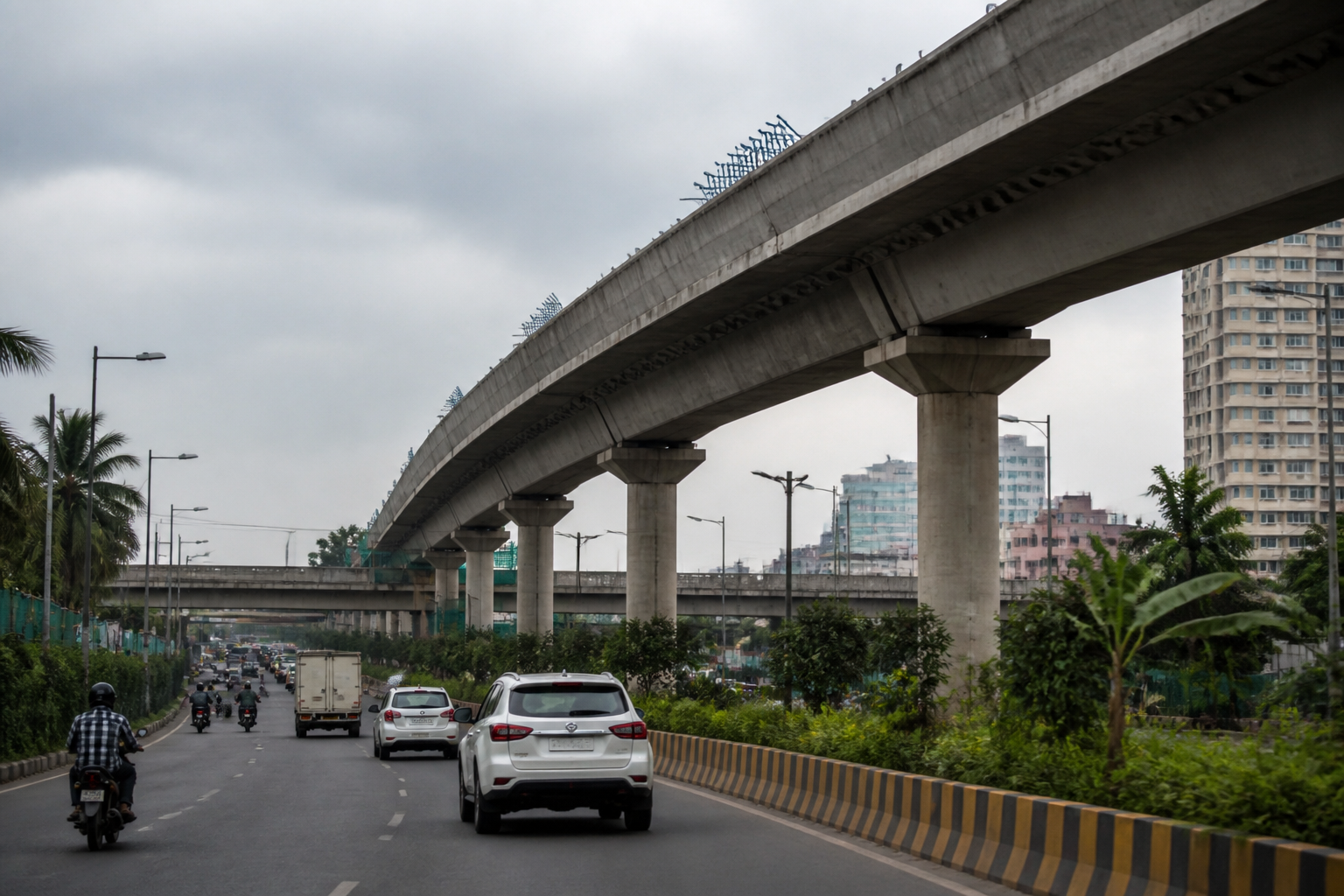
Kolkata Metro’s Orange Line has crossed its most persistent construction bottleneck at Chingrighata, bringing the Beleghata–Sector V section closer to commissioning. The first push-trolley inspection across the completed stretch shows that the project has moved beyond the most difficult viaduct work, but the line still has to pass through electrical works and subsequent operational stages before passengers can use it.
The milestone is important because the Chingrighata crossing was not simply a missing piece of track. It was a 366-metre gap on the viaduct along the EM Bypass, separating the operational section from the route towards the IT Centre, or Sector V. Until that gap was bridged, the Orange Line could run only for about 9 km between New Garia’s Kavi Subhas station and Metropolitan, also known as Beleghata station. The completed connection changes the project from a short operational corridor into a route with a clearer path towards Kolkata’s major technology and employment district.
Metro Railway said the first push-trolley inspection on the Beleghata–IT Centre section of the Kavi Subhas–Jai Hind Bimanbandar Metro Corridor was conducted on September 17. The inspection followed completion of the viaduct and ballastless track works on the section. According to the Metro spokesperson cited by the Times of India, the next stage is the beginning of electrical works.
That sequence matters. The completion of the viaduct and track creates the physical railway corridor, but it does not by itself establish readiness for passenger operations. Electrical systems, inspection, testing and operational approvals remain necessary before services can begin. The available information establishes that the civil and track interface has advanced; it does not establish that passenger trains are ready to run or that the commissioning date is guaranteed.
The project’s history explains why the Chingrighata milestone has attracted attention. The last 31-metre concrete deck slab was placed in August to bridge the remaining gap. The larger viaduct work was completed after concrete girders were erected across the crossing over two weekends in May 2026. During that work, vehicles were diverted through a new road built by Rail Vikas Nigam Ltd in December 2024.
The crossing had previously delayed the intended expansion towards Sector V. The section would have been functional by June 2025 if the 366-metre viaduct bridging work had been completed in January that year, according to the report. The difference between the earlier target and the current stage illustrates how a relatively short missing link can hold back the usefulness of an entire urban transport corridor. In a metro project, network value is not created evenly by every metre of construction. A single unresolved crossing can prevent a completed section from reaching a major interchange or employment cluster.
The Orange Line is a 32-km corridor between Kavi Subhas and Jai Hind Bimanbandar, being executed in five phases after receiving sanction in 2010. The first two phases—from Kavi Subhas to Hemanta Mukhopadhyay at Ruby crossing, and from Hemanta Mukhopadhyay to Beleghata—have already been commissioned and are carrying passengers. The third phase, between Beleghata and the IT Centre, has now been substantially completed, according to Metro Railway.
This phased structure has created a contrast between construction progress and passenger utility. The operational 9-km section provides metro service, but its full urban transport significance depends on extending it to destinations that generate large volumes of daily travel. Sector V is also the point where the Orange Line interfaces with the Green Line, the corridor connecting Sector V and Howrah Maidan. That interface gives the Beleghata–IT Centre section importance beyond its own stations: it can connect the southern and eastern portions of the Orange Line with an existing cross-city metro corridor.
The reported target is to commission the Beleghata–IT Centre section by December 31. Metro Railway general manager Prem Sagar Gupta had earlier told the Times of India that the authority was working towards that deadline. If the section opens as planned, passengers will be able to travel from New Garia to Sector V in about half an hour, according to the report. The three new stations and the viaduct between Beleghata and the IT Centre have been built, but the remaining electrical and operational processes will determine when the infrastructure becomes a usable public service.
The project therefore raises a familiar issue in urban infrastructure: the difference between asset completion and service delivery. A viaduct, station or track can be physically complete while the system remains unavailable to commuters. Electrification, inspections and commissioning are less visible than the construction of concrete structures, but they determine whether the investment can begin producing mobility benefits. The push-trolley inspection is significant precisely because it indicates movement from construction into a systems-integration phase, while also showing that the project has not yet reached final operation.
The Chingrighata work also demonstrates how metro construction is shaped by the existing road network. The girder erection required traffic diversions and the use of an alternative road built by RVNL. This is a reminder that elevated metro construction is not confined to the viaduct alignment. It affects traffic management, road capacity and the coordination of multiple public agencies. The completion of the crossing required the railway project and the road system to function together, even temporarily.
For residents and commuters, the most immediate potential change is the extension of direct metro access from the existing New Garia–Beleghata section to Sector V. The available evidence does not provide passenger forecasts, fare details, train frequencies or an assessment of how the new section will affect road traffic. It does, however, identify the principal connectivity gain: a metro route linking New Garia with the IT Centre and connecting there with the Green Line.
The project’s numbers also show the scale of the implementation challenge. A 32-km corridor sanctioned in 2010 is being delivered in five phases, while the currently operational section covers only 9 km. The delayed portion discussed in the report is just 366 metres, yet that gap was central to the line’s inability to reach Sector V. The construction history makes clear that corridor length alone is a poor measure of readiness. Bottleneck locations, interchange points and complex crossings can have a disproportionate effect on the opening of an entire section.
The next stage will test whether the project can convert the recent civil-works achievement into an operational opening. Metro Railway has identified electrical works as the immediate task and is working towards the December 31 commissioning target. Until those works, inspections and approvals are completed, the Chingrighata breakthrough should be treated as a major construction milestone rather than the start of passenger service. What is established is that the viaduct and ballastless track between Beleghata and the IT Centre are substantially complete; what remains to be demonstrated is the system’s readiness for safe and reliable operations.

