


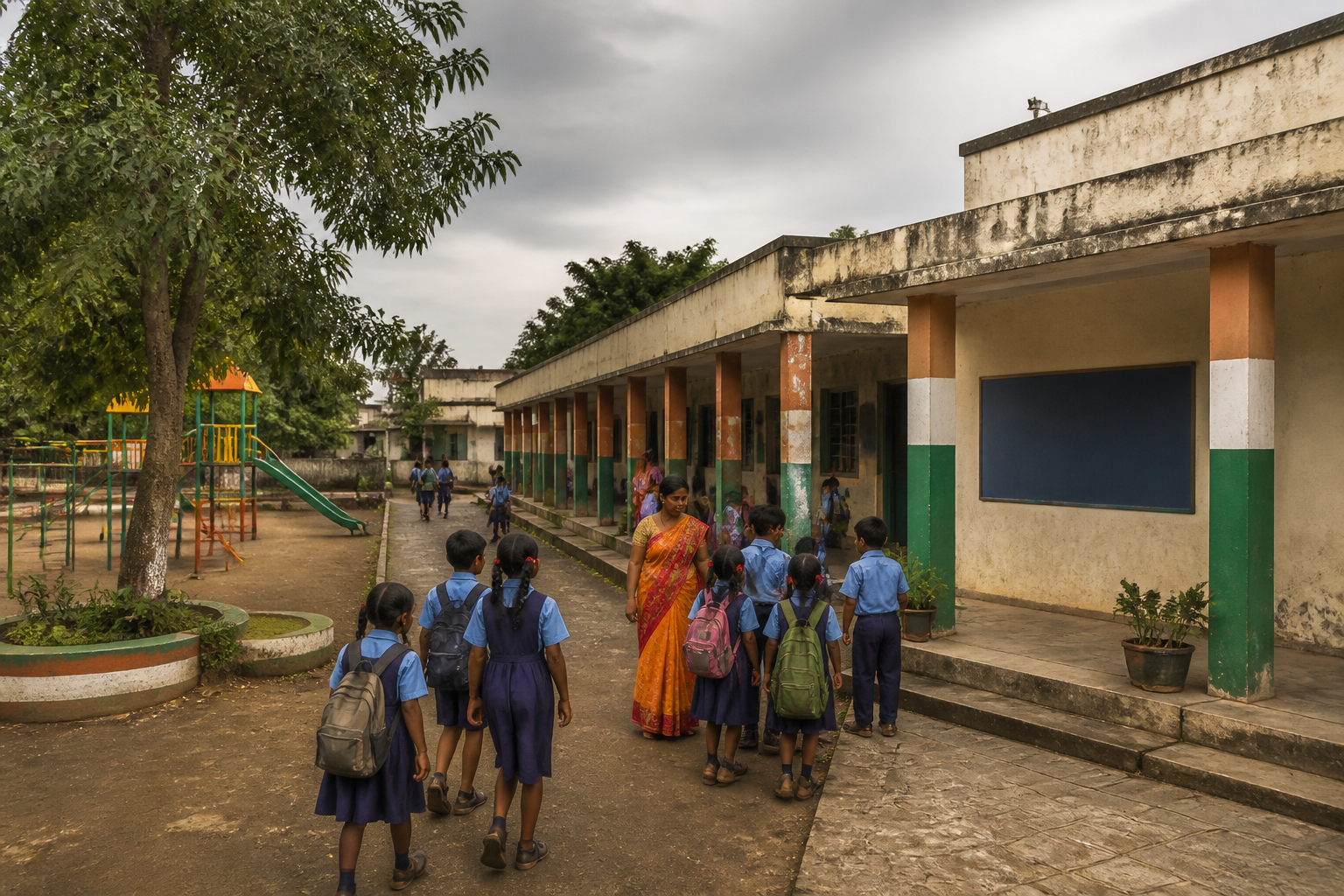
The nine-month delay in announcing results and distributing prizes under Maharashtra’s Maji Shala Sundar Shala Abhiyan has turned a school-improvement competition into a test of how the state funds and administers public education programmes. The third phase was conducted between 3 November and 31 December 2025, but participating schools were still waiting for the results and the promised prize money as of 20 September 2026, according to a report by Loksatta – Mumbai.
The amount involved is substantial for a school-focused state programme. Prizes totalling ₹72.22 crore were to be distributed to winning schools across different levels and categories. The report says that evaluation was completed in February and that a state-level prize distribution ceremony was expected soon afterwards. Neither the results nor the prize distribution had taken place by the time of publication.
The delay matters because the campaign is not presented merely as a ceremonial competition. It was designed for schools across management types and mediums, with objectives extending beyond academic performance. The programme seeks to promote awareness among students about health, cleanliness, the environment and sports, while also encouraging improvements in school facilities and supporting students’ intellectual development.
That design places the campaign within a wider school-governance framework. A school-improvement programme can use recognition and financial awards to encourage institutions to focus on areas that are often difficult to measure through examination results alone. Sanitation, physical infrastructure, environmental practices, sports facilities and student development all require sustained administrative attention. When the assessment process is completed but the results and awards remain pending, the administrative promise of the programme becomes difficult to evaluate.
The history of the campaign shows that the current delay is not an isolated administrative incident. The first phase was conducted between January and February 2024 and was implemented successfully, according to the Loksatta report. The second phase took place between August and September 2024. Schools that won in the second phase received the prize money, but the prize distribution ceremony was not held. The third phase was later announced for November and December 2025, followed by an expected evaluation and state-level award event in February.
This sequence reveals a gradual weakening of programme continuity. The first phase established the campaign. The second phase reportedly delivered the prize money but did not complete the public recognition process. In the third phase, both the results and the financial awards remained pending. The issue, therefore, is not only whether one ceremony has been postponed. It is whether the state has been able to maintain a predictable cycle of announcement, evaluation, result publication and payment.
For schools, that cycle has practical importance. A competition of this kind requires institutions to prepare records, participate in inspections or assessments and organise efforts around the stated criteria. The source report does not specify the number of participating schools, the detailed evaluation framework or the allocation of the ₹72.22 crore across categories. It does, however, establish that the programme covers all school managements and mediums in the state and that awards were intended for winners at different levels and in different categories.
The absence of published results also creates an information gap. Until the rankings or category-wise outcomes are announced, schools cannot know whether their efforts have been recognised, whether the assessment has been completed uniformly or whether the third phase will lead to the promised financial support. Students, teachers and parents are also left without closure on a programme that was publicly framed around school quality and student development.
The funding issue is central to this uncertainty. Loksatta attributes the delay to a lack of funds. The report does not identify the specific budget head, release order, administrative department or approval stage responsible for the shortfall. It also does not state whether the entire ₹72.22 crore has been sanctioned, whether part of the amount has been released, or whether the delay is linked to financial approvals after evaluation. Those details would be necessary to determine whether the problem is a temporary cash-flow constraint, a planning failure or a broader weakness in the programme’s financial design.
That distinction is important in public administration. A programme may be announced with clear objectives and a defined prize pool, but its credibility depends on whether the financial commitment survives the full implementation chain. The chain includes budget provision, release of funds, assessment, verification of winners, publication of results and payment to schools. A delay at any one of these stages can make the programme appear active on paper while leaving institutions waiting for its actual outcome.
The campaign also highlights the difference between physical delivery and public recognition. In the second phase, the winning schools reportedly received the prize money even though the award ceremony did not take place. This suggests that the ceremony and the financial payment are administratively separable. The third phase, by contrast, has seen the results themselves remain unpublished, which means that the process has stalled before schools can even be formally identified as winners.
For an education department, result publication is more than a publicity exercise. It provides a record of what the programme has achieved and makes the assessment process visible to participating institutions. Without results, there is no public account of which schools performed well, what practices were rewarded or whether the campaign’s objectives influenced school conditions. The available report does not indicate that an evaluation report or category-wise performance statement has been released.
The delay also raises questions about how such programmes should be designed. If the campaign is intended to improve health, cleanliness, environmental awareness, sports and school facilities, the prize mechanism is only one part of the policy. The more important question is whether the improvements are sustained after a phase ends. The supplied report does not provide evidence on whether winning schools maintained their facilities or whether lessons from one phase were transferred to other schools. It does establish, however, that the state has conducted three phases but has faced increasing delays in completing the associated recognition process.
There is also an institutional accountability question. The report identifies the funding shortage as the reason for the pending results and awards, but it does not name the official or department that has explained the delay, nor does it provide a revised timetable. In the absence of such information, participating schools are left with no clear milestone for the release of results or prize money. A credible administrative response would require clarity on the pending decision, the funding status and the next confirmed date for completion. Those details were not available in the supplied material.
The third phase was scheduled for late 2025, and the evaluation was expected to be completed by February. By September 2026, the gap between the expected milestone and the reported status had extended to around nine months. That time period is significant because it spans a substantial portion of an academic and administrative cycle. A programme intended to motivate schools cannot easily maintain momentum when its own results remain unresolved across that period.
The immediate facts are therefore clear, while several institutional details remain open. Maharashtra’s Maji Shala Sundar Shala Abhiyan was conducted in three phases. The third phase ran from 3 November to 31 December 2025, carried a promised prize pool of ₹72.22 crore and was expected to have its evaluation completed by February. As reported by Loksatta – Mumbai, results, prize payments and the award ceremony were still pending after nine months because of a funding shortage.
What remains to be established is how much funding has been approved and released, which authority controls the final decision, when the results will be published and whether the programme will continue in its present form. Until those questions are answered, the delay is not only a missed ceremony or a pending payment. It is an unresolved test of whether a statewide school-improvement initiative can deliver the administrative commitments that give its policy objectives meaning.
