


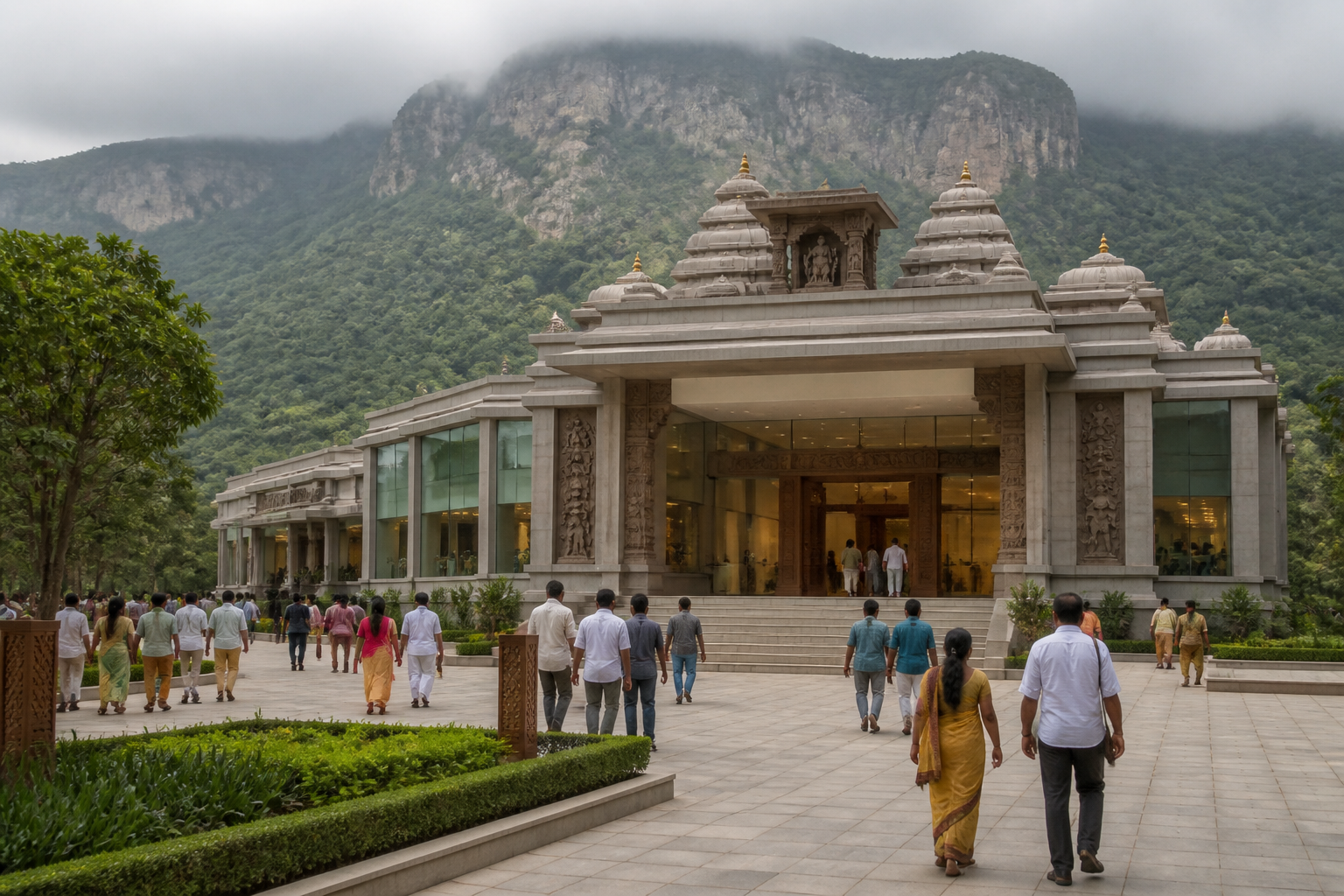
The redesigned Sri Venkateswara Museum at Tirumala is more than a new attraction for temple visitors. With an investment of ₹100 crore, a four-storey, 1.25 lakh sq ft building and more than 6,000 artefacts, it represents a significant expansion of how one of India’s busiest pilgrimage destinations presents its history, art and institutional memory. In a place visited by more than 2.5 crore devotees each year, the museum is being positioned as part of the pilgrimage infrastructure itself rather than as a conventional cultural annex.
Inaugurated by Andhra Pradesh Chief Minister Nara Chandrababu Naidu on September 16 during the Srivari Salakatla Brahmotsavams, the museum is located close to the Vaikuntam Queue Complex. Its location is important. Tirumala is organised around managing large and continuous flows of pilgrims, from arrival and accommodation to darshan, offerings and departure. Placing a large heritage centre near a principal queue facility brings cultural interpretation into the same system that manages devotional access. The museum therefore adds a new layer to the visitor journey: it gives pilgrims an opportunity to understand the institution and traditions surrounding the temple while they move through one of the country’s most heavily visited religious destinations.
The project is an initiative of the Tirumala Tirupati Devasthanams, or TTD, with support from the TCS Foundation. The museum first opened in the 1980s and was relocated in September 1998. Its latest redesign reflects a broader change in the expectations placed on museums. Instead of presenting artefacts in isolation, the new facility uses holographic displays, panoramic screens, spatial audio, projection mapping, digital storytelling and interactive installations. These technologies are intended to connect objects with the narratives, rituals and systems of belief that give them meaning.
That approach also changes the role of the building. The museum’s architecture, described in the supplied report as evoking the grandeur of Gujarat’s Akshardham temple, is designed to establish a sense of scale before visitors encounter the collections. Across four floors, the building combines galleries on temple culture, architecture, weapons, music, the Vedas, religious traditions and cosmology. The experience moves from material objects to stories and then to immersive representations of the sacred universe. It is a curated progression rather than a simple display of an institutional collection.
The museum’s most important urban and institutional feature is the way it brings together pilgrimage management, conservation and public interpretation. TTD is not only responsible for temple administration. Through the museum, it is also acting as a custodian of coins, copper plates, sculptures, musical instruments and other objects accumulated over centuries. The collection has been shaped substantially by devotional offerings, which makes it different from a conventional archaeological collection assembled through excavation or private acquisition.
This is particularly visible in the numismatic gallery. The museum holds coins from the Vishnukundin, Chola, Pallava, Vijayanagara, Bahmani, Tughlaq, Mughal, Maratha and colonial periods, as well as foreign coins from more than 60 countries across Europe, Asia and Africa. More than 1,200 gold coins and nearly 1,400 silver, copper and base-metal coins have been formally documented and published by numismatic scholars, according to the report. The collection records not only political succession but also the movement of pilgrims, merchants and money across regions and maritime networks.
A Roman gold aureus issued around 54 CE during the reign of Emperor Nero is among the most notable objects on display. Its presence in the Tirumala holdings is linked not to an archaeological hoard but to a devotional offering placed in the Srivari Hundi. That distinction is central to understanding the collection. The coin carries evidence of early Indo-Roman connections, but its route into the museum also records the continuing economic and devotional relationship between pilgrims and the temple institution.
The copper-plate collections reveal another dimension of the museum’s work. Plates associated with the traditional Kubera loan narrative connect mythology with the practice of hundi offerings. According to the Sthala Purana, Lord Venkateswara borrowed 14 lakh Ramamudra coins from Kubera for his marriage with Goddess Padmavathi and agreed to repay the amount with interest over 1,000 Devaloka years. The museum presents the plates as part of a narrative that helps explain why devotees understand their offerings as contributions towards the repayment of a divine debt.
The Annamacharya collection demonstrates how religious heritage is also a record of literary and musical transmission. Tallapaka Annamacharya, who lived from 1408 to 1503, is believed to have composed around 32,000 devotional and romantic kirtanas in praise of Lord Venkateswara. His compositions were originally written on palm leaves and later engraved on copper plates by his son, Tallapaka Pedda Tirumalaharyulu. Around 2,500 plates containing approximately 14,000 songs were rediscovered in 1922 after remaining hidden and largely unstudied for more than four centuries. TTD formally took possession of nearly 2,700 surviving plates in 1949 and has since undertaken cataloguing, cleaning and publishing work.
The museum thus makes visible a chain of institutional labour that is often absent from the public experience of pilgrimage. Objects do not become heritage merely because they are old. They require identification, conservation, cataloguing, interpretation and a system for presenting them to visitors. The museum’s galleries place that work alongside the devotional narratives that make the collections meaningful to pilgrims.
The stone and metal galleries extend this chronological account into the history of South Indian sacred art. They include ancient stone icons dating from the eighth century to the modern period, including what the report describes as the earliest known stone statue of Lord Venkateswara from the eighth century. A ninth-century Jyesta Devi statue, Sri Trivikrama and Trinity icons are also displayed. Together, these objects allow visitors to observe changes in iconography, craftsmanship, posture, ornamentation and devotional representation across centuries.
The presentation of the Pancha Beras and the original Kulasekara Padi adds a more direct connection to temple ritual. The five sacred forms of Lord Venkateswara include Dhruva Beram, Bhoga Srinivasa, Ugra Srinivasa, Koluvu Srinivasa and Malayappa Swamy. Bhoga Srinivasa is an 18-inch silver idol donated in 966 CE by Pallava Queen Samavai, also known as Kadavan Perundevi. The museum’s display allows visitors to view representations of these forms and understand the significance of the sacred threshold more closely than is ordinarily possible inside the temple complex.
This is where the museum’s public-access function becomes especially significant. Access to the principal temple and its ritual spaces is structured by time, crowd management, security and hierarchy. The museum cannot replace the temple experience, but it can offer a different kind of access: a slower encounter with objects, traditions and architectural history. In a destination where the scale of the annual visitor population creates constant pressure on movement and time, interpretation can be separated from the brief duration of darshan and given its own institutional space.
The museum’s upper floors broaden the experience beyond individual artefacts. Galleries on temple architecture, Vaastu, sacred geometry, construction tools, dynastic arms and ritual soundscapes connect the religious site to the built and material systems that sustain it. The weapons gallery includes swords, daggers, shields and axes associated with Vijayanagara, Chola and local traditions, along with colonial artefacts. The music gallery presents nagaswarams, veenas, mridangams, horns, drums and bells used during sevas and festivals.
The second floor’s Vedas and Trinity gallery uses interactive media to present the four Vedas, chanting traditions, Brahma, Vishnu, Shiva and the Dashavatara. The third-floor Brahmandam gallery uses projection, domes and spatial audio to explore Vishnu as a cosmic Purusha and to present ideas of Yugas, Kalpas, Lokas and the universe’s sacred order. These displays show how the museum is designed to serve visitors with different levels of prior knowledge. Artefacts provide material evidence, while digital environments supply narrative and sensory context.
The project also raises a practical question about the long-term management of large cultural facilities within pilgrimage destinations. A museum of this scale needs more than a successful inauguration. Its collections require continuing conservation, scholarly documentation, maintenance of digital systems and careful management of visitor circulation. The report records TTD’s past work on the Annamacharya plates, but it does not establish the museum’s operating hours, ticketing arrangements, visitor capacity, conservation budget or future programming. Those details will determine how effectively the building functions beyond its opening phase.
The redesigned Sri Venkateswara Museum is therefore best understood as an experiment in cultural infrastructure within a high-volume pilgrimage city. It combines a large public building, a religious institution’s collections, digital interpretation and the management of millions of visitors. Its evidence confirms the scale and breadth of Tirumala’s material heritage, while the museum’s future performance will depend on how consistently that heritage is documented, conserved and made accessible. The next stage will be to see how the facility operates as part of the everyday pilgrimage system and whether its immersive format can sustain public understanding without overwhelming the objects and traditions it has been built to present.
